 MineArchive
Cyfarthfa Ironworks
| Location | Cyfarthfa, Merthyr Tydfil — 51.7534, -3.3944 (exact) |
|---|---|
| Commodities | Iron, Coal |
| Type | Iron |
| Worked | 1765–1874 |
Overview
Under the Crawshay dynasty, briefly the largest ironworks in the world, supplying cannon for Nelson's navy and rolling the bar iron that helped build Britain's railway age, before falling into a long 19th-century decline and closing for the last time in 1919.
History
Cyfarthfa was founded in 1765 by Anthony Bacon, the MP for Aylesbury, and his fellow Whitehaven native William Brownrigg, who secured a 99-year lease at a fixed annual rent of £100 with no royalty payments. Charles Wood was employed to build the first furnaces and forges, and construction of the works' first coke blast furnace began in August 1766, initially using charcoal before the operation switched to coal as local charcoal supplies proved insufficient. On Bacon's death in 1786 the works passed to Richard Crawshay, who took sole control by 1794 after a brief partnership with Watkin George; Crawshay expanded the works dramatically, changing it to bar-iron production and taking a licence from Henry Cort for his newly patented puddling process. By 1800 Cyfarthfa was the largest ironworks in the world, and its importance to Britain's war effort was such that Admiral Nelson paid a personal visit in 1802 to see cannon being cast.
Crawshay's descendants carried the works to its peak. Under William Crawshay and then William Crawshay II, output grew to six blast furnaces producing 23,000 tons of iron a year by 1819, and to eight furnaces yielding 24,200 tons of pig iron by 1823 — again making Cyfarthfa the largest ironworks in Britain. William Crawshay II underlined the family's wealth by building Cyfarthfa Castle in 1824, an extravagant mock-medieval residence set in 158 acres of landscaped parkland overlooking the works, at a cost of £30,000. Robert Thompson Crawshay, the last of the great Crawshay ironmasters, ran the works until his death in 1879, presiding over an increasingly difficult period as foreign competition and rising ore costs eroded Cyfarthfa's advantages.
The original ironworks closed in 1874 while the site was converted to steel production, a process completed by 1884. Brief reopenings followed in 1879 and again in 1915 to meet First World War demand, and the business passed to Guest, Keen and Nettlefolds in 1902, but the works closed for the last time in 1919 and were dismantled in 1928.
Geology
Iron and coal of the South Wales field at Merthyr Tydfil, the raw materials that put the ironworks where it stands.
Workings
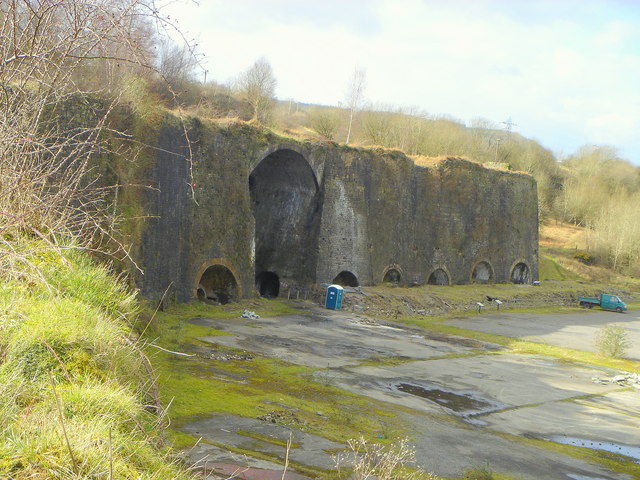
Blast furnaces grew from a single furnace in 1766 to six by 1819 and eight by 1823, alongside puddling furnaces for bar-iron production licensed under Henry Cort's process. Seven furnaces survive today in the 'furnace bank', over ten metres high, preserved largely because later cylindrical blast furnaces were built in front of them in the 1880s rather than replacing them outright.
Closure
The original ironworks closed in 1874 as the site was converted to steel production, a process completed by 1884.
What remains
Six masonry blast furnaces and the associated Pont-y-cafnau bridge survive, considered the largest and most complete surviving furnaces of their type anywhere. The site is reachable via the Taff Trail but has no developed visitor infrastructure at the ironworks itself, in contrast to Cyfarthfa Castle nearby, which now houses a museum.
Related mines
- Cwm Colliery, Merthyr Tydfil — Sunk in 1845 as one of the Cyfarthfa Works' own coal pits.
Nearby mines
- Robbins Colliery — 0.4 miles (0.7 km) SE
- Cornel Wain Colliery — 0.5 miles (0.8 km) E
- Rhydycar Colliery — 0.5 miles (0.9 km) SE
- Gellideg Colliery — 0.7 miles (1.1 km) E
- Ynysfach Colliery — 0.7 miles (1.1 km) SE
Straight-line distance, within 9 miles (15 km). Show on the map.
Culture
- Cyfarthfa Band (Music)
The ironworks whose owner, Robert Thompson Crawshay, founded and personally funded the band.
Recorded claims
Individual factual claims, each attached to the source(s) that support it below. Where sources disagree, both are kept.
- Cyfarthfa was founded in 1765 by Anthony Bacon and William Brownrigg on a 99-year lease at £100 a year with no royalty payments; construction of the first coke blast furnace began in August 1766. 1,2
- Richard Crawshay took sole control by 1794, converted the works to bar-iron production under licence from Henry Cort's puddling process, and by 1800 Cyfarthfa was the largest ironworks in the world; Nelson visited in 1802. 1,2
- Output grew to six blast furnaces producing 23,000 tons of iron a year by 1819, and to eight furnaces yielding 24,200 tons of pig iron by 1823. 1
- William Crawshay II built Cyfarthfa Castle in 1824 at a cost of £30,000, set in 158 acres of landscaped parkland. 1
- The works closed in 1874 for conversion to steel production, completed by 1884; Guest, Keen and Nettlefolds acquired the business in 1902; brief reopenings in 1879 and 1915 preceded final closure in 1919 and dismantling in 1928. 1,2
Sources
- (secondary) Cyfarthfa Ironworks — Wikipedia
- (secondary) Cyfarthfa Ironworks — Grace's Guide to British Industrial History
Record created: 26 August 2026 · Last researched: 26 August 2026