 MineArchive
Coalbrookdale Ironworks
| Location | Coalbrookdale, Ironbridge Gorge, Shropshire — 52.6407, -2.4931 (approximate) |
|---|---|
| Commodity | Iron |
| Type | Iron |
| Worked | ironworks on site from the 17th century; Darby's furnace from 1709–blast furnaces closed by the 1820s; foundry closed November 2017 |
| Operators | Abraham Darby I (1709–1717), Abraham Darby III (1763–1794) |
| Status | Researched |
Overview
On a tributary of the River Severn in Shropshire, Abraham Darby I first smelted iron using coke instead of charcoal in 1709 — the technical breakthrough that made cheap, large-scale iron production possible and is widely regarded as a founding moment of the Industrial Revolution. Three generations of the Darby family ran the works, and Abraham Darby III cast the iron for the world's first cast-iron bridge, the Iron Bridge, a short distance downstream in 1779. The Old Furnace survives in situ as the centrepiece of the Coalbrookdale Museum of Iron, within the Ironbridge Gorge UNESCO World Heritage Site.
History
An ironworks already stood at Coalbrookdale in the late 17th century, but its blast furnace was damaged or destroyed in an explosion in the early 1700s and lay derelict until Abraham Darby I leased the site in 1708-09. Darby succeeded where earlier attempts at coal-based smelting had failed by first 'coking' the coal — driving off sulphur and other volatile impurities before charging it into the furnace — rather than using raw coal, which had previously produced brittle, unusable iron. Coalbrookdale's local coal seam happened to be low in sulphur, which was critical to the coke's purity; coke was also mechanically stronger than charcoal, letting Darby build larger furnaces supporting heavier charges without the fuel bed collapsing, and undercut charcoal-iron competitors on cost, particularly for cast-iron goods such as pots. Coalbrookdale was not the world's first coke-fired blast furnace, but it was the first in Europe to operate one successfully for more than a few years. Abraham Darby II succeeded his father and continued the business; in 1754 the partners resumed experiments applying coke pig iron to bar-iron production in charcoal finery forges, leading to new furnaces at Horsehay and Ketley. Production diversified over the century: cast-iron domestic pots and kettles from the 1720s-30s, cylinders for Newcomen atmospheric engines from 1723 (with boring facilities upgraded by 1748 to cast cylinders up to 60in diameter, later 70in), the first cast-iron railway rails from 1767, and cast-iron components for aqueducts and mill structures. In the 19th century the works became noted for decorative and fine ironwork, including the gates of Hyde Park. Abraham Darby I's grandson, Abraham Darby III, was appointed treasurer of the Iron Bridge project in 1775 and was commissioned to cast and build it — see below. The blast furnaces were closed by perhaps as early as the 1820s, though the foundries continued in use under a succession of corporate owners: absorbed into Light Castings Limited, then Allied Ironfounders Limited (1929), later Glynwed, then Aga Foodservice. The Coalbrookdale foundry finally closed in November 2017. The Darbys were Quakers, and the works' housing and welfare arrangements were rooted in early Quaker industrial social-care practice, with Friends' meetings held on-site well into the company's history.
Workings
The Old Furnace, a massive square brick tower containing a double-cone firebrick furnace, retains at ground level a small area of foundation walls from the original 1638 furnace in which the 1709 coke-smelting first took place; the furnace was repaired and improved over the following decades until Abraham Darby III rebuilt it to a new design in 1777 in preparation for casting the Iron Bridge, adding widened boshes to the front and left sides only, since the waterwheel occupied the right side, leaving the furnace mouth off-centre. Cast-iron lintels spanning the recesses on two sides of the furnace carry the initials and date '1638' and, on the forehearth recess, the bold inscription 'ABRAHAM DARBY 1777'. The furnace was originally driven by a waterwheel powering the bellows, fed by a system of ponds and culverts; to cope with low water supply the company installed a Newcomen engine in 1743 as a 'water-returning engine', pumping water from below the wheel back up to the header pond, and in 1781 a more efficient Watt-condenser beam engine named Resolution.
What remains
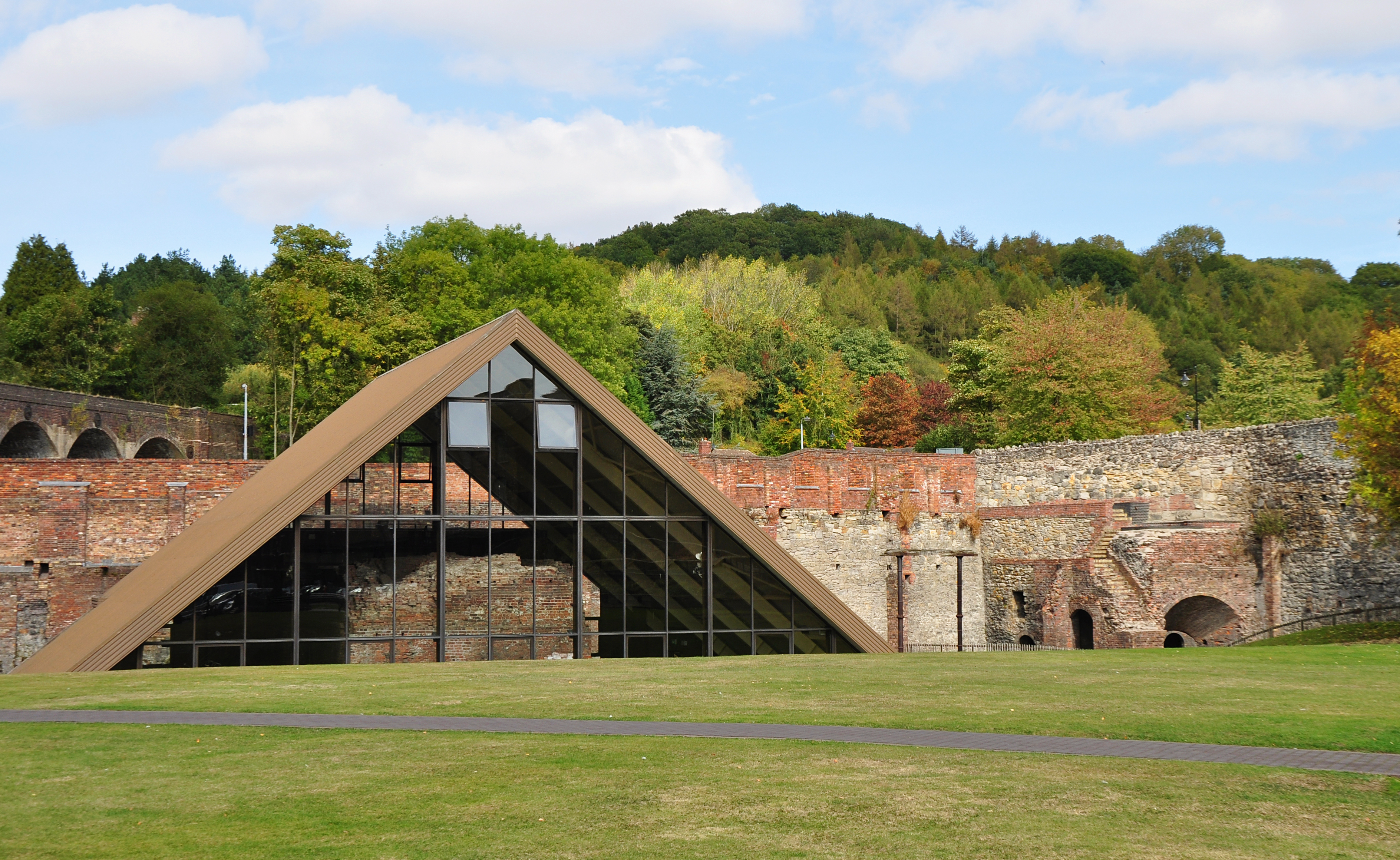
The Old Furnace and its surrounding buildings now form the Coalbrookdale Museum of Iron, one of ten sites run by the Ironbridge Gorge Museum Trust; the museum opened in 1959 to mark 250 years since Darby's 1709 breakthrough and holds a collection of decorative and fine-art iron castings. The furnace itself has stood since 1981 beneath a protective structure allowing visitors to view it in situ, and was the 100th recipient of the Institution of Mechanical Engineers' Engineering Heritage Award in 2014.
Abandoned workings can be dangerous — unstable ground, uncapped shafts, flooding and bad air are common even where a site looks safe from the surface. This entry describes history and general location only; it is not an access guide.
Recorded claims
Individual factual claims, each attached to the source(s) that support it below. Where sources disagree, both are kept.
- Abraham Darby I succeeded in smelting iron with coke rather than charcoal in 1709 by first 'coking' the coal to drive off sulphur and other impurities; Coalbrookdale's naturally low-sulphur local coal was critical to the process, and coke's greater mechanical strength allowed larger furnace charges than charcoal could support. 1
- Abraham Darby III rebuilt the Old Furnace in 1777 in preparation for casting the Iron Bridge, recorded in a cast-iron lintel over the forehearth recess boldly inscribed 'ABRAHAM DARBY 1777'. 2
- Abraham Darby III was appointed treasurer of the Iron Bridge project in 1775 and cast the bridge's five sectional cast-iron ribs, consuming almost 385 tonnes of iron across some 1,700 individually cast components; the bridge first spanned the river on 2 July 1779 and opened to traffic on 1 January 1781. 3
- Ironbridge Gorge was inscribed as a UNESCO World Heritage Site in 1986; UNESCO's own citation names the Coalbrookdale blast furnace as perpetuating 'the creative effort of Abraham Darby I' and calls it 'a masterpiece of man's creative genius' alongside the Iron Bridge itself. 4
- The blast furnaces closed by perhaps as early as the 1820s, though the foundries continued in use under later corporate owners until the Coalbrookdale foundry finally closed in November 2017. 1
Images
Sources
- (secondary) Coalbrookdale — Wikipedia
- (primary) The Old Furnace at Coalbrookdale Ironworks (List Entry 1054135) — Historic England
- (secondary) The Iron Bridge — Wikipedia
- (primary) Ironbridge Gorge (World Heritage List entry 371) — UNESCO World Heritage Centre
Record created: 26 August 2026 · Last researched: 26 August 2026