 MineArchive
Springwell Colliery shaft accident, 1834
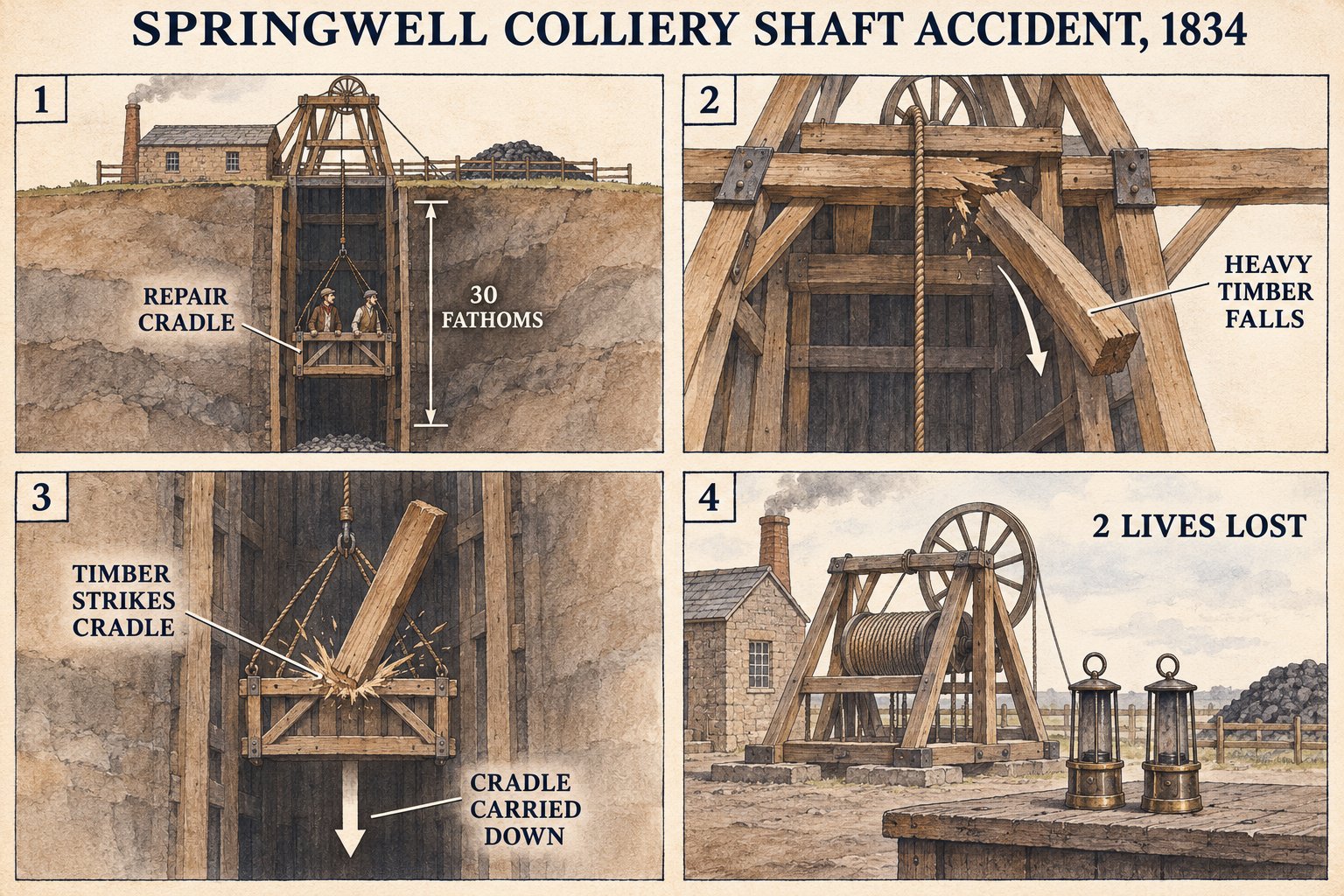
On 4 October 1834 a heavy timber fell down the shaft at Springwell Colliery onto the cradle where two men were repairing it, carrying them thirty fathoms to the bottom.
| Date | 4 October 1834 |
|---|---|
| Mine | Springwell Colliery |
| Region | Tyne and Wear |
| Type | Winding / Shaft Accident |
| Fatalities | 2 (William Puncheon, brakesman, and John Smith, wasteman.) |
| Context | During active mining |
Location
Plotted at Springwell Colliery. Recorded location. The large pin is the mine; the small round markers are the nearest mines on record. Click one for its page. View on full map
Cause
A heavy piece of timber fell down the shaft onto the cradle on which the two men were working.
What happened
Springwell Colliery, near Eighton Banks on the high ground south of Gateshead, belonged to Lord Ravensworth and Partners. On 4 October 1834 a brakesman, William Puncheon, and a wasteman, John Smith, were repairing the shaft from a scaffold, or cradle, when a heavy piece of timber fell down the pit and landed on it. Its weight carried the cradle and both men to the bottom, thirty fathoms (about 55 metres) below, and they were killed on the spot. Puncheon left a widow and six children.
Investigation & inquiry
The inquest found no blame attached to anyone and returned a verdict of accidental death; the two were described as steady men, much respected by their employers.
Recorded claims
Individual factual claims, each attached to the source(s) that support it below. Where sources disagree, both are kept.
- On 4 October 1834, at Lord Ravensworth and Partners' Springwell Colliery near Eighton Banks, a heavy piece of timber fell down the pit onto the scaffold, or cradle, on which William Puncheon, a brakesman, and John Smith, a wasteman, were standing. 1,2
- The weight carried the cradle and the two men to the bottom, a depth of thirty fathoms, and both were killed on the spot. 1,2
- The two were standing on the cradle repairing the shaft. 1
- Puncheon left a widow and six children. 1
- No blame attached to anyone, and the verdict was accidental death; the two were steady men, much respected by their employers. 3
Related terminology
Mining terms this disaster is structurally linked to, with the nature of the relationship.
- Colliery (contextual relationship)
Named twice in this record, first in the summary: “On 4 October 1834 a heavy timber fell down the shaft at Springwell Colliery onto the cradle where two men were repairing it, carrying them…” - Engineman (contextual relationship)
Named in this record’s narrative: “…belonged to Lord Ravensworth and Partners. On 4 October 1834 a brakesman, William Puncheon, and a wasteman, John Smith, were standing on a…” - Fathom (contextual relationship)
Named twice in this record, first in the summary: “…the cradle where two men were repairing it, carrying them thirty fathoms to the bottom.” - Shaft (contextual relationship)
Named 3 times in this record, first in the summary: “On 4 October 1834 a heavy timber fell down the shaft at Springwell Colliery onto the cradle where two men were repairing…”
Further reading
This page doesn't try to reproduce everything — these are the best original sources found for this disaster.
T. Fordyce's 1867 register of remarkable events in Northumberland and Durham, with the contemporary account.
View sourceSources
- (primary) Durham Mining Museum: Springwell Colliery — Durham Mining Museum
- (primary) Local Records; or, Historical Register of Remarkable Events, vol. 3 (T. Fordyce, 1867) — Internet Archive
- (primary) William Puncheon, Springwell, 4 October 1834 (individual page; Richardson's Table Book) — Durham Mining Museum
Record created: 5 October 2026 · Last researched: 3 November 2026