 MineArchive
Silverwood Colliery Paddy Mail Disaster
A runaway underground materials train collided with a man-riding train carrying miners to their shift at Silverwood Colliery, killing ten men and injuring 29 — one of the worst underground transport accidents in the South Yorkshire coalfield.
| Date | 3 February 1966 |
|---|---|
| Mine | Silverwood Colliery |
| Region | South Yorkshire |
| Type | Haulage / Transport |
| Fatalities | 10 (The Minister of Power's same-day statement to Parliament gave nine men killed and one seriously injured. The Durham Mining Museum's roll records a tenth death, Jack Nettleship, aged 53, on 6 February 1966. The ten were aged between 49 and 61, and included back rippers, salvage workers and a chock-maintenance man.) |
| Injuries | 29 injured |
| Context | During active mining (The man-riding train was taking men inbye at the start of the morning shift, followed as usual by a materials train.) |
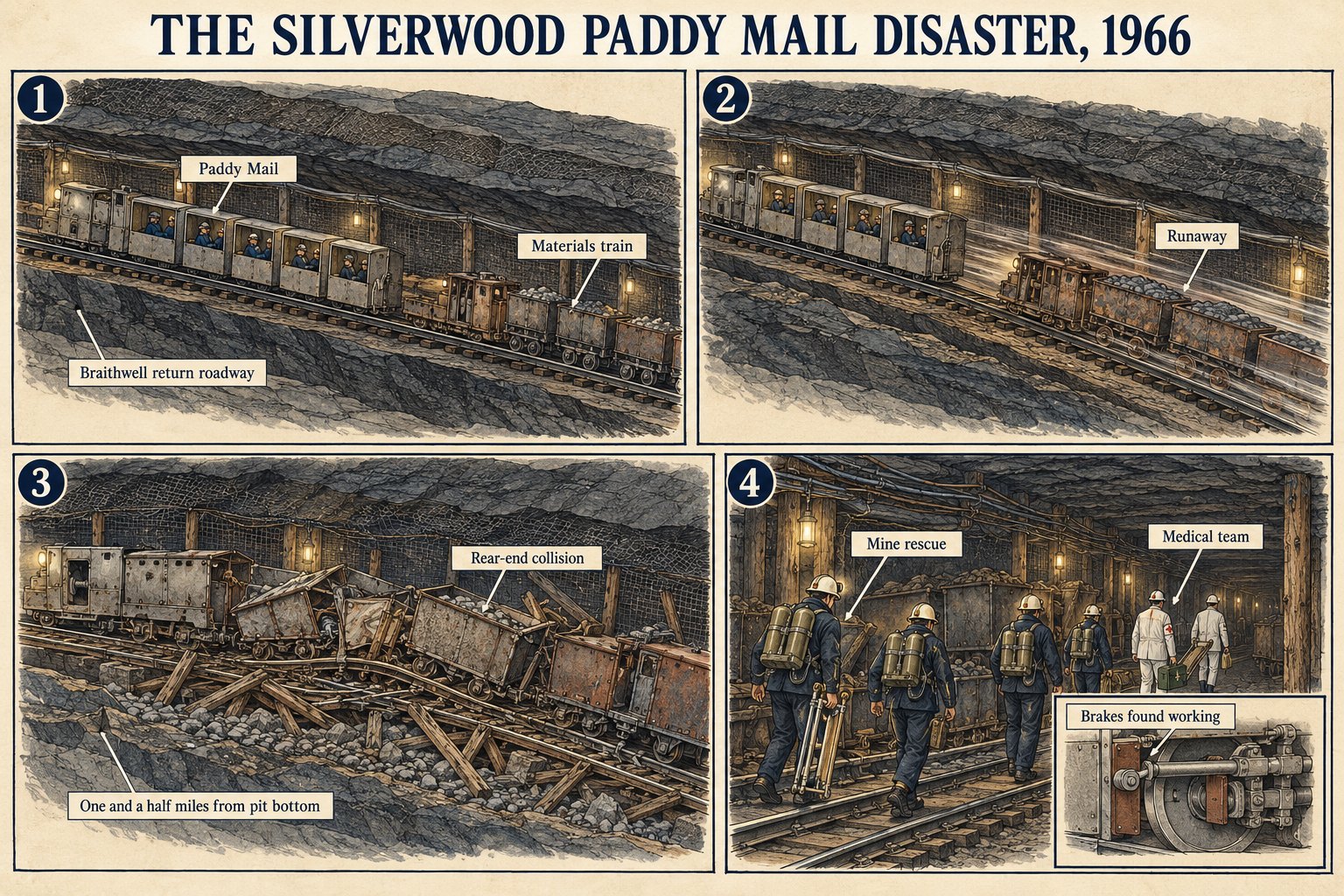
Cause
A materials train ran out of control underground and collided with the rear of the 'Paddy Mail' man-riding train carrying miners to their morning shift, around one and a half miles from the pit bottom in the Braithwell return roadway.
Contributing factors
Materials trains routinely followed the man-riding train into the workings. The brakes of the locomotives and vehicles were found to be in full working order when tested afterwards, so the runaway was not put down to a brake defect.
What happened
Shortly before 8am on 3 February 1966, an underground materials train lost control roughly one and a half miles from the pit bottom, in the Braithwell return roadway, and ran into the rear of the 'Paddy Mail' — the man-riding train carrying miners in to their morning shift. Ten men were killed and a further 29 injured in the collision. In an urgent statement to the House of Commons that same day, the Minister of Power reported a provisional toll of nine men killed and one seriously injured, pending further investigation by H.M. Divisional Inspector of Mines; a tenth man, Jack Nettleship, died of his injuries three days later, on 6 February. It was normal practice at Silverwood for the man-riding train to be followed by a second train carrying materials; when the locomotives and vehicles were later taken to the underground workshops for testing, their brakes were found to be in full working order.
Rescue & recovery
Members of the Rotherham Mines Rescue team worked with Silverwood's medical staff to tend the injured as they were brought out of the wreckage. Much of the press coverage centred on Sister Adsetts of the colliery medical team, whose emergence from the pit prompted headlines such as 'The Angel with the dirty face'.
Investigation & inquiry
H.M. Divisional Inspector of Mines investigated on behalf of the Ministry of Power, reported to Parliament the same day the accident occurred. A subsequent coroner's inquest at Rotherham examined Silverwood's underground transport rules.
Changes to practice & legislation
The Mines Inspectorate's findings led to a change in national underground safety practice, recommending that materials trains should not be permitted to run immediately behind man-riding (passenger) trains.
Memorials & commemoration
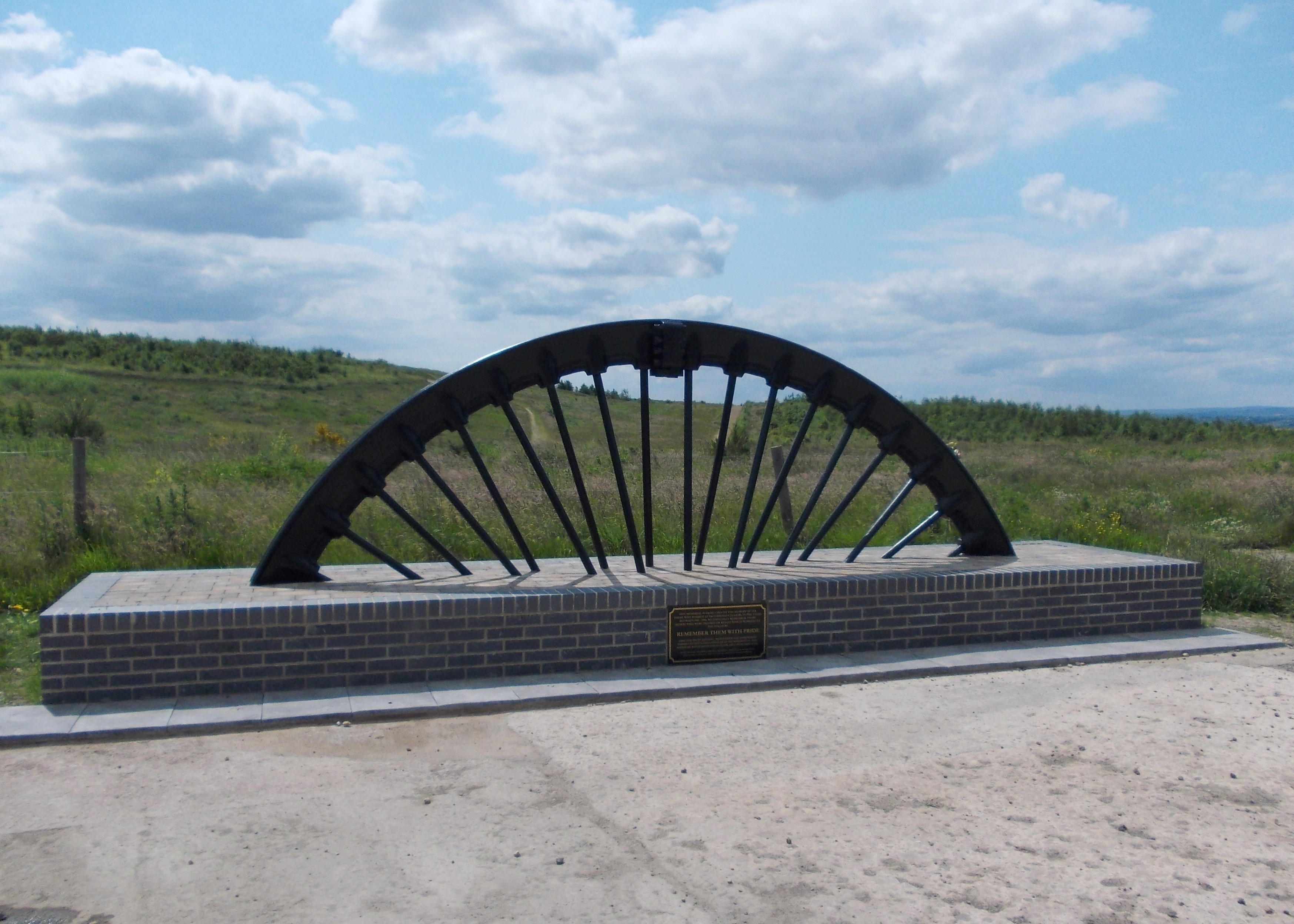
A memorial to the miners of Silverwood Colliery, put up near the former colliery site in 2013, commemorates all the men who worked at the pit between 1905 and 1994 rather than the 1966 dead alone.
Recorded claims
Individual factual claims, each attached to the source(s) that support it below. Where sources disagree, both are kept.
- A materials train ran out of control underground and collided with the rear of the man-riding 'Paddy Mail' train, around one and a half miles from the pit bottom in the Braithwell return roadway.
- The Mines Inspectorate's investigation led to a change in national practice, recommending materials trains should not run immediately behind man-riding trains.
- Ten men were killed and 29 injured. Nine died on 3 February 1966 — the toll the Minister of Power gave the Commons that day, with one man seriously injured — and a tenth, Jack Nettleship, died on 6 February. 1,2,3
- The ten who died were aged 49 to 61: back rippers, salvage workers and a chock-maintenance man. 3,4
- Materials trains normally followed the man-riding train; the brakes of the locomotives and vehicles were found in full working order when tested afterwards. 1
- Rotherham Mines Rescue team members and Silverwood's medical team, including Sister Adsetts, tended the injured as they were brought from the wreckage. 1
- A memorial instituted in 2013 near the former site asks visitors to remember with pride the miners who worked at Silverwood between 1905 and 1994. 5
Related terminology
Mining terms this disaster is structurally linked to, with the nature of the relationship.
- Colliery (contextual relationship)
Named in this record’s summary: “…with a man-riding train carrying miners to their shift at Silverwood Colliery, killing ten men and injuring 29 — one of the worst underground…” - HM Chief Inspector of Mines (contextual relationship)
Named 3 times in this record, first in the narrative: “…seriously injured, pending further investigation by H.M. Divisional Inspector of Mines; the final toll of ten fatalities was established as the fuller…” - Man-riding (contextual relationship)
Named 6 times in this record, first in the summary: “A runaway underground materials train collided with a man-riding train carrying miners to their shift at Silverwood Colliery, killing…”
Photographs & further reading
This page doesn't try to reproduce everything — these are the best original sources found for this disaster.
The names, ages and jobs of the ten men killed, including the one who died three days later.
View sourceThe Minister of Power's same-day statement to the House of Commons on the accident.
View sourceSources
- (secondary) Silverwood Colliery — Wikipedia
- (primary) Silverwood Colliery (Accident) — Hansard, House of Commons
- (primary) Disasters – Names: Silverwood, 3rd February 1966 — Durham Mining Museum
- (primary) Silverwood Colliery — Durham Mining Museum
- (observational) A memorial to the miners of Silverwood Colliery (Geograph photo 3527451, 2013) — Geograph Britain and Ireland
Record created: 26 August 2026 · Last researched: 16 September 2026