 MineArchive
Risehow Colliery Explosion
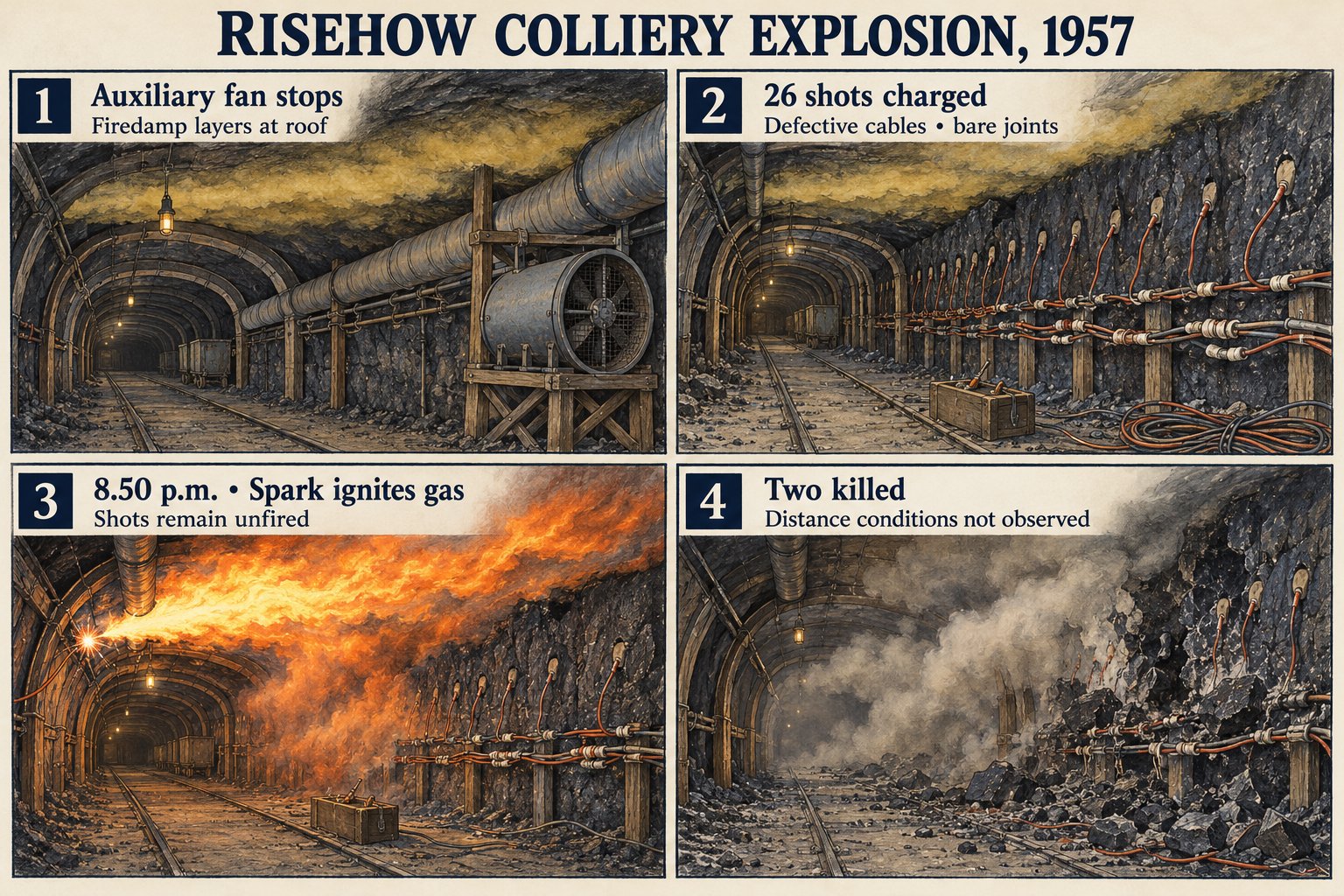
Two men died at Risehow Colliery, Flimby, on the evening of 26 November 1957 when firedamp was ignited in a cross-measure drift as a round of shots was fired. The gas came from a feeder in the roof about 30 yards back from the face and had been detected repeatedly through the shift whenever the auxiliary fan stopped; the ignition came not from the explosives, which never fired, but from a spark in shotfiring cables carrying nearly forty crude, bare joints between them. The Inspector concluded that both deaths would have been avoided had the two simple distance conditions attached to the exploder’s Approval been observed.
| Date | 26 November 1957 |
|---|---|
| Mine | Risehow Colliery |
| Region | Cumbria |
| Primary type | Explosion |
| Associated types | Gas / Asphyxiation |
| Fatalities | 2 |
| Injuries | Two other drifters were blown along a stenton by the blast and were treated for shock. |
| Context | During active mining |
Cause
Firedamp from a roof feeder in the Lower Three Quarters Main Drift, ignited by an incendive spark when an attempt was made to fire a round of 26 shots through shotfiring cables in a grossly defective condition.
Contributing factors
Repeated failure of the auxiliary fan through electrical overload, leaving the drift unventilated for long periods of the shift; firedamp layering at the roof of a large 12 ft by 8 ft arched roadway; a standard of gas testing the Inspector found unsatisfactory, including a 1½–2 per cent reading three weeks earlier that was never entered in a statutory report; the single circuit-testing ohmmeter for two drifting districts being at the other firing station; and the round being fired by an unauthorised person standing far closer than the 150 yards the exploder’s Approval required.
What happened
Risehow was driving two long cross-measure drifts south-westward to prove reserves beyond the Flimby Brow fault. On the afternoon shift of 26 November 1957 the team of three drifters reached No. 4 Stenton in the Lower Three Quarters Main Drift shortly after 2.30 p.m. to find the auxiliary fan stopped. It was restarted, but firedamp had already collected: walking inbye, Robert Peters saw a cap reach into the bonnet of his flame safety lamp, and on a second attempt Joseph Armstrong’s lamp was extinguished by gas altogether. The men withdrew twice to a refuge hole and borrowed a lamp from the Back Drift team. The fan stopped again on an electrical overload while they were laying rail turns into No. 5 Stenton, and stayed off about ten minutes. The deputy, Joseph Banton, came inbye, made an inspection, and went to find the overman; the two returned, tested at both faces and allowed thirteen more shotholes to be drilled. At about 8 p.m. Banton judged there was just time to fire the round before the end of the shift, and the men helped him charge and stem 26 holes. Joseph Mitcheson was sent back to the firing station at No. 4 Stenton — some 57 yards out, not the 150 yards the exploder’s Approval required — connected the cables, wound the exploder and, on hearing Banton shout that all was ready, pressed the button at about 8.50 p.m. The shots did not fire. The firedamp did. Banton and Armstrong, at the face, were killed; Mitcheson and Peters were blown a short way along the stenton.
Rescue & recovery
Mitcheson regained his feet, stopped the dislodged fan and with Peters found Banton badly injured about five yards inbye of No. 4 Stenton. The three Back Drift men, unhurt and dressing just outbye, came at once; William Wilkinson went further in and found Armstrong. The overman William Heyhurst, who had felt the blast, arrived with an electrician, a fitter and an apprentice, took charge, and had already summoned rescue brigades, doctors and ambulances. Both men were brought out on stretchers and were found dead at the surface. A Winscales Central Rescue Station team went underground at 9.25 p.m., found 3 per cent firedamp by lamp test at the Back Drift fan, and reported no fire, no carbon monoxide, damage confined to the Main Drift near No. 4 Stenton — and the round of 26 shots still unfired at the face of No. 5 Stenton, its detonator leads coupled to the cables. Restoring ventilation took a week: gas persisted at the roof, and only after regulators near the shaft bottom were opened over the weekend, raising the fan drift quantity from 121,680 to 178,470 cubic feet a minute, could a thorough inspection be made on 2 December.
Investigation & inquiry
H. Hyde, HM Divisional Inspector of Mines and Quarries, reported to Parliament in April 1958 (Cmnd. 396). Flame had travelled 26 yards from the face by eye and a further 57 yards on microscopic examination of wood splinters and canvas; there was no coking and the roadway was wet, so the explosion was one of firedamp alone. A feeder was found issuing from the roof some 30 yards from the face at the last coal met in the drivage, emitting a steady 30 to 35 cubic feet of gas a minute on measurements taken in December and January — steady enough, Hyde concluded, to have been present for an appreciable time rather than bursting out suddenly. Fan, signalling gear, compressed-air range, lamps and explosives were each examined and cleared; the round was later fired successfully once its heat-damaged leads were repaired. The exploder itself was found at the Safety in Mines Research Establishment to be in first class condition — but tests there proved it could ignite a methane-air mixture through shunt paths or series gaps in the circuit without firing the shots at all. The cables supplied those paths: the left-hand cable had 20 crude joints exposing bare conductor and eight further faults, the right-hand cable eighteen joints and eleven faults, several resting against steel arches, in a drift whose roof water was appreciably corrosive with sodium chloride. Against a specification of 8.6 ohms per 1,000 yards, the cables measured 2,000 and 1,500 ohms. The statutory continuity test before firing had not been made and no ohmmeter was found in the area: only one served both drifting districts, the other having been damaged and not replaced, and it was at the Loco Drifts station all shift.
Changes to practice & legislation
Hyde made no recommendation for new legislation — his point was that the existing rules would have been enough. He recommended that the approved circuit-testing device be brought to the surface weekly for examination by an electrician; that shotfiring cables be single continuous lengths so far as practicable, hung on proper insulators, replaced at once when damaged and examined and tested weekly on the surface; that the merits of a twin-core cable be investigated; and that the ventilation of every narrow large-section drivage be specially considered so that air quantity at roof level, not merely mid-roadway, was enough to clear gas. He also asked, as a matter of some urgency, for a critical comparison of the capacitor-discharge exploder in general use with the spring-driven generator type fitted with a time-limit switch, on the principle that a firing circuit should be live for the shortest possible time at the lowest possible voltage.
Recorded claims
Individual factual claims, each attached to the source(s) that support it below. Where sources disagree, both are kept.
- Joseph Grierson Banton, aged 42, deputy, and Joseph Lancaster Armstrong, aged 50, drifter, were both killed at about 8.50 p.m. on 26 November 1957. 1,2
- The Inspector concluded that firedamp from a roof feeder reached dangerous percentages through the irregularity and inadequacy of the ventilating current, and that the very unsatisfactory condition of the shotfiring cables caused an incendive spark when the exploder was operated. 2
- Inspection confirmed that the round of 26 shots at the face of No. 5 Stenton had not exploded, so the explosive and detonators were not the cause; the round was later fired successfully after its heat-damaged detonator leads were repaired. 2
- The left-hand shotfiring cable, about 145 yards long, carried 20 crudely made joints exposing bare conductors and eight further faults; the right-hand cable, about 123 yards, carried eighteen joints and eleven faults. Against a specification of 8.6 ohms per 1,000 yards, the two measured 2,000 and 1,500 ohms. 2
- The Beethoven Dynamo-Condenser exploder was tested at the Safety in Mines Research Establishment and found to be in first class condition and to specification — but experiments there proved it capable of igniting a methane-air mixture through shunt paths or series gaps in the circuit without firing a round of 26 shots. 2
- Hyde wrote that there would have been no loss of life had two conditions of the exploder’s Approval been observed: that the shotfirer’s station be at least 150 yards from the shotholes, and that all other persons be in proper places of safety not less than 200 yards away. 2
- A deputy told the investigation he had found between 1½ and 2 per cent firedamp at the roof at the face of the Main Drift about three weeks before the explosion. He did not enter it in his report, believing the test not to be a statutory inspection, but told an overman, who on testing found no gas. 2
- At the time of the explosion Risehow produced about 500 tons of coal a day and employed 450 underground and 140 on the surface. Its two shafts were sunk to the Lower Three Quarters Seam at 580 feet. 3,2
Related terminology
Mining terms this disaster is structurally linked to, with the nature of the relationship.
- Fault (contextual relationship)
Named 3 times in this record, first in the narrative: “…drifts south-westward to prove reserves beyond the Flimby Brow fault. On the afternoon shift of 26 November 1957 the team of three…” - Overman (contextual relationship)
Named twice in this record, first in the narrative: “…Joseph Banton, came inbye, made an inspection, and went to find the overman; the two returned, tested at both faces and allowed thirteen more…” - Rescue Brigade (contextual relationship)
Named in this record’s rescue and recovery: “…a fitter and an apprentice, took charge, and had already summoned rescue brigades, doctors and ambulances. Both men were brought out on stretchers and…” - Stone Drift (contextual relationship)
Named twice in this record, first in the summary: “…on the evening of 26 November 1957 when firedamp was ignited in a cross-measure drift as a round of shots was fired. The gas came from a feeder in the…” - Stoneman (contextual relationship)
Named in this record’s narrative: “…fault. On the afternoon shift of 26 November 1957 the team of three drifters reached No. 4 Stenton in the Lower Three Quarters Main Drift shortly…”
Photographs & further reading
This page doesn't try to reproduce everything — these are the best original sources found for this disaster.
The whole of H. Hyde’s report to Parliament, from the description of the colliery through the events of the shift, the rescue, the testing of every possible source of ignition and the recommendations on cables and exploders.
View sourceThe casualty record: both men’s names, ages and occupations, and the contemporary newspaper reports of 27 November 1957.
View sourceSources
- (primary) Colliery Accident, 26 November 1957, Risehow — Durham Mining Museum
- (primary) Explosion at Risehow Colliery, Cumberland: Report on the causes of, and circumstances attending the Explosion which occurred on 26th November, 1957 (Cmnd. 396) — H. Hyde, HM Divisional Inspector of Mines and Quarries, presented to Parliament April 1958
- (primary) Risehow Colliery — Durham Mining Museum
Record created: 8 September 2026 · Last researched: 8 September 2026