 MineArchive
Naval (Pen-y-Craig) Colliery explosion, 1880
An explosion at Pen-y-Craig Colliery (also called Naval Steam Colliery), Penygraig, on 10 December 1880 killed 101 men and boys, one of the worst disasters of the Rhondda coalfield's early expansion; a joint inquest strongly condemned the colliery's manager, Moses Rowlands, for breaches of safety rules.
| Date | 10 December 1880 |
|---|---|
| Mine | Naval Colliery |
| Region | Rhondda Cynon Taf |
| Type | Explosion |
| Fatalities | 101 (101 dead is the figure most widely cited and used as this record's headline total. One contemporary inspector's report gives 110 — a genuine period discrepancy in the historical record, presented honestly here rather than silently resolved in favour of either figure.) |
| Injuries | Detailed injury figures beyond the fatalities were not established. |
| Context | During active mining |
Cause
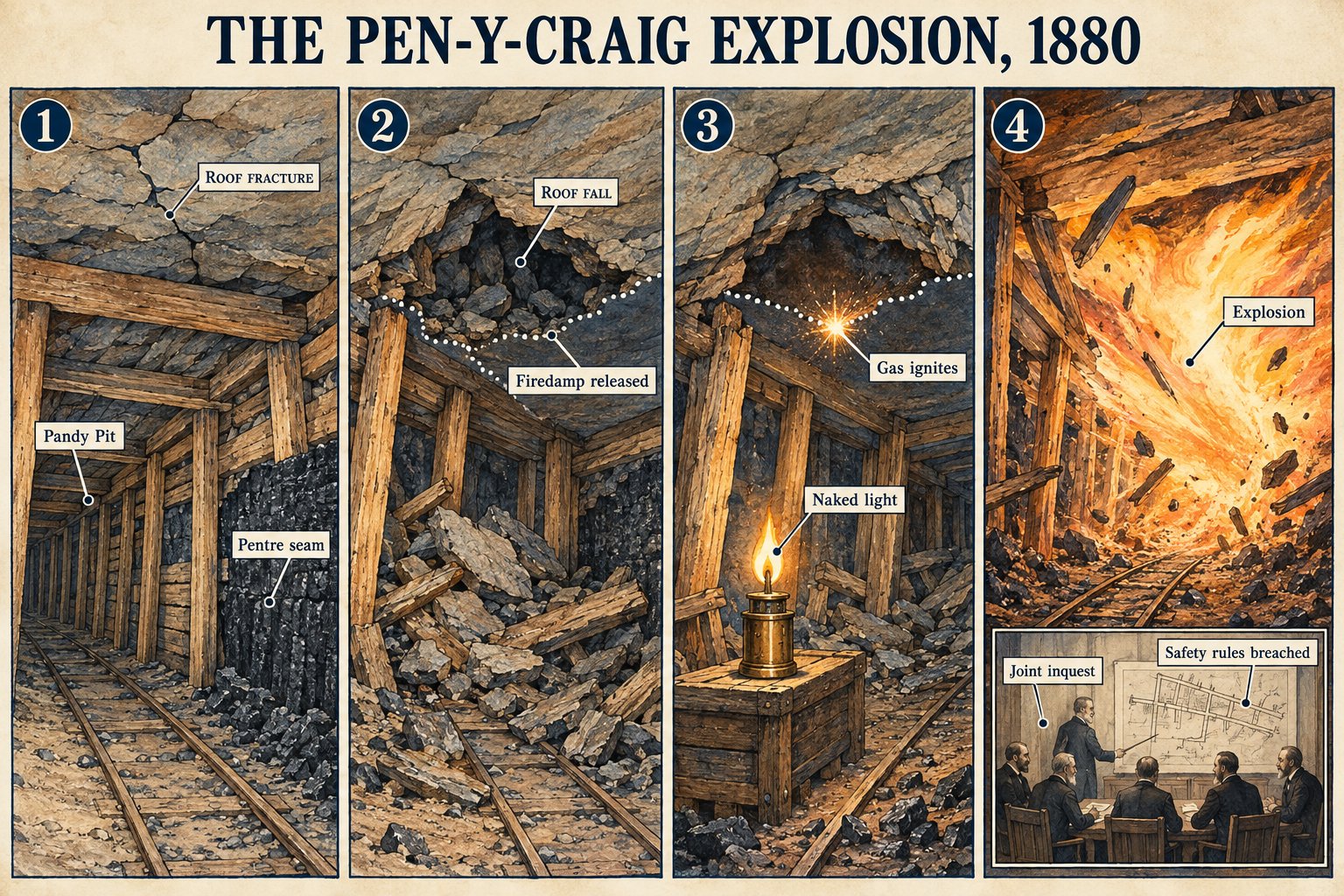
A joint inquest found the explosion was caused by a roof fall that released firedamp gas, which then ignited from a naked light.
Contributing factors
The inquest jury strongly condemned the colliery's manager, Moses Rowlands, for breaches of safety rules, indicating that inadequate safety practice at the mine was found to be a contributing factor alongside the immediate physical cause.
What happened
The explosion struck the Pandy pit workings, sunk only the year before to the Pentre seam, on 10 December 1880. It remains one of the deadliest single incidents in the history of the Rhondda coalfield, striking a colliery barely into full production.
Rescue & recovery
Detailed rescue operation specifics were not established.
Investigation & inquiry
A joint inquest examined the cause and found the explosion resulted from a roof fall releasing gas that then ignited from a naked light; the jury strongly condemned the colliery manager, Moses Rowlands, for breaches of safety rules.
What's uncertain
Points where sources disagree or the record could not be settled; both accounts are kept. All open questions in the archive.
- The explosion killed 101 men and boys per most sources; one contemporary inspector's report gives 110, a genuine period discrepancy. (disputed) 1
Recorded claims
Individual factual claims, each attached to the source(s) that support it below. Where sources disagree, both are kept.
- The explosion killed 101 men and boys per most sources; one contemporary inspector's report gives 110, a genuine period discrepancy. (disputed) 1
- The colliery where the explosion occurred, recorded as Pen-Y-Craig Colliery, is explicitly identified as 'also called Naval Steam Colliery' — the same site later known simply as Naval Colliery. 1
- A joint inquest found the explosion was caused by a roof fall releasing firedamp gas which ignited from a naked light, and strongly condemned the colliery's manager, Moses Rowlands, for breaches of safety rules. 1
Related terminology
Mining terms this disaster is structurally linked to, with the nature of the relationship.
- Colliery (contextual relationship)
Named 6 times in this record, first in the summary: “An explosion at Pen-y-Craig Colliery (also called Naval Steam Colliery), Penygraig, on 10 December 1880…” - Firedamp (contextual relationship)
Named in this record’s cause: “…inquest found the explosion was caused by a roof fall that released firedamp gas, which then ignited from a naked light.” - Naked Light (contextual relationship)
Named twice in this record, first in the cause: “…by a roof fall that released firedamp gas, which then ignited from a naked light.” - Roof Fall (contextual relationship)
Named twice in this record, first in the cause: “A joint inquest found the explosion was caused by a roof fall that released firedamp gas, which then ignited from a naked light.”
Sources
- (secondary) Pen-Y-Craig Colliery Explosion - Rhondda - 1880 — Northern Mine Research Society
- (secondary) Naval Colliery Penygraig — welshcoalmines.co.uk
Record created: 27 August 2026 · Last researched: 27 August 2026