 MineArchive
National Colliery explosion, 1905
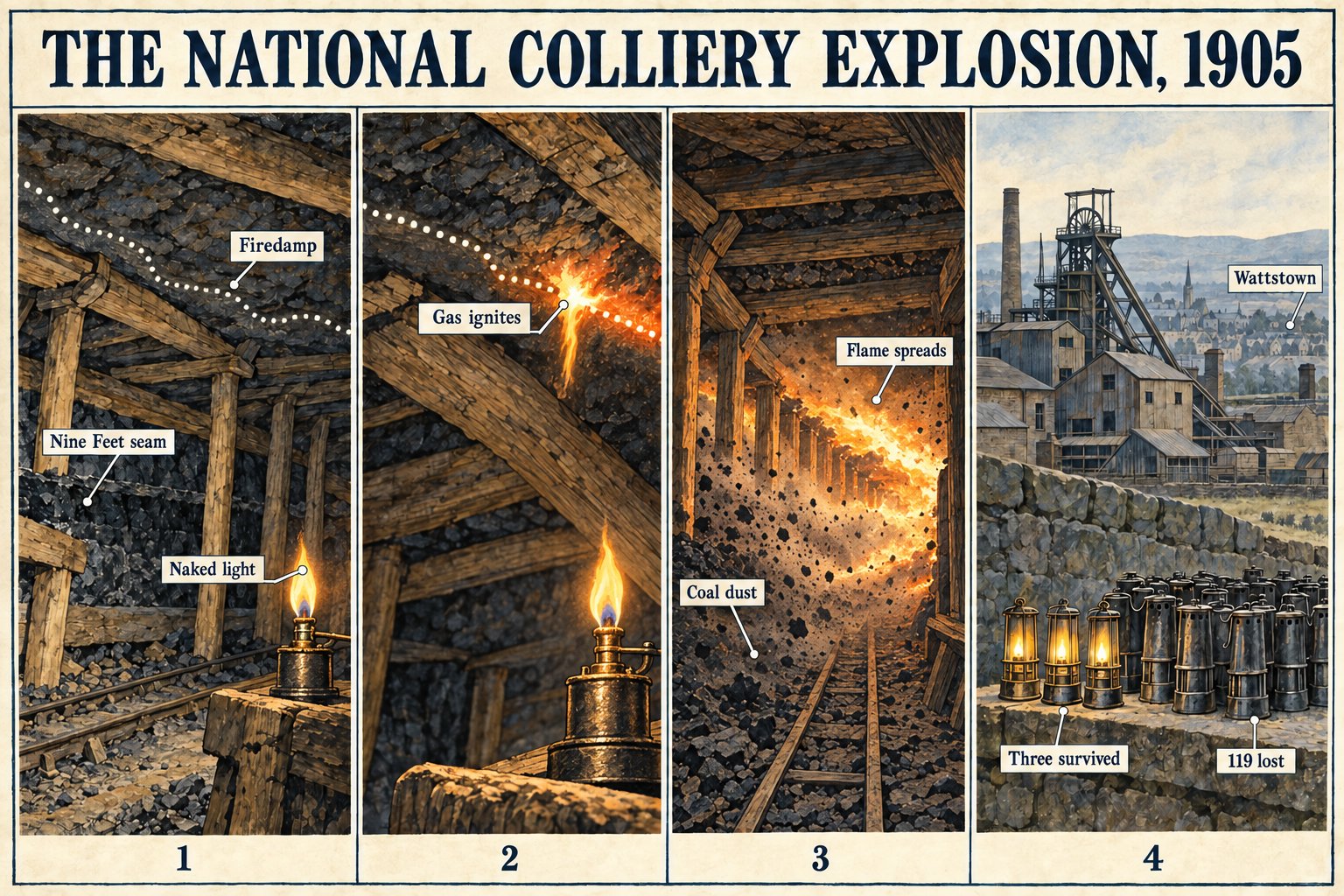
A firedamp explosion in the Nine Feet seam workings at National Colliery, Wattstown, on the morning of 11 July 1905 killed 119 of the 122 men and boys at work there, one of the worst disasters in the history of the South Wales coalfield.
| Date | 11 July 1905 |
|---|---|
| Mine | National Colliery |
| Region | Rhondda Cynon Taf |
| Type | Explosion |
| Fatalities | 119 (119 dead is the figure given consistently across sources. One contemporary summary rounds this to 120; this record uses 119, the figure supported by both Wikipedia's dedicated article and the Northern Mine Research Society's disaster page. Of the 122 men and boys working the Nine Feet seam that morning, only three survived. Thirty-three of the dead were recorded as under the age of fifteen.) |
| Injuries | Three men survived from the 122 working the affected district; no separate injury count beyond the survivors is established. |
| Context | During active mining |
Cause
The explosion was attributed to firedamp gas igniting in the Nine Feet seam workings, in a district worked using naked lights rather than safety lamps at the time; coal dust in the roadways is understood to have propagated the explosion once ignited, consistent with the pattern of other major South Wales explosions of the period.
Contributing factors
The Nine Feet seam was known to be a gassy seam; the disaster occurred during a period when naked-light working and coal-dust accumulation were common contributing factors across South Wales explosions, though this record does not have a detailed, disaster-specific technical inquiry finding to cite beyond the general cause established above.
What happened
The explosion struck the Nine Feet seam workings on the morning of 11 July 1905, killing all but three of the 122 men and boys at work there. Thirty-three of the dead were under the age of fifteen, reflecting the widespread employment of boys underground in South Wales collieries at the time. The scale of loss devastated the small community of Wattstown, in the Rhondda Fach valley, where the colliery was by far the largest employer.
Rescue & recovery
Detailed rescue operation specifics were not established.
Investigation & inquiry
Detailed inquiry/inquest specifics were not established.
Memorials & commemoration
A permanent memorial to the disaster stands in Wattstown; specific unveiling date and form were not established.
Recorded claims
Individual factual claims, each attached to the source(s) that support it below. Where sources disagree, both are kept.
- The explosion killed 119 of the 122 men and boys at work in the Nine Feet seam that morning; only three survived. 1,2
- Thirty-three of the 119 killed were recorded as under the age of fifteen. 2
- The disaster was a firedamp explosion in the Nine Feet seam workings. 1,2
Related terminology
Mining terms this disaster is structurally linked to, with the nature of the relationship.
- Coal (contextual relationship)
Named in this record’s cause: “…worked using naked lights rather than safety lamps at the time; coal dust in the roadways is understood to have propagated the explosion…” - Colliery (contextual relationship)
Named twice in this record, first in the summary: “A firedamp explosion in the Nine Feet seam workings at National Colliery, Wattstown, on the morning of 11 July 1905 killed 119 of the 122 men…” - Firedamp (contextual relationship)
Named twice in this record, first in the summary: “A firedamp explosion in the Nine Feet seam workings at National Colliery,…” - Naked Light (contextual relationship)
Named in this record’s contributing factors: “…known to be a gassy seam; the disaster occurred during a period when naked-light working and coal-dust accumulation were common contributing factors…”
Sources
- (secondary) National Colliery Explosion - Wattstown - 1905 — Northern Mine Research Society
- (secondary) National Colliery disaster — Wikipedia
Record created: 27 August 2026 · Last researched: 27 August 2026