 MineArchive
Nantymwyn dynamite explosion, 1892
Two Cornish miners, William Beswetherick and John Lewarne, died after a box of gelatine dynamite they were handling caught fire and partly exploded underground — an incident that prompted a formal report to the Home Secretary by HM Inspector of Explosives.
| Date | 28 March 1892 |
|---|---|
| Mine | Nantymwyn Mine |
| Region | Carmarthenshire |
| Type | Explosion |
| Fatalities | 2 (William Beswetherick (25) and John Lewarne (33), both Cornish miners. Beswetherick died within hours of reaching home; Lewarne two days later, leaving a widow and two children.) |
| Context | During active mining |
Cause
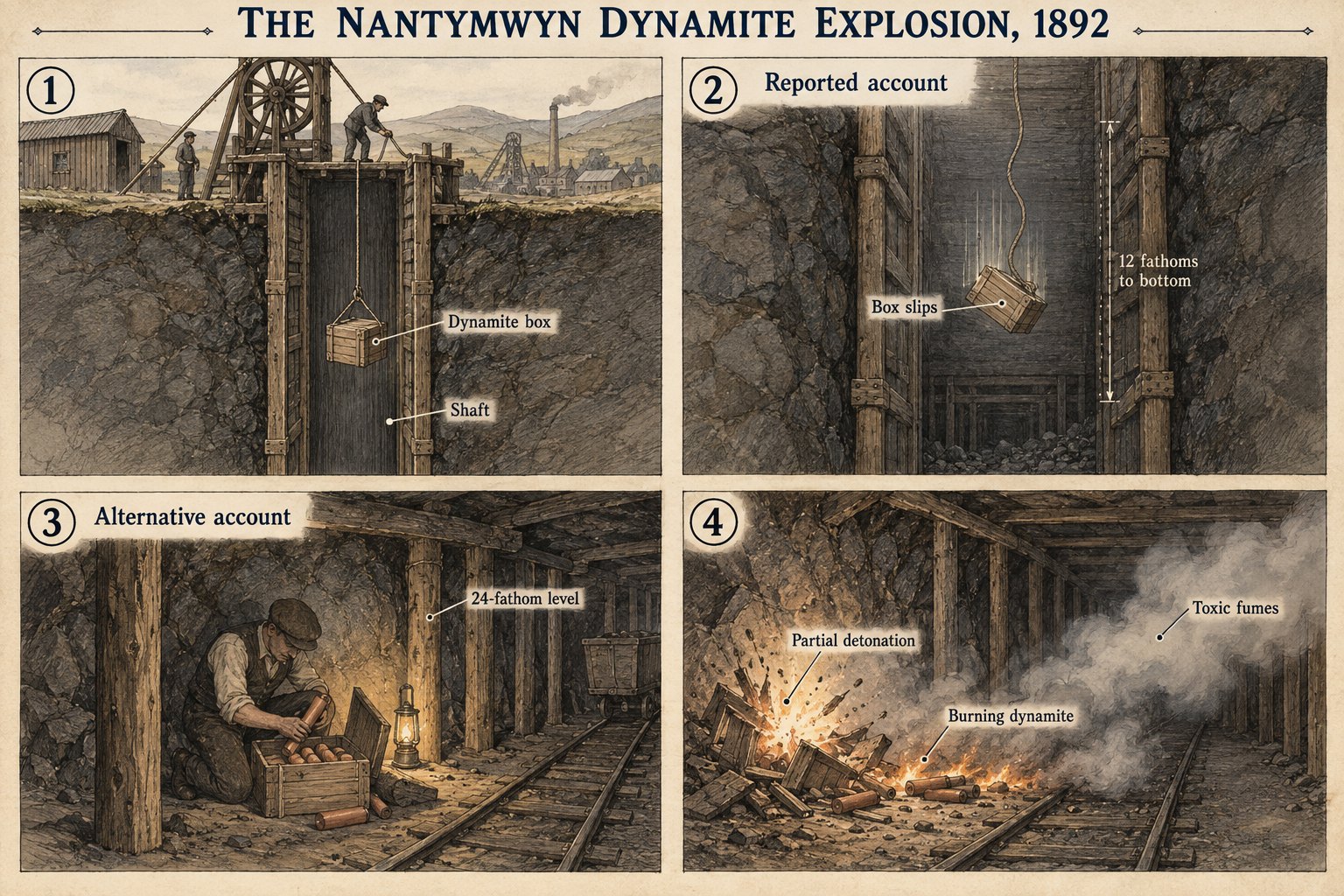
Accounts differ on the exact mechanism: one local-history account describes the box of dynamite slipping from its rope and exploding as it was lowered down the shaft; a contemporary newspaper account instead describes Lewarne opening a box of dynamite at the 24-fathom level to distribute it among the men, when only part of the contents detonated and the rest burned, releasing toxic fumes.
What happened
On 28 March 1892, William Beswetherick (25) and John Lewarne (33), both Cornish miners working at Nantymwyn, were fatally injured in an incident involving a box of gelatine dynamite underground. The Rhandirmwyn local-history account describes the box, roughly 50 lb and attached to a rope, slipping from its rope about 12 fathoms from the bottom and exploding "with terrible violence" as it was lowered down the shaft, both men being knocked briefly unconscious, with medical evidence attributing the deaths to heart failure brought on by shock. A contemporary newspaper account (Carmarthen Journal, 15 April 1892) instead describes Lewarne being sent to fetch the box from the 24-fathom level and open it to distribute among the men; only part of the contents exploded, with the rest burning and releasing toxic gases — by this account, neither man showed significant external injury beyond superficial scratches, and it was the fumes rather than the blast that killed them. Both men were able to walk home after the incident, helped by a fellow miner named Morges, and were attended by Dr Lewis of Llandovery: Beswetherick died within six hours (about five hours after reaching home by the local account), Lewarne two days later, on the Wednesday afternoon, leaving a widow and two children.
Investigation & inquiry
Lieutenant-Colonel Cundhill, RA, HM Inspector of Explosives, examined the circumstances and reported to the Home Secretary; the Carmarthen Journal reported his findings on 15 April 1892. At the inquest the medical evidence was that both men died from the shock of the explosion affecting the action of the heart, and it was noted that a box of dynamite slipping and falling did not usually cause an explosion of this kind, the mechanism of ignition being left unexplained.
What's uncertain
Points where sources disagree or the record could not be settled; both accounts are kept. All open questions in the archive.
- A local-history account describes the dynamite box slipping and exploding while being lowered down the shaft, with the men dying of shock-induced heart failure. (disputed) 1
- A contemporary newspaper account instead describes the box being opened at the 24-fathom level, with only part of its contents detonating and the rest burning to release toxic fumes, which is given as the actual cause of death. (disputed) 2
Recorded claims
Individual factual claims, each attached to the source(s) that support it below. Where sources disagree, both are kept.
- William Beswetherick (25) and John Lewarne (33), both Cornish miners, died after an incident involving a box of gelatine dynamite at Nantymwyn on 28 March 1892. 1,2
- A local-history account describes the dynamite box slipping and exploding while being lowered down the shaft, with the men dying of shock-induced heart failure. (disputed) 1
- A contemporary newspaper account instead describes the box being opened at the 24-fathom level, with only part of its contents detonating and the rest burning to release toxic fumes, which is given as the actual cause of death. (disputed) 2
- Lieutenant-Colonel Cundhill, HM Inspector of Explosives, reported on the circumstances to the Home Secretary; his findings were reported in the Carmarthen Journal on 15 April 1892. 2
Related terminology
Mining terms this disaster is structurally linked to, with the nature of the relationship.
- Fathom (contextual relationship)
The dynamite was being handled at the 24-fathom level — depth at Nantymwyn, as at Cornish and Welsh metal mines generally, counted in fathoms. - Level (contextual relationship)
One account has Lewarne opening the box at the 24-fathom level to share the dynamite out among the men; the other has it exploding as it was lowered, and the record keeps both. - Shaft (contextual relationship)
The competing accounts turn on the shaft: in one the box slipped from its rope and blew up as it was lowered down it, in the other the explosion happened at a level off it.
Sources
- (secondary) Nantymwyn lead mine - Tragedies and Obituaries — Rhandirmwyn.net
- (primary) Carmarthen Journal, 15 April 1892 (explosion report) — Carmarthen Journal / National Library of Wales
Record created: 20 August 2026 · Last researched: 20 August 2026