 MineArchive
Michael Colliery fire, 1967
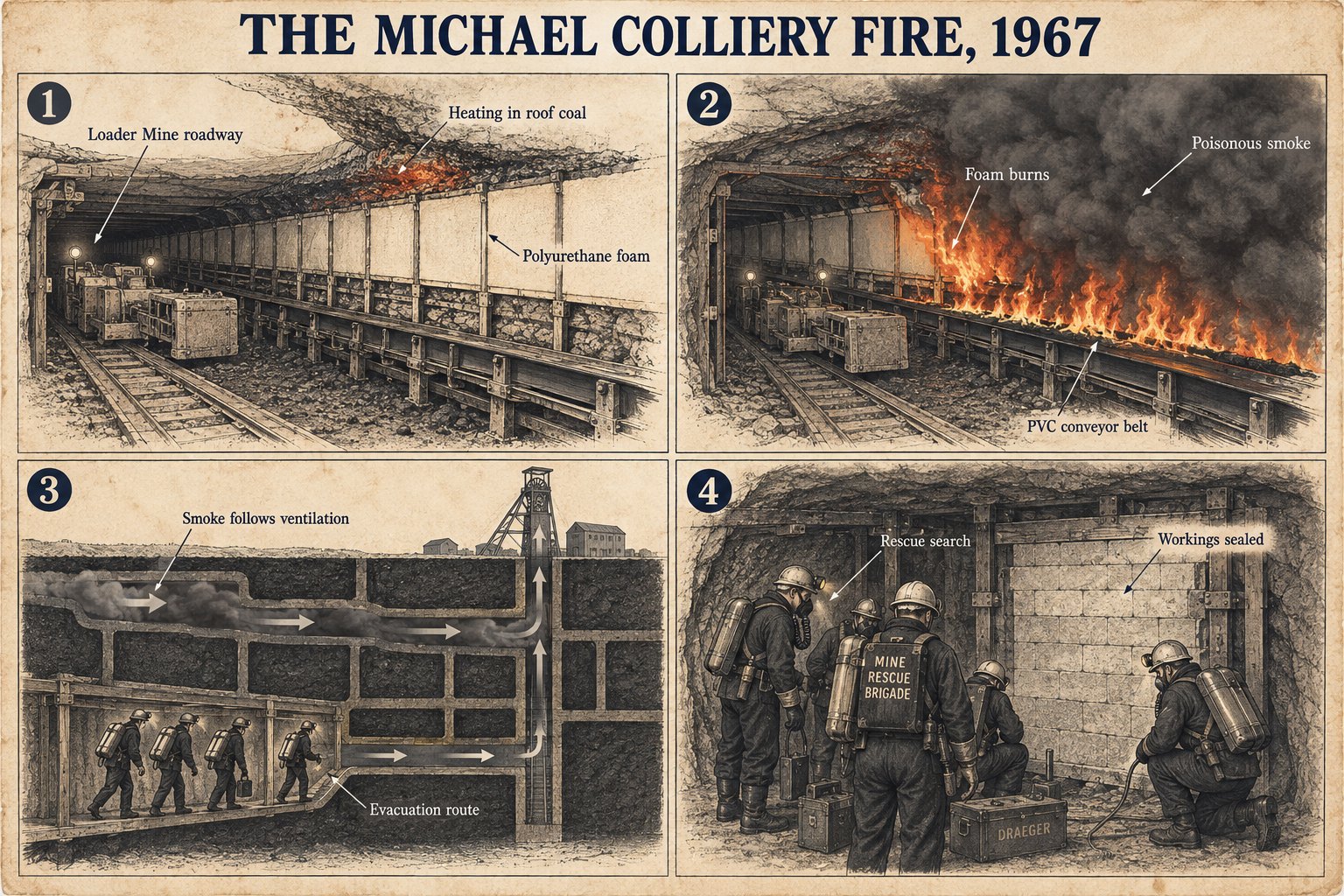
A fire broke out underground during the night shift at Michael Colliery on 9 September 1967, filling the workings with thick smoke as some 300 miners fought their way to the surface. Nine men died; the bodies of three were never recovered, and remain in the sealed workings to this day. The fire closed the colliery for good.
| Date | 9 September 1967 |
|---|---|
| Mine | Michael Colliery |
| Region | Fife |
| Primary type | Fire |
| Associated types | Entrapment, Gas / Asphyxiation |
| Fatalities | 9 (Six bodies were recovered on the day of the fire: Alexander Henderson (41), Johnstone Smith (36), James Tait (41), Andrew Thomson (55), Philip Thomson (64) and Henry Morrison (36). Three men — Hugh Gallacher (61), James McKay (59) and Andrew Taylor (43) — were never found, and their bodies remain in the sealed workings.) |
| Context | During active mining |
Cause
An inquiry chaired by Henry Stephenson, HM Chief Inspector of Mines and Quarries, found the fire began as heating in roof coal in the Loader Mine roadway, which was lined with polyurethane foam insulation; the exact ignition mechanism was not conclusively established.
Contributing factors
The burning polyurethane foam, together with PVC conveyor belting caught by the fire, produced dense black smoke and poisonous gases that spread rapidly through the ventilation system, cutting off escape routes before many of the men below realised the danger.
What happened
At around 2.30am on 9 September 1967, cable-belt attendant J. Izatt reported hearing rumbling and a loud bang underground. By 3.50am thick black smoke was spreading through the ventilation system; overman A. Stirling discovered burning material and raised the alarm, triggering a rapid evacuation of the roughly 300 to 311 men then underground. Nine men did not get out.
Rescue & recovery
Swift action by underground supervisors got the great majority of the shift to the surface safely; two miners who became trapped in old workings near the No. 2 shaft inset were located and brought out alive at 2.50pm the following afternoon. Rescue brigades searched for the nine missing men for roughly 24 hours, recovering six bodies on 9 September before conditions forced the search to be called off on 10 September with three men still unaccounted for; their bodies were never recovered from the sealed workings.
Investigation & inquiry
The official inquiry into the fire was chaired by Henry Stephenson, HM Chief Inspector of Mines and Quarries.
Legal & regulatory aftermath
The colliery was sealed and never reopened; the National Coal Board's handling of the closure, and the roughly 2,000 jobs lost with it, was raised repeatedly in Parliament through 1968 and 1969.
Changes to practice & legislation
The inquiry recommended banning polyurethane foam insulation underground, reviewing emergency procedures and the delegation of authority during an incident, improving systems for checking who was underground, standardising the signposting of escape routes, and requiring monthly supervisory inspection of all egress routes.
Memorials & commemoration
A memorial to the nine men who died was unveiled in East Wemyss in 1992 and remains the focus of an annual remembrance service; three of the men are commemorated there without a grave, their bodies still in the sealed mine.
Recorded claims
Individual factual claims, each attached to the source(s) that support it below. Where sources disagree, both are kept.
- The inquiry, chaired by HM Chief Inspector of Mines and Quarries Henry Stephenson, found the fire began as heating in roof coal in a roadway lined with polyurethane foam insulation. 1
- Nine men died. Six bodies were recovered on 9 September 1967; three men — Hugh Gallacher, James McKay and Andrew Taylor — were never found and remain in the sealed workings. 1,2
- Roughly 300 men were evacuated after the alarm was raised at 3.50am; two miners trapped in old workings near the No. 2 shaft inset were found alive the following afternoon. Rescue brigades searched for about 24 hours before the operation was called off with three men still missing. 1
- The inquiry recommended banning polyurethane foam underground, reviewing emergency procedures, improving systems for checking who was underground, and standardising escape-route signage with monthly inspection. 1
- The colliery's closure and the roughly 2,000 resulting job losses were debated repeatedly in the House of Commons through 1968 and 1969. 3
Related terminology
Mining terms this disaster is structurally linked to, with the nature of the relationship.
- Colliery (contextual relationship)
Named 3 times in this record, first in the summary: “A fire broke out underground during the night shift at Michael Colliery on 9 September 1967, filling the workings with thick smoke as some…” - Filler (contextual relationship)
Named in this record’s cause: “…and Quarries, found the fire began as heating in roof coal in the Loader Mine roadway, which was lined with polyurethane foam insulation; the…” - HM Chief Inspector of Mines (contextual relationship)
Named twice in this record, first in the cause: “An inquiry chaired by Henry Stephenson, HM Chief Inspector of Mines and Quarries, found the fire began as heating in roof coal in the…” - Overman (contextual relationship)
It was an overman, A. Stirling, who found the burning material at around 3.50am and raised the alarm, starting the evacuation that got most of the shift out alive. - Spontaneous Combustion (contextual relationship)
The official inquiry concluded the fire started as heating in roof coal — coal warming by slow oxidation with nothing to ignite it — though the final ignition mechanism was never conclusively established.
Sources
- (secondary) Michael Colliery Fire - Fife - 1967 — Northern Mine Research Society
- (secondary) Michael Colliery pit disaster: 55 years on from the darkest day in Fife's mining history — The Courier
- (primary) Michael Colliery, West Fife (Closure) (Hansard, 10 July 1969) — Hansard, House of Commons
- (secondary) Fifty years on community remembers Michael Colliery disaster which killed nine — The Courier
- (secondary) Pit M-4: Michael Colliery, East Wemyss — fifepits.co.uk
Record created: 20 August 2026 · Last researched: 20 August 2026