 MineArchive
Linnyshaw Colliery Explosion, 1861
An explosion in the Rams mine at Linnyshaw Colliery, Worsley, killed nine colliers; the coroner could find no evidence of how the gas had been ignited.
| Date | 27 February 1861 |
|---|---|
| Mine | Linnyshaw Colliery |
| Region | Greater Manchester |
| Type | Explosion |
| Fatalities | 9 (Nine colliers died: John Latchford (34, fireman), Peter Hope (assistant fireman), James Cooke (20), William Cooke (17), Edmund Rushton (43), William Crompton (16), Joseph Wilcock (15), James Lyon, and William Knight (19, died after rescue).) |
| Context | During active mining |
Cause
An explosion in the Rams mine, cause unknown; the coroner advised the jury that the only safe verdict was that the men had died from an explosion whose cause there was no evidence to establish.
What happened
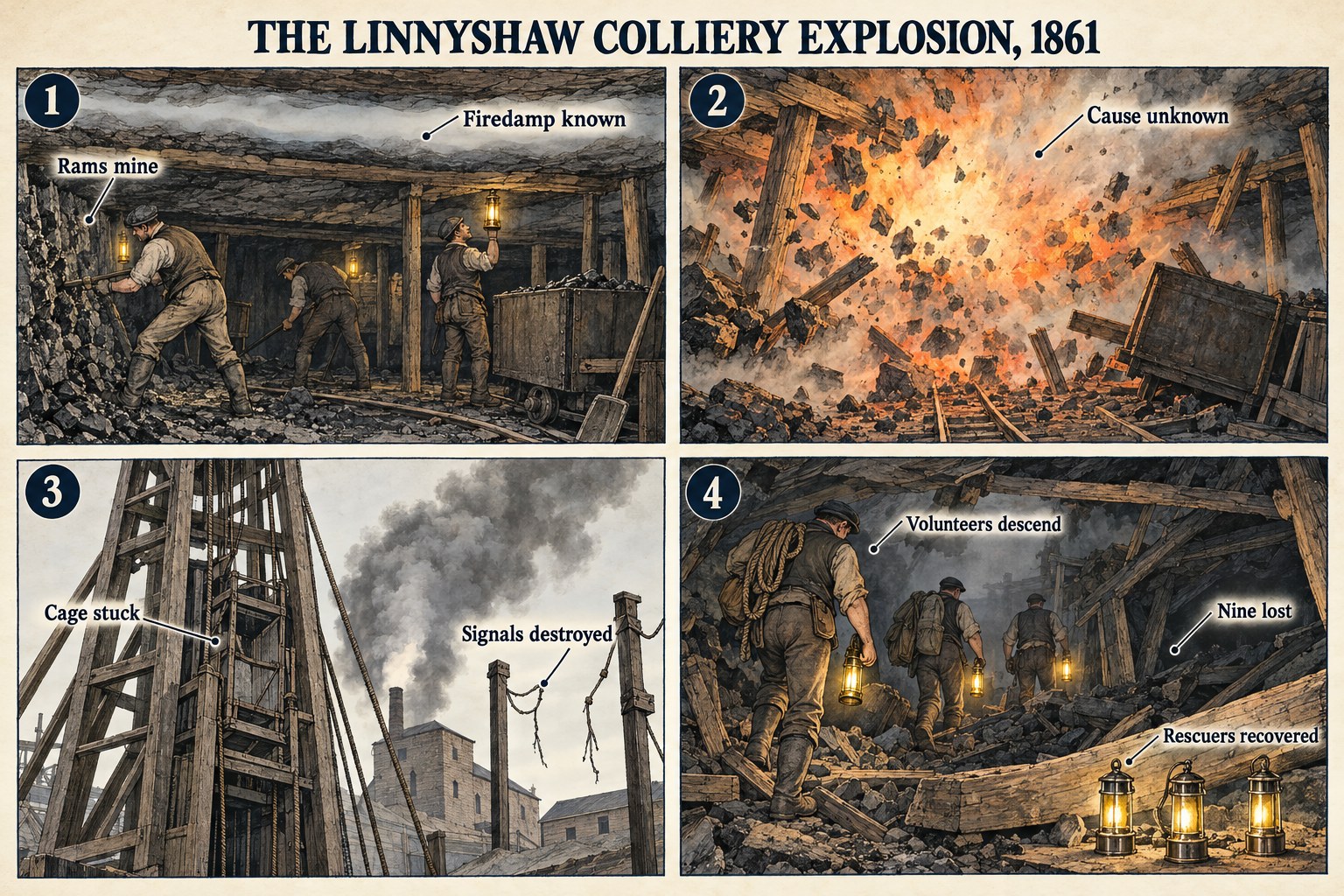
At about 1:30pm on 27 February 1861, an explosion occurred in the Rams mine at Linnyshaw Colliery, Worsley — a pit that had then been working for around two years, owned by the Bridgewater Trustees. Fourteen men were working in the lower pit and twenty in the higher workings at the time. Smoke rose up the shaft, and an immediate rescue attempt was made impossible when it was found that the cage was stuck and the signal wires connecting the surface to the workings below had been destroyed. Volunteers descended through heavy debris once the shaft was cleared, locating survivors including William Knight and James Lyon, though Knight later died of his injuries. Nine men in total lost their lives. Firedamp was already known to be present in the workings, and safety precautions were in place, but the inquest could establish nothing further about the specific cause.
Rescue & recovery
Volunteers descended through heavy debris once the shaft could be cleared, locating survivors including William Knight and James Lyon; three rescuers — Richard Evans, Armstrong and Jones — lost consciousness from poor air quality underground but recovered after being brought to the surface.
Investigation & inquiry
An inquest was held at the Stocks Inn, Worsley. The coroner told the jury that the cause of the explosion was doubtful, and advised that the only safe verdict they could reach was that the men had died from an explosion whose cause there was no evidence to show.
Recorded claims
Individual factual claims, each attached to the source(s) that support it below. Where sources disagree, both are kept.
- Nine colliers died: John Latchford (34, fireman), Peter Hope (assistant fireman), James Cooke (20), William Cooke (17), Edmund Rushton (43), William Crompton (16), Joseph Wilcock (15), James Lyon, and William Knight (19, died after rescue). 1
- The rescue was initially blocked when the shaft cage stuck and the signal wires connecting the surface to the workings were destroyed by the blast; three rescuers were themselves overcome by poor air underground before recovering. 1
- The coroner's inquest at the Stocks Inn, Worsley, concluded that the cause of the explosion was doubtful, and the only safe verdict was that the men had died from an explosion of unknown cause. 1
- The explosion occurred in the Rams mine at Linnyshaw, a colliery then owned by the Bridgewater Trustees which had been working for only around two years. 2
Related terminology
Mining terms this disaster is structurally linked to, with the nature of the relationship.
- Cage (contextual relationship)
Named in this record’s narrative: “…rescue attempt was made impossible when it was found that the cage was stuck and the signal wires connecting the surface to the…” - Colliery (contextual relationship)
Named twice in this record, first in the summary: “An explosion in the Rams mine at Linnyshaw Colliery, Worsley, killed nine colliers; the coroner could find no evidence…” - Firedamp (direct cause)
Firedamp was known to be present in the Rams mine's workings, and the explosion is presumed to have been a gas explosion, though the exact ignition source was never established. - Shaft (contextual relationship)
Named 3 times in this record, first in the narrative: “…pit and twenty in the higher workings at the time. Smoke rose up the shaft, and an immediate rescue attempt was made impossible when it was…”
Sources
- (primary) Linnyshaw Colliery Explosion — Worsley — 1861 — Northern Mine Research Society
- (secondary) Linnyshaw Colliery — Wikipedia — Wikipedia
Record created: 2 September 2026 · Last researched: 2 September 2026