 MineArchive
Herbertshire Colliery explosion, 1893
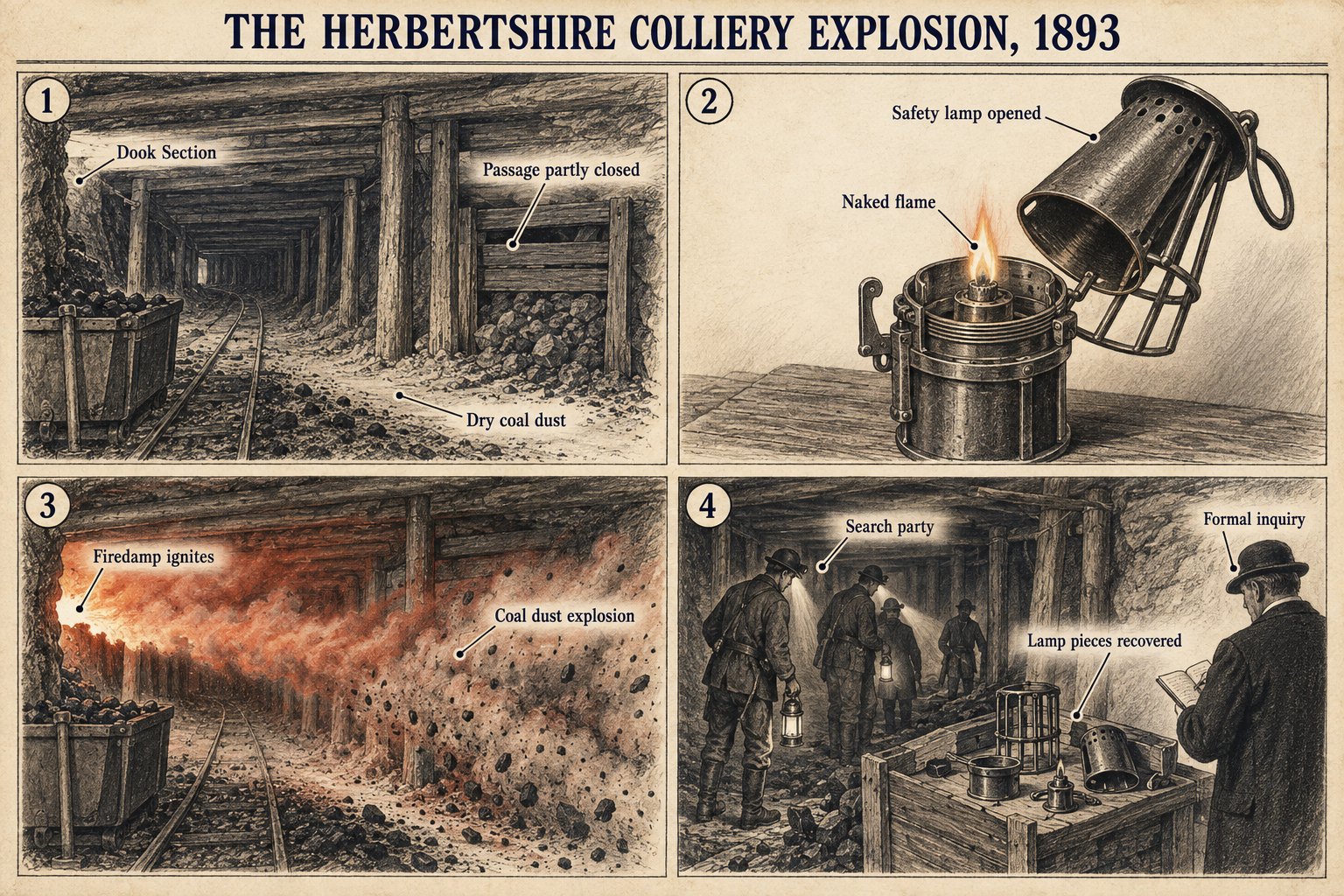
On the afternoon of 30 June 1893, an explosion of firedamp and coal dust in the Dook Section of Herbertshire No. 3 pit, Denny, killed two men and injured several more. A formal government inquiry, appointed personally by the Home Secretary H. H. Asquith, concluded after a two-day hearing and 29 witnesses that a safety lamp had been unlawfully opened, exposing a naked flame in ground where fine, dry coal dust turned a small gas ignition into a serious explosion.
| Date | 30 June 1893 |
|---|---|
| Mine | Herbertshire Colliery |
| Region | Falkirk |
| Type | Explosion |
| Fatalities | 2 (Lovell Thursby, a 14-year-old miner's drawer, died on 22 July 1893 of injuries from the explosion; Joseph Robertson, a miner aged 27, also died of his injuries. Andrew McGarrell, James McGeachie, Alexander Kirkwood and Fulton Gillespie were burned, McGarrell severely. The Inspector's annual report records two killed and five injured.) |
| Context | During active mining (An explosion caused by an unlawfully opened safety lamp, investigated by a full government inquiry.) |
Cause
Firedamp ignited by the naked flame of a safety lamp that had been unlawfully unlocked and opened, in a working place where unusually dry coal dust turned a minor gas ignition into a serious explosion.
Contributing factors
The passage intended to ventilate the affected working place, connecting it to a neighbouring, properly ventilated place, had become partially closed in the weeks before the explosion, reducing the air reaching the site; the working place itself was unusually dry, with fine coal dust on the floor and sides that had not been watered down as in neighbouring roads.
What happened
Three miners — John Hamilton, James Todd and 14-year-old Lovell Thursby, a drawer new to the working place that morning — were working in the same section of the Dook workings on the day of the explosion. It was common practice for miners to swap safety lamps during a shift, and at some point Thursby's lamp ended up in Hamilton's working place. The inquiry found that the explosion was caused by fire damp coming into contact with a naked flame from that lamp, which had either been opened by Hamilton to trim it or was open with his knowledge — evidence showed the lamps in use could be picked with a filed key, two nails, or a filed rail spike. Hamilton was burned but rendered unconscious by afterdamp and found unconscious in his own working place some time after the blast; Thursby, McGarrell and Robertson, all closer to the explosion's origin, were severely burned. Thursby gave a statement in the presence of his father and local officials before he died seventeen days later, which the inquiry accepted as reliable, though incomplete. Hamilton was subsequently indicted for unlawfully opening a safety lamp and causing the deaths of Robertson and Thursby, though the report notes he had not yet been tried at the time of its publication.
Rescue & recovery
The colliery overman and a search party, including the mine manager, located Hamilton unconscious in his working place and brought him to the surface, where he recovered consciousness; the pieces of the tampered lamp were later recovered from the scene and handed to the police.
Investigation & inquiry
Home Secretary H. H. Asquith personally appointed Charles J. Guthrie, Advocate, to conduct a formal inquiry under the Coal Mines Regulation Act 1887, assisted by Mining Inspector J. M. Ronaldson. The inquiry sat over two days in September 1893 — the 12th and 13th, in the Sheriff Courthouse at Stirling — examined 29 witnesses including representatives of the Scottish miners' federations, and concluded that the explosion was caused by contact between firedamp and a naked lamp flame that had been unlawfully exposed, worsened by unwatered coal dust and a partially obstructed ventilation passage — but found no direct fault on the part of the mine owners themselves.
The formal inquiry was not the first investigation, and it happened because the miners asked for it. The Inspector had examined the mine the day after the explosion and reported to the Procurator Fiscal, who investigated in the usual way. Before the Home Secretary ordered a formal inquiry, the newspapers carried a letter to him from R. Chisholm Robertson, a miners' agent, asking for a public inquiry on behalf of the miners on the ground that they had no confidence in the investigations of the Inspector of Mines and the Procurator Fiscal. The Inspector's own annual report responded coolly: Chisholm Robertson had represented the workmen at the inquiry and been given every facility to inspect the mine and call witnesses, and in the Inspector's view nothing of importance emerged that his own report had not already covered.
Legal & regulatory aftermath
John Hamilton was arrested, imprisoned and charged with causing the explosion, then released on bail. After he had appeared as a witness at the formal investigation the charge against him was withdrawn on the direction of the Lord Advocate.
The Inspector of Mines recorded in his annual report that two more workmen at the same mine were prosecuted for opening their safety lamps in the months after the explosion. The first was let off with a fine of £2; in the second case the sheriff imposed thirty days' imprisonment without the option of a fine, which the Inspector noted approvingly as 'what is very much required'.
Recorded claims
Individual factual claims, each attached to the source(s) that support it below. Where sources disagree, both are kept.
- Firedamp ignited from the naked flame of a safety lamp unlawfully opened in Hamilton's working place, worsened by unusually dry, unwatered coal dust there. 1
- Lovell Thursby, a 14-year-old miner's drawer, died on 22 July 1893; Joseph Robertson also died of his injuries. 1
- The Home Secretary appointed a formal inquiry under the Coal Mines Regulation Act 1887; after examining 29 witnesses over two days it found the explosion was caused by an unlawfully opened safety lamp but did not attribute direct fault to the mine owners. 1
- John Hamilton was indicted for unlawfully opening a safety lamp and causing the two deaths, though he had not yet been tried at the time the report was published. 1
- The Inspector of Mines' annual report for 1893 records that the first fatal explosion of the year happened in No. 3 Pit, Herbertshire, Denny, and that by it two persons were killed and five others injured. 2
- Joseph Robertson, a miner aged 27, was fatally injured in the explosion at 2.30pm on 30 June 1893 at Herbertshire No. 3, Denny, then owned by Robert Addie & Sons. 2
- Before the Home Secretary directed a formal investigation, the newspapers published a letter to him from the miners' agent R. Chisholm Robertson requesting a public inquiry on behalf of the miners, on the ground that they had no confidence in the investigations of the Inspector of Mines and the Procurator Fiscal. 2
- John Hamilton was arrested, imprisoned and charged with causing the explosion, then liberated on bail; after he appeared as a witness at the formal investigation the charge was withdrawn by the direction of the Lord Advocate. 2
- Two workmen employed at the mine were prosecuted for opening their safety lamps after the explosion: the first was fined £2, and in the second case the sheriff imposed thirty days' imprisonment without the option of a fine. 2
Related terminology
Mining terms this disaster is structurally linked to, with the nature of the relationship.
- Dook (contextual relationship)
The explosion happened in the Dook Section of the No. 3 pit, the down-dip workings that gave the district its name in Scottish pits. - HM Chief Inspector of Mines (contextual relationship)
Named twice in this record, first in the investigation: “…the ground that they had no confidence in the investigations of the Inspector of Mines and the Procurator Fiscal. The Inspector's own annual report…” - Naked Light (contextual relationship)
Named 3 times in this record, first in the summary: “…witnesses that a safety lamp had been unlawfully opened, exposing a naked flame in ground where fine, dry coal dust turned a small gas ignition into…” - Putter (contextual relationship)
Named in this record’s narrative: “…miners — John Hamilton, James Todd and 14-year-old Lovell Thursby, a drawer new to the working place that morning — were working in the same…” - Safety Lamp (contextual relationship)
Named 5 times in this record, first in the summary: “…Asquith, concluded after a two-day hearing and 29 witnesses that a safety lamp had been unlawfully opened, exposing a naked flame in ground where…”
Sources
- (primary) Report on the Herbertshire Colliery Explosion, Denny — 1893 government inquiry — Scottish Mining Website (reproducing the official 1893 government inquiry report)
- (primary) 1893 deaths index: Herbertshire No 3, Denny — with the Inspector of Mines' annual report for 1893 on the explosion — Scottish Mining Website, transcribing the appendices and main body of the Report of the Inspector of Mines
Record created: 25 August 2026 · Last researched: 5 September 2026