 MineArchive
Hebburn Colliery Explosion, 1805
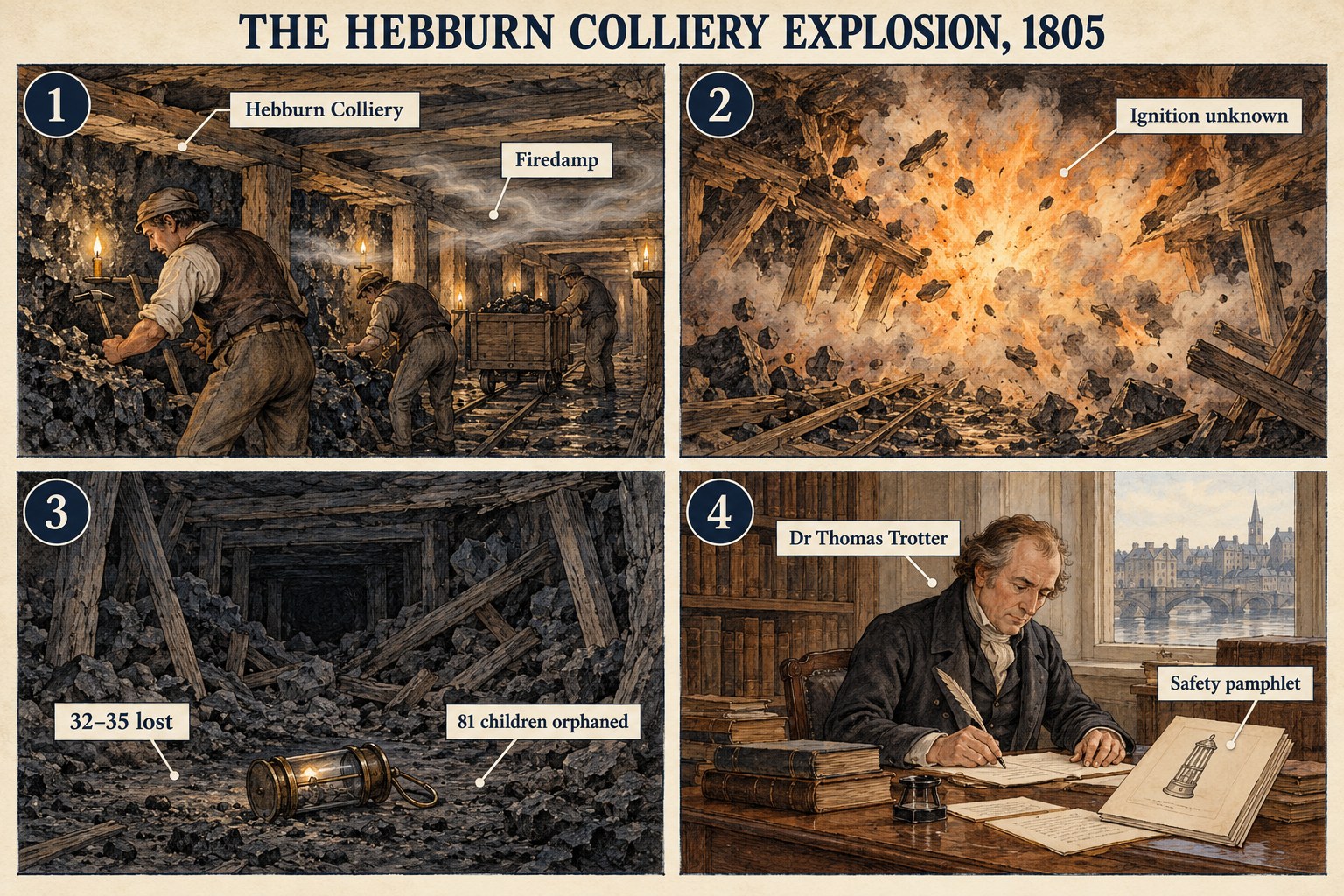
A firedamp explosion at Hebburn Colliery on 21 October 1805 killed between 32 and 35 men and boys, leaving five widows and eighty-one orphaned children — a tragedy that directly inspired Newcastle physician Dr. Thomas Trotter's pioneering pamphlet on preventing mine gas explosions.
| Date | 21 October 1805 |
|---|---|
| Mine | Hebburn Colliery |
| Region | Tyne and Wear |
| Type | Explosion |
| Fatalities | 32 (Between 32 and 35 killed, per varying contemporary accounts. Left 5 widows and 81 orphaned children.) |
| Context | During active mining |
Cause
A firedamp explosion; the specific ignition source is not recorded.
What happened
On 21 October 1805, an explosion at Hebburn Colliery — then only thirteen years into its working life and already known for the volume of gas it produced — killed between 32 and 35 men and boys, accounts of the exact toll varying. The disaster left five widows and eighty-one children orphaned. Newcastle physician Dr. Thomas Trotter, who witnessed the burials, was moved by the scale of loss to prepare and circulate a pamphlet, 'A Proposal for Destroying Fire and Choak Damps of Coal Mines', addressed to coal owners and viewers, proposing practical schemes for neutralising dangerous underground gases. The pamphlet became an early and influential contribution to the public discussion of mine safety that, over the following decade, would lead to Humphry Davy's own investigations — including, in 1815, his sampling of firedamp from this same colliery.
Investigation & inquiry
No inquest record is recorded.
Memorials & commemoration
No dedicated memorial to this specific explosion is known.
What's uncertain
Points where sources disagree or the record could not be settled; both accounts are kept. All open questions in the archive.
- Between 32 and 35 men and boys were killed, leaving 5 widows and 81 orphaned children. (disputed) 1
- Durham Mining Museum's own colliery page independently lists this explosion, giving 35 lives lost but dating it to 6 October 1805 rather than the 21 October 1805 given by NMRS's dedicated disaster page — both figures are kept rather than one being silently preferred. (disputed) 2
Recorded claims
Individual factual claims, each attached to the source(s) that support it below. Where sources disagree, both are kept.
- Between 32 and 35 men and boys were killed, leaving 5 widows and 81 orphaned children. (disputed) 1
- Dr. Thomas Trotter, who witnessed the burials, was inspired to write an early pamphlet on preventing mine gas explosions. 1
- Durham Mining Museum's own colliery page independently lists this explosion, giving 35 lives lost but dating it to 6 October 1805 rather than the 21 October 1805 given by NMRS's dedicated disaster page — both figures are kept rather than one being silently preferred. (disputed) 2
Related terminology
Mining terms this disaster is structurally linked to, with the nature of the relationship.
- Coal (contextual relationship)
Named twice in this record, first in the narrative: “…a pamphlet, 'A Proposal for Destroying Fire and Choak Damps of Coal Mines', addressed to coal owners and viewers, proposing practical…” - Colliery (contextual relationship)
Named 3 times in this record, first in the summary: “A firedamp explosion at Hebburn Colliery on 21 October 1805 killed between 32 and 35 men and boys, leaving…” - Firedamp (direct cause)
The explosion was caused by an ignition of firedamp underground. - Viewer (contextual relationship)
Named in this record’s narrative: “…Fire and Choak Damps of Coal Mines', addressed to coal owners and viewers, proposing practical schemes for neutralising dangerous underground…”
Sources
- (primary) Hebburn Colliery Explosion — Hebburn — 1805 — Northern Mine Research Society
- (primary) Durham Mining Museum — Hebburn Colliery — Durham Mining Museum
Record created: 3 September 2026 · Last researched: 3 September 2026