 MineArchive
Grove Pit Disaster, 1930
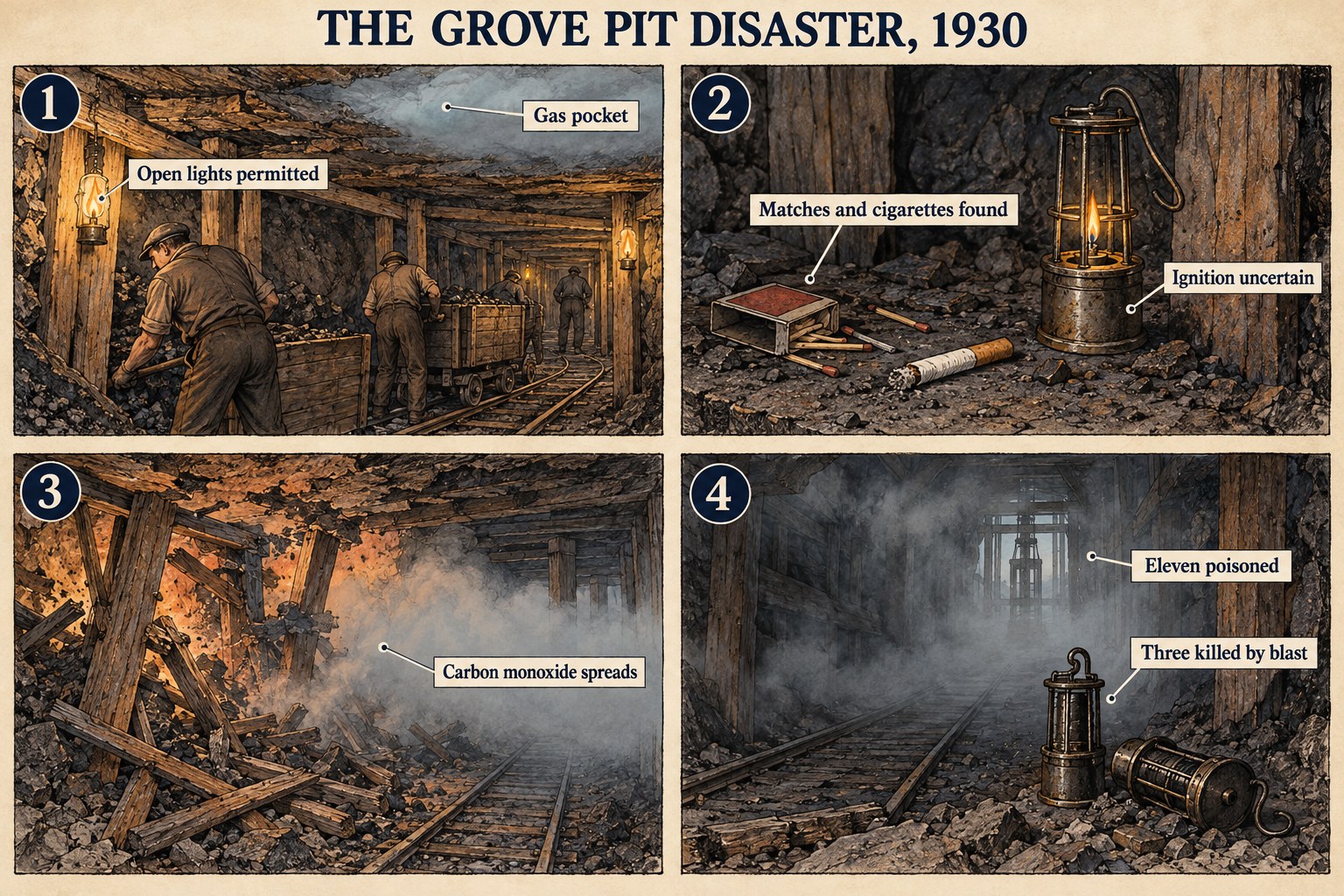
An underground gas explosion at Grove Colliery, beneath Brownhills Common, killed fourteen miners — most from carbon monoxide poisoning as they tried to escape rather than from the blast itself.
| Date | 1 October 1930 |
|---|---|
| Mine | Grove Colliery |
| Region | Staffordshire |
| Primary type | Explosion |
| Associated types | Gas / Asphyxiation |
| Fatalities | 14 (Fourteen men killed: Alfred Boden (49), John Brownridge (34), Ben Corbett (52), John Hackett (33), Alfred Heath (27), Jack Holland (41), Richard Howdle (30), Alex Martin (32), James Malley (33), William Robbins (45), John Scoffam (50), Harry Smith (38), John Whittaker (44) and William Whittaker (62). Eleven died from carbon monoxide poisoning and three from blast injuries; around twelve men survived the initial explosion itself but perished afterward.) |
| Context | During active mining |
Cause
An underground gas explosion, most likely triggered by a naked light — the inquiry found that five of the dead were carrying contraband matches or cigarettes, though it could not establish with certainty who or what actually ignited the gas.
What happened
On 1 October 1930, an underground explosion tore through Grove Colliery, beneath Brownhills Common near Walsall. The pit was not generally considered especially gassy, and open lights were normally permitted in most of its workings — which made the presence of matches and cigarettes on five of the men later found dead particularly significant to investigators, without ever conclusively identifying who struck the fatal light. Around twelve men survived the explosion itself, only to die afterward; in total, eleven of the fourteen victims died from carbon monoxide poisoning rather than the blast's direct force, and three from blast injuries.
Investigation & inquiry
A public inquiry examined the explosion but returned an open verdict, unable to establish with sufficient evidence exactly how or by whom the gas had been ignited, despite matches and cigarettes being found on five of the dead in a pit where open lights were normally allowed.
Memorials & commemoration
Ten of the fourteen victims were buried together in a communal mass grave, divided into ten sections, at St James the Great churchyard, Brownhills, on 7 October 1930, with full military honours, as six of the men had served in the First World War.
What's uncertain
Points where sources disagree or the record could not be settled; both accounts are kept. All open questions in the archive.
- The explosion is believed to have been triggered by a naked light; five of the dead were found carrying contraband matches or cigarettes, though the inquiry could not establish with certainty who or what ignited the gas. (disputed) 1
Recorded claims
Individual factual claims, each attached to the source(s) that support it below. Where sources disagree, both are kept.
- Fourteen men were killed: Alfred Boden, John Brownridge, Ben Corbett, John Hackett, Alfred Heath, Jack Holland, Richard Howdle, Alex Martin, James Malley, William Robbins, John Scoffam, Harry Smith, John Whittaker and William Whittaker. Eleven died from carbon monoxide poisoning and three from blast injuries. 1
- The explosion is believed to have been triggered by a naked light; five of the dead were found carrying contraband matches or cigarettes, though the inquiry could not establish with certainty who or what ignited the gas. (disputed) 1
- Ten of the fourteen victims were buried together in a communal mass grave at St James the Great churchyard, Brownhills, on 7 October 1930, with full military honours, as six had served in the First World War. 1
- Grove Colliery's own coal winding ended as a direct result of this explosion; the site continued afterward only as a washery for a neighbouring colliery. 2
Related terminology
Mining terms this disaster is structurally linked to, with the nature of the relationship.
- Colliery (contextual relationship)
Named twice in this record, first in the summary: “An underground gas explosion at Grove Colliery, beneath Brownhills Common, killed fourteen miners — most from…” - Contraband (contextual relationship)
Named in this record’s cause: “…naked light — the inquiry found that five of the dead were carrying contraband matches or cigarettes, though it could not establish with certainty…” - Firedamp (direct cause)
The disaster was a firedamp explosion, most likely ignited by a naked light in a pit where open lights were normally permitted. - Naked Light (contextual relationship)
Named in this record’s cause: “An underground gas explosion, most likely triggered by a naked light — the inquiry found that five of the dead were carrying contraband…”
Sources
- (secondary) 90 years ago today: The Grove Pit Disaster — BrownhillsBob's Brownhills Blog
- (secondary) Grove Colliery — Wikipedia — Wikipedia
Record created: 2 September 2026 · Last researched: 2 September 2026