 MineArchive
Grange Colliery explosion, 1858
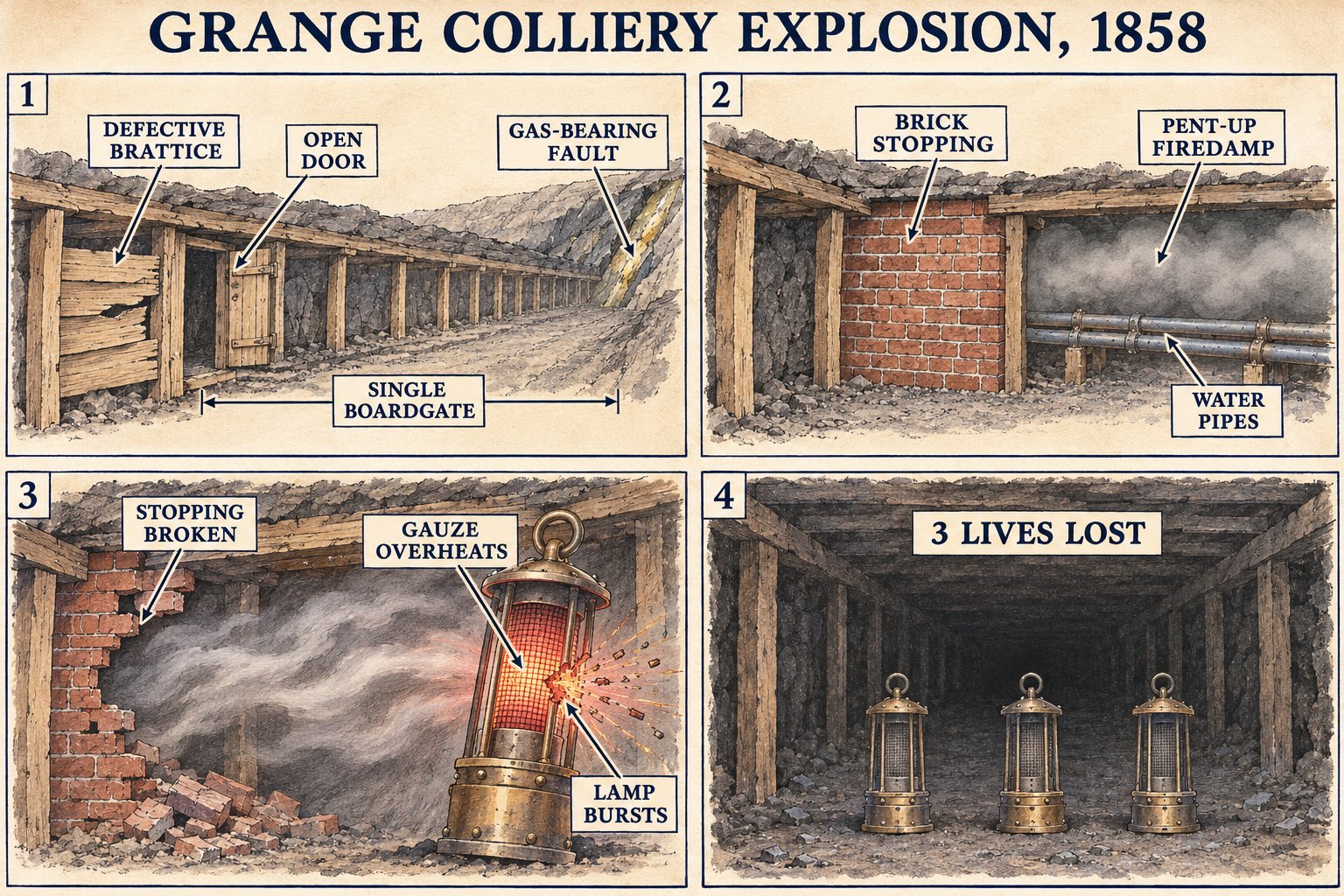
On 10 July 1858 men sent with Davy lamps to fetch water pipes from a boardgate at Grange Colliery, near Rotherham, broke through a stopping that was holding back gas from a fault. The gas fired at their lamps, killing the bottom steward William Steer and two others and badly burning a fourth.
| Date | 10 July 1858 |
|---|---|
| Mine | Grange Colliery |
| Region | South Yorkshire |
| Type | Explosion |
| Fatalities | 3 (William Steer, bottom steward; William Taylor; and James Davy, a boy. A fourth man was seriously burnt.) |
| Context | During active mining |
Location
Plotted at Grange Colliery. Approximate location, low confidence. The large pin is the mine; the small round markers are the nearest mines on record. Click one for its page. View on full map
Cause
Firedamp released from behind a brick stopping overheated the gauzes of the men's Davy lamps until one burst and fired the gas.
Contributing factors
The single boardgate, only 5 feet wide and 4 feet high, had been driven 150 yards to the dip with naked lights into a fault known to give off gas, and was ventilated only by a defective wooden brattice and one door that often stood open. The furnace was neglected, and the whole pit had scarcely 1,000 cubic feet of air a minute.
What happened
Piercing the fault in the Silkstone boardgate released a sudden rush of gas, and a brick stopping was built across the road about thirty yards from the face to hold it back. Two or three days later the agent sent Steer and the others, with Davy lamps, to take out the water pipes in the rest of the boardgate. Against orders, it was said, they broke the stopping to get out more pipes. The pent-up gas came out, the lamp gauzes filled with flame and turned red-hot, and one burst.
Investigation & inquiry
The coroner's jury returned accidental death, adding that the mine had been carelessly and inefficiently managed by Mark Davy and that a more competent man should take charge. The inspector, Charles Morton, said two boardgates with a pillar between them should have been driven for proper ventilation.
Legal & regulatory aftermath
On a later visit Morton found Davy and the new bottom steward, Robert Gillings, still breaking the general and special rules. He was authorised to prosecute, and the Rotherham magistrates convicted both in penalties and costs.
Recorded claims
Individual factual claims, each attached to the source(s) that support it below. Where sources disagree, both are kept.
- On 10 July 1858 an explosion of firedamp in the Silkstone seam at George Chambers's Grange Colliery, near Rotherham, killed the bottom steward William Steer and two others and badly burnt a fourth man. 1,2
- Sent with Davy lamps to recover water pipes, the men broke a brick stopping that held back gas from a fault; the lamp gauzes filled with flame and one burst. 2
- The whole colliery had little more than 1,000 cubic feet of air a minute, carried 150 yards up a single boardgate by a leaky wooden brattice. 2
- The inquest returned accidental death and said the mine had been carelessly and inefficiently managed by Mark Davy. 2
- Davy and a new bottom steward, Robert Gillings, were later prosecuted and convicted by the Rotherham magistrates for breaking the rules. 2
Related terminology
Mining terms this disaster is structurally linked to, with the nature of the relationship.
- Brattice (contextual relationship)
Named in this record’s contributing factors: “…known to give off gas, and was ventilated only by a defective wooden brattice and one door that often stood open. The furnace was neglected, and…” - Fault (contextual relationship)
Named 3 times in this record, first in the summary: “…Rotherham, broke through a stopping that was holding back gas from a fault. The gas fired at their lamps, killing the bottom steward William…” - Naked Light (contextual relationship)
Named in this record’s contributing factors: “…feet wide and 4 feet high, had been driven 150 yards to the dip with naked lights into a fault known to give off gas, and was ventilated only by a…” - Safety Lamp (contextual relationship)
Named 3 times in this record, first in the summary: “On 10 July 1858 men sent with Davy lamps to fetch water pipes from a boardgate at Grange Colliery, near…” - Stopping (contextual relationship)
Named 4 times in this record, first in the summary: “…from a boardgate at Grange Colliery, near Rotherham, broke through a stopping that was holding back gas from a fault. The gas fired at their…”
Sources
- (primary) Grange Colliery — Durham Mining Museum
- (primary) Grange, 10 July 1858: explosion of firedamp (Mines Inspectors Report 1858) (Durham Mining Museum) — Durham Mining Museum
Record created: 25 October 2026 · Last researched: 6 November 2026