 MineArchive
Gleision Colliery Flooding, 2011
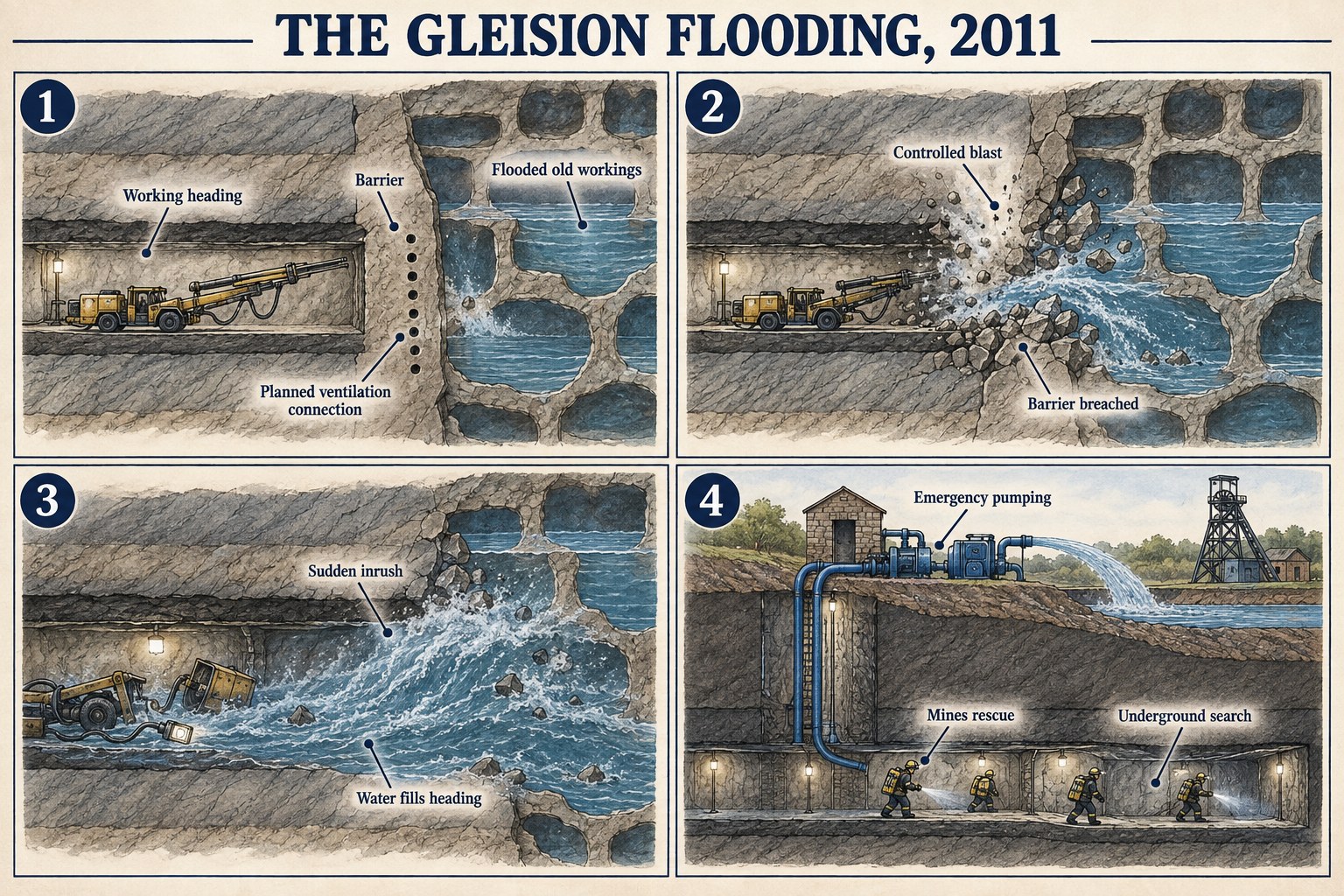
Four miners drowned at the small drift mine Gleision Colliery when a controlled blast, intended to breach into disused flooded workings for ventilation, instead released around 650,000 gallons of water into the tunnel where seven men were working -- the worst mining disaster in Wales in three decades.
| Date | 15 September 2011 |
|---|---|
| Mine | Gleision Colliery |
| Region | Neath Port Talbot |
| Primary type | Flooding / Inundation |
| Associated types | Rescue |
| Fatalities | 4 (Charles Breslin (62), David Powell (50), Philip Hill (44) and Garry Jenkins (39) died; a fifth miner survived with life-threatening injuries, and two others escaped unharmed.) |
| Injuries | One miner was hospitalised with life-threatening injuries; two others escaped without serious injury. |
| Context | During active mining |
Cause
A controlled blast, intended to breach into a separate, disused and flooded mine network to improve ventilation, instead released a large body of water directly into the tunnel where the miners were working.
What happened
On the morning of 15 September 2011, seven miners were working with explosives on a narrow coal seam at Gleision Colliery, a small drift mine at Cilybebyll in the Tawe valley. A controlled blast intended to breach into a separate, disused and flooded mine network -- to improve ventilation -- instead released around 650,000 gallons of water directly into the tunnel. Three miners escaped, one with life-threatening injuries; the remaining four, working roughly 90 metres underground, were trapped by the flood: Charles Breslin (62), David Powell (50), Philip Hill (44) and Garry Jenkins (39).
Rescue & recovery
The Mid and West Wales Fire and Rescue Service launched a major search and rescue operation, drawing on mines rescue units from across the United Kingdom to reach the trapped men roughly 90 metres below the surface. All four were found dead on 16 September, the day after the flooding.
Investigation & inquiry
South Wales Police and the Health and Safety Executive launched parallel investigations. Mine manager Malcolm Fyfield was arrested on 18 October 2011 and charged on 18 January 2013 with four counts of manslaughter by gross negligence; the operating company, MNS Mining Ltd, was charged with four counts of corporate manslaughter.
Legal & regulatory aftermath
Both Fyfield and MNS Mining Ltd were found not guilty at trial on 19 June 2014. A coroner later ruled that a full inquest should go ahead, stating there was 'more than a suspicion' that safety regulations had not been properly followed at Gleision for over a decade; as of recent reporting, the community was still awaiting that inquest more than a decade after the disaster.
Memorials & commemoration
The Swansea Valley Miners Appeal Fund was established on 17 September 2011, raising £30,000 within a day, with the Prince of Wales as royal patron and the Coal Industry Social Welfare Organisation administering it. Churches across South Wales held prayers on 18 September; Swansea City F.C. held a minute's silence; the Welsh rugby team dedicated their 2011 World Cup victory over Samoa to the miners' families; and the Welsh National Poet, Gwyneth Lewis, wrote a poem titled 'Gleision' in response.
What's uncertain
Points where sources disagree or the record could not be settled; both accounts are kept. All open questions in the archive.
- The Written Ministerial Statement of 10 October 2011 describes the immediate cause as the failure of a retaining wall at the drift mine, releasing water into the workings -- a slightly different framing from other accounts describing a controlled blast breaching into flooded workings; both describe the same event, that a barrier separating the workings from a large body of water gave way. Sources also disagree narrowly on Philip Hill's age: 44 (Wikipedia) versus 45 (the Written Ministerial Statement). (disputed) 1,2
Recorded claims
Individual factual claims, each attached to the source(s) that support it below. Where sources disagree, both are kept.
- Mine manager Malcolm Fyfield and the operating company MNS Mining Ltd were both charged with manslaughter over the four deaths, and both were found not guilty at trial on 19 June 2014. 1
- The Welsh National Poet, Gwyneth Lewis, wrote a poem titled 'Gleision' in response to the disaster. 1
- The Written Ministerial Statement of 10 October 2011 describes the immediate cause as the failure of a retaining wall at the drift mine, releasing water into the workings -- a slightly different framing from other accounts describing a controlled blast breaching into flooded workings; both describe the same event, that a barrier separating the workings from a large body of water gave way. Sources also disagree narrowly on Philip Hill's age: 44 (Wikipedia) versus 45 (the Written Ministerial Statement). (disputed) 1,2
- The rescue and support effort was coordinated nationally: the Cabinet Office's Civil Contingencies Secretariat worked alongside the Welsh Government, and the British Red Cross and WRVS provided welfare support to the miners' families during the search. 2
Related terminology
Mining terms this disaster is structurally linked to, with the nature of the relationship.
- Coal (contextual relationship)
Named twice in this record, first in the narrative: “…2011, seven miners were working with explosives on a narrow coal seam at Gleision Colliery, a small drift mine at Cilybebyll in the…” - Colliery (contextual relationship)
Named twice in this record, first in the summary: “Four miners drowned at the small drift mine Gleision Colliery when a controlled blast, intended to breach into disused flooded…” - Drift (contextual relationship)
Named twice in this record, first in the summary: “Four miners drowned at the small drift mine Gleision Colliery when a controlled blast, intended to breach…” - Miners' Welfare Fund (contextual relationship)
Named in this record’s memorials: “…within a day, with the Prince of Wales as royal patron and the Coal Industry Social Welfare Organisation administering it. Churches across South Wales held prayers on 18…”
Sources
- (secondary) Gleision Colliery mining accident — Wikipedia
- (primary) Written Ministerial Statement on incident at Gleision Colliery — UK Government (Secretary of State for Wales, Rt Hon Cheryl Gillan MP, 10 October 2011)
Record created: 2 September 2026 · Last researched: 2 September 2026