 MineArchive
East Gawber Colliery explosion, 1861
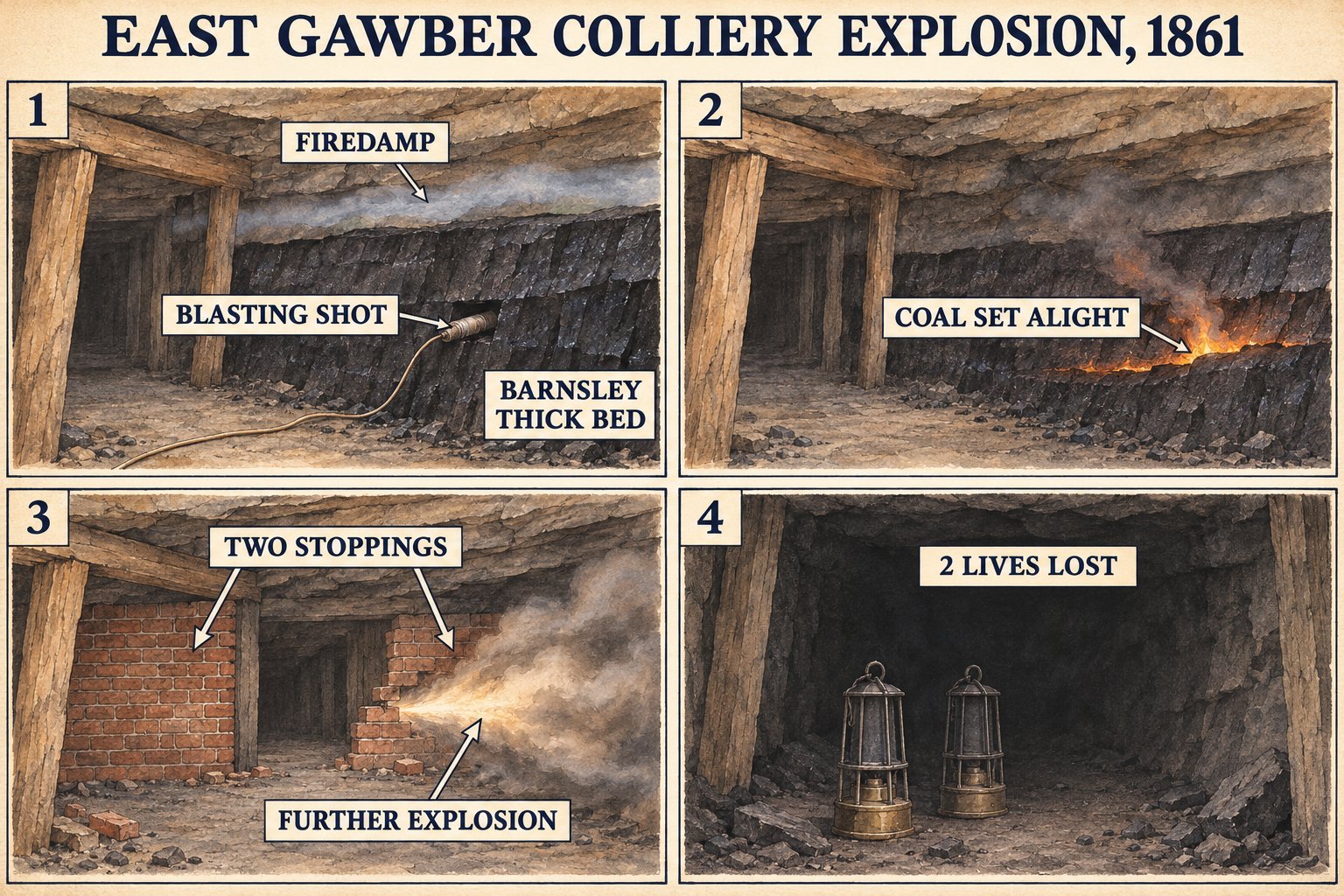
In the summer of 1861 a shot fired in a heading at East Gawber Colliery, near Barnsley, set the Barnsley Thick Bed alight. On 2 August, while building stoppings to shut off the fire, the underground viewer Mark Ward and his deputy John Warhurst were burnt to death by a further explosion.
| Date | 2 August 1861 |
|---|---|
| Mine | East Gawber Colliery |
| Region | South Yorkshire |
| Primary type | Explosion |
| Associated types | Fire |
| Fatalities | 2 (Mark Ward, underground viewer, and John Warhurst, his deputy.) |
| Context | During active mining |
Location
Plotted at East Gawber Colliery. Recorded location. The large pin is the mine; the small round markers are the nearest mines on record. Click one for its page. View on full map
Cause
Firedamp ignited by blasting set fire to the coal; further explosions of gas from the fire killed the two men at the stoppings.
Contributing factors
After Lundhill in 1857 the inspector, Charles Morton, had persuaded the owners to ban naked lights and indiscriminate blasting at what was only a moderately ventilated pit, but safety lamps were later given up for cheapness, candles came back and gunpowder was used freely. Small flashes of gas had become common and little regarded.
What happened
In the last week of July 1861 two ignitions of firedamp were caused by blasting in a heading. The first did no harm; the second set fire to the Barnsley Thick Bed. Mark Ward, the underground viewer, and John Warhurst, his deputy, began building two stoppings to keep air from the burning coal. While they worked, another explosion burnt them fatally. Others who tried to finish the stoppings were knocked down when still stronger explosions blew out the brickwork.
The injured men and the horses were brought out, the mine was abandoned, and the pumping and drawing shafts were covered, leaving the upcast open at first. Explosions could still be felt at the surface twelve hours later.
Rescue & recovery
The injured and the horses were brought to the surface before the shafts were covered.
Investigation & inquiry
Charles Morton, HM Inspector of Mines, reported the case at length in 1861 as a grievous and unnecessary loss of life and property, blaming the return to naked lights and loose blasting at a pit he had warned.
Legal & regulatory aftermath
Some of the owners were impatient to work again, and after 32 days two shafts were uncovered. Within half an hour two slight explosions were felt and a third violent one blew the coverings off, so the bottom of the drawing shaft was choked with earth. On the advice of the viewer John Brown and Morton, with the owner Edwin Booth agreeing, the mine was then kept closed for months and allowed to flood to quench the fire. In February 1862 a spark from a mason's hammer lit gas at the upcast top. A steam-driven ventilating fan was then put up, and Morton expected the mine to reopen by July 1862.
Recorded claims
Individual factual claims, each attached to the source(s) that support it below. Where sources disagree, both are kept.
- On 2 August 1861 an explosion of firedamp at Craik and Co.'s East Gawber Colliery, near Barnsley, fatally burnt the underground viewer Mark Ward and his deputy John Warhurst. 1,2
- Blasting in a heading had fired the Barnsley Thick Bed, and the men were killed while building stoppings to cut off air from the fire. 2
- After Lundhill in 1857 the owners had banned naked lights and loose blasting on the inspector's advice, but candles and gunpowder had since come back for cheapness. 2
- The mine was abandoned and sealed; an attempt to uncover the shafts after 32 days set off three more explosions, and the pit was left closed and partly flooded into 1862. 2
Related terminology
Mining terms this disaster is structurally linked to, with the nature of the relationship.
- Deputy (contextual relationship)
Named twice in this record, first in the summary: “…to shut off the fire, the underground viewer Mark Ward and his deputy John Warhurst were burnt to death by a further explosion.” - Heading (contextual relationship)
Named twice in this record, first in the summary: “In the summer of 1861 a shot fired in a heading at East Gawber Colliery, near Barnsley, set the Barnsley Thick Bed…” - Shot-firing (contextual relationship)
Named 4 times in this record, first in the cause: “Firedamp ignited by blasting set fire to the coal; further explosions of gas from the fire killed…” - Stopping (contextual relationship)
Named 4 times in this record, first in the summary: “…set the Barnsley Thick Bed alight. On 2 August, while building stoppings to shut off the fire, the underground viewer Mark Ward and his…” - Viewer (contextual relationship)
Named 3 times in this record, first in the summary: “…while building stoppings to shut off the fire, the underground viewer Mark Ward and his deputy John Warhurst were burnt to death by a…”
Sources
- (primary) East Gawber Colliery — Durham Mining Museum
- (primary) East Gawber, 2 August 1861: explosion of firedamp (Mines Inspectors Report 1861) (Durham Mining Museum) — Durham Mining Museum
Record created: 25 October 2026 · Last researched: 6 November 2026