 MineArchive
Chartershaugh Colliery Explosion, 1778
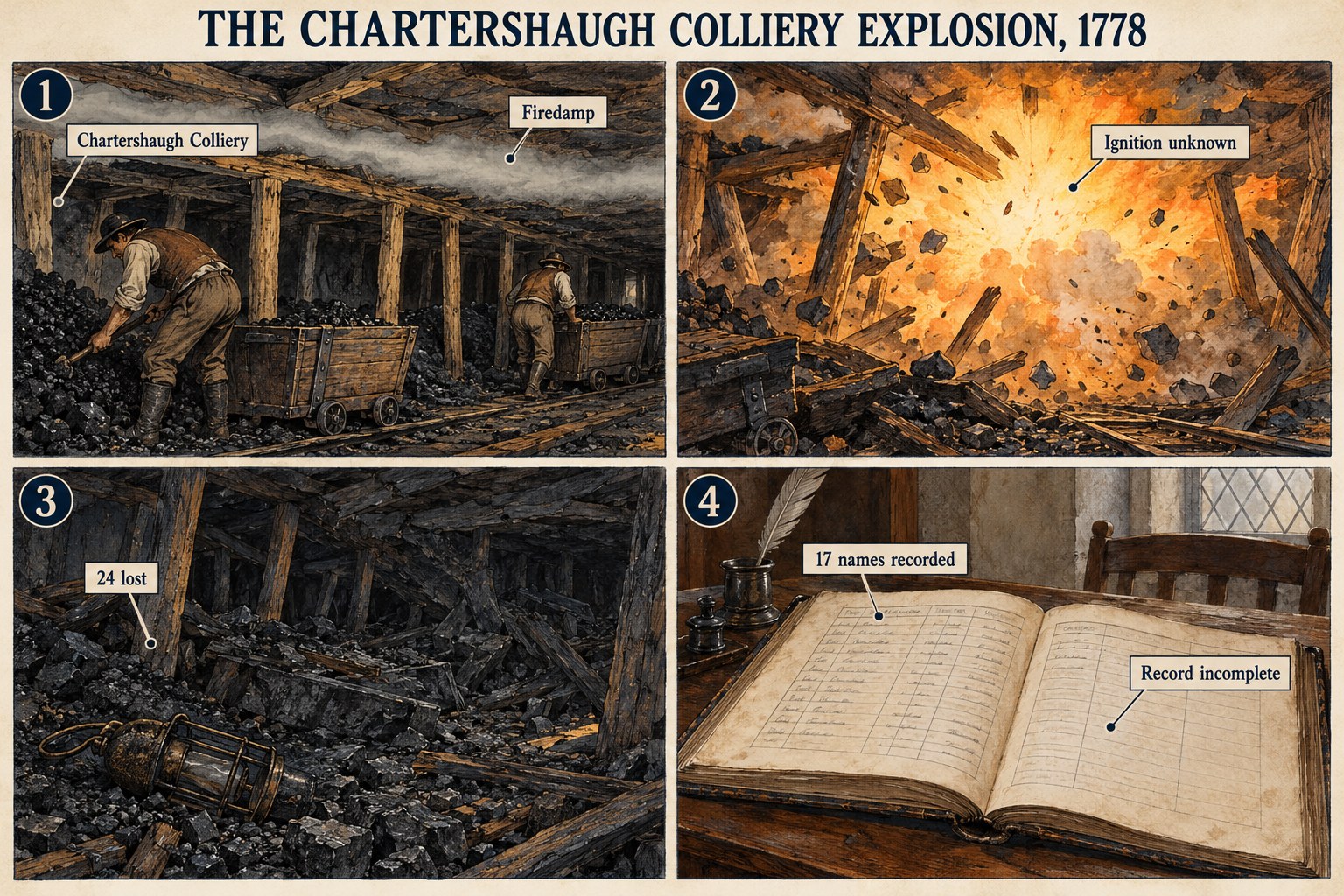
A firedamp explosion at Chartershaugh Colliery on 8 December 1778 killed 24 men, one of the deadliest recorded Durham coalfield disasters of the eighteenth century.
| Date | 8 December 1778 |
|---|---|
| Mine | Chartershaugh Colliery |
| Region | County Durham |
| Type | Explosion |
| Fatalities | 24 (24 dead, per contemporary and secondary accounts; the Durham Mining Museum's own name-by-name burial records confirm 17 individuals by name, with burials recorded between 9 December 1778 and 6 January 1779 — the museum itself notes its collection of names is not complete.) |
| Context | During active mining |
Cause
A firedamp explosion; the specific ignition source is not recorded.
What happened
On 8 December 1778, an explosion of firedamp at Chartershaugh Colliery, then owned by W. Peareth, Esq., killed 24 men — one of the deadliest disasters recorded on the Durham coalfield in the eighteenth century, comparable in scale to the 1708 Fatfield disaster (69 dead), the 1710 Bensham disaster (80 dead) and Fatfield's own second disaster in 1767 (39 dead). The colliery had already suffered a smaller explosion in 1756, which killed four men and was powerful enough to blow a loaded coal corf clear up an 80-fathom shaft. Burial records compiled by the Durham Mining Museum name 17 of the victims — Ralph Ashley, Walter Ashley (jnr), George Brown, Thomas Brown, Thomas Coulson, Robert Forster, William Henderson, Francis Hobson, David How, John Kirtley (jnr), Ralph Mason, John Peal, William Taylor, Joseph Thompson, Marshall Thompson and Joseph Woolfe — buried between 9 December 1778 and 6 January 1779, with the museum's own collection noted as incomplete against the reported total of 24.
Investigation & inquiry
No formal investigation record is recorded; this predates the era of statutory mine inspection.
Memorials & commemoration
No dedicated memorial to this specific explosion is known.
What's uncertain
Points where sources disagree or the record could not be settled; both accounts are kept. All open questions in the archive.
- 24 men were killed per contemporary and secondary accounts; Durham Mining Museum's own burial records confirm 17 individuals by name and note the collection is incomplete. (disputed) 1,2
Recorded claims
Individual factual claims, each attached to the source(s) that support it below. Where sources disagree, both are kept.
- 24 men were killed per contemporary and secondary accounts; Durham Mining Museum's own burial records confirm 17 individuals by name and note the collection is incomplete. (disputed) 1,2
- The 1778 Chartershaugh explosion (24 dead) ranks among the deadliest eighteenth-century Durham coalfield disasters, alongside Fatfield 1708 (69 dead), Bensham 1710 (80 dead) and Fatfield 1767 (39 dead). 2
Related terminology
Mining terms this disaster is structurally linked to, with the nature of the relationship.
- Coal (contextual relationship)
Named in this record’s narrative: “…1756, which killed four men and was powerful enough to blow a loaded coal corf clear up an 80-fathom shaft. Burial records compiled by the…” - Colliery (contextual relationship)
Named 3 times in this record, first in the summary: “A firedamp explosion at Chartershaugh Colliery on 8 December 1778 killed 24 men, one of the deadliest recorded…” - Firedamp (contextual relationship)
Named 3 times in this record, first in the summary: “A firedamp explosion at Chartershaugh Colliery on 8 December 1778 killed 24…” - Shaft (contextual relationship)
Named in this record’s narrative: “…was powerful enough to blow a loaded coal corf clear up an 80-fathom shaft. Burial records compiled by the Durham Mining Museum name 17 of the…”
Sources
- (primary) Durham Mining Museum — Chaytor's Haugh Colliery — Durham Mining Museum
- (primary) Chartershaugh Colliery Explosion — Durham — 1778 — Northern Mine Research Society
Record created: 3 September 2026 · Last researched: 3 September 2026