 MineArchive
Bilsthorpe Colliery Piping Collapse (1927)
A burst water pipe brought roughly 100 tons of shattered ironwork crashing down the sinking shaft, killing fourteen men working below.
| Date | 1 March 1927 |
|---|---|
| Mine | Bilsthorpe Colliery |
| Region | Nottinghamshire |
| Primary type | Winding / Shaft Accident |
| Associated types | Rescue |
| Fatalities | 14 (Fourteen men were killed and three injured; named victims include Patrick Kelly, 22.) |
| Context | During active mining |
Cause
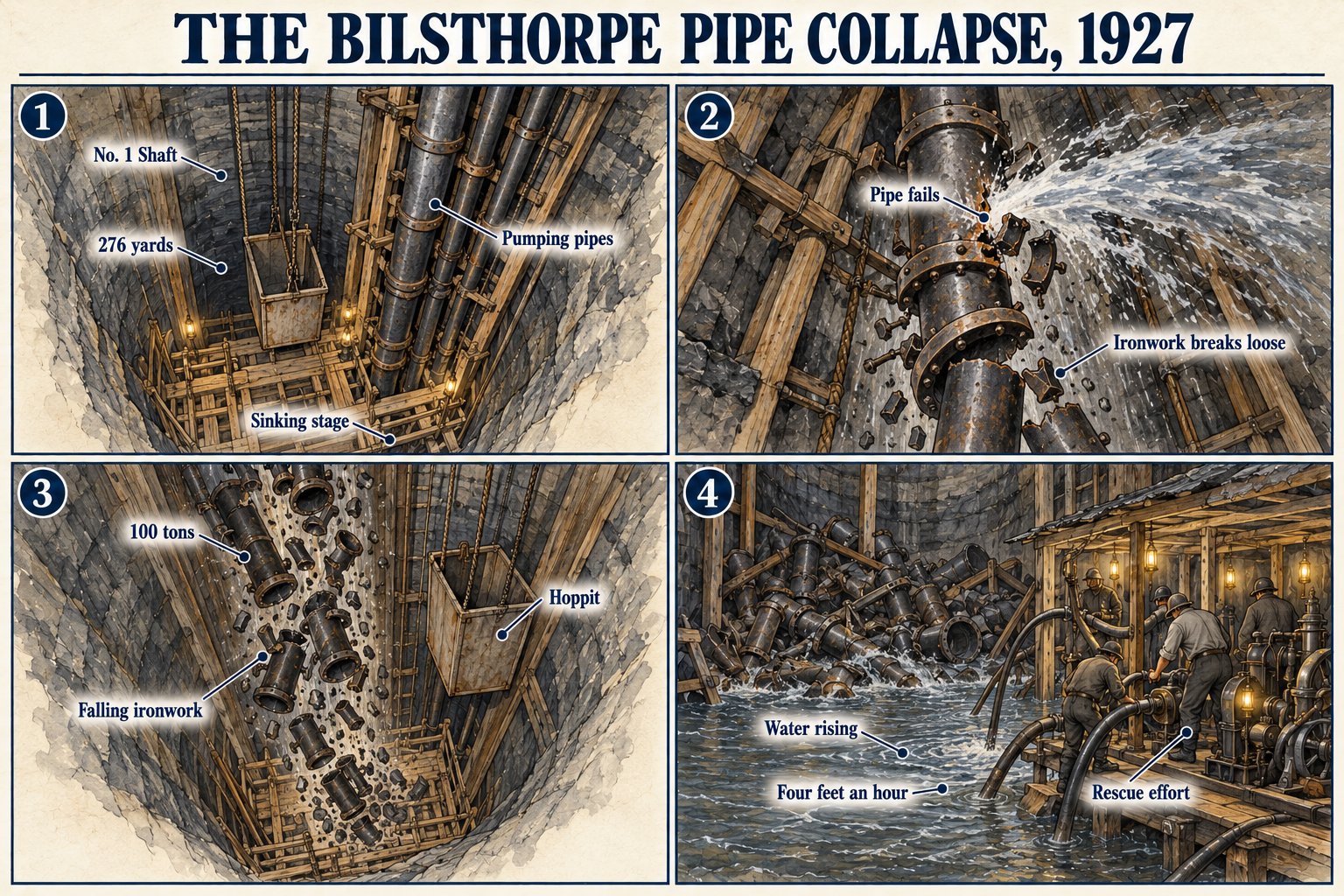
A pipe used to pump floodwater from the pit burst or broke during shaft-sinking operations, sending roughly 100 tons of shattered ironwork down the shaft.
What happened
In the early hours of 1 March 1927, during shaft-sinking operations at Bilsthorpe Colliery, one of the pipes used to pump floodwater from the workings burst or broke high up in No. 1 Shaft, then 276 yards deep. The resulting fall of perhaps 100 tons of shattered iron piping crashed onto nine men on the staging at the bottom of the shaft and eight more who were being lowered in a hoppit, a bucket-shaped carrier, having just eaten their usual three o'clock meal. Fourteen men were killed and three injured. A contemporary newspaper called it the worst pit disaster in the Nottinghamshire coalfield since 1913 -- an explicit echo of the already-published Rufford Colliery disaster of that year. One of the dead, Patrick Kelly, was just 22 and had started work at the colliery less than two months earlier, on 5 January 1927. The King and Queen sent their condolences to the men's families.
Rescue & recovery
Rescuers worked against water rising at four feet an hour to reach the entombed men, guided in part by the moans of those still alive beneath the wreckage; conditions that night were made worse by gale-force winds heralding the arrival of March.
Recorded claims
Individual factual claims, each attached to the source(s) that support it below. Where sources disagree, both are kept.
- During shaft-sinking operations on 1 March 1927, a burst water pipe sent roughly 100 tons of shattered iron piping down No. 1 Shaft onto nine men on staging and eight more descending in a hoppit, killing fourteen and injuring three; the King and Queen sent their condolences. 1
Related terminology
Mining terms this disaster is structurally linked to, with the nature of the relationship.
- Colliery (contextual relationship)
Named 3 times in this record, first in the narrative: “…hours of 1 March 1927, during shaft-sinking operations at Bilsthorpe Colliery, one of the pipes used to pump floodwater from the workings burst or…” - Kibble (contextual relationship)
Named in this record’s narrative: “…the bottom of the shaft and eight more who were being lowered in a hoppit, a bucket-shaped carrier, having just eaten their usual three…” - Shaft (contextual relationship)
Named 4 times in this record, first in the summary: “…roughly 100 tons of shattered ironwork crashing down the sinking shaft, killing fourteen men working below.” - Shaft Sinking (contextual relationship)
Named in this record’s summary: “…brought roughly 100 tons of shattered ironwork crashing down the sinking shaft, killing fourteen men working below.”
Sources
- (secondary) Bilsthorpe Mining Disaster, 1st March 1927 -- 14 men lost their lives (Nottinghamshire Mining Museum, contemporary Evening Post report) — Nottinghamshire Mining Museum
- (secondary) Bilsthorpe Colliery — Wikipedia
Record created: 31 August 2026 · Last researched: 31 August 2026