 MineArchive
Bentley Colliery manrider derailment, 1978
An underground manriding train carrying 65 miners derailed after running away down an incline at Bentley Colliery on 21 November 1978, killing seven men and injuring many more.
| Date | 21 November 1978 |
|---|---|
| Mine | Bentley Colliery |
| Region | South Yorkshire |
| Type | Haulage / Transport |
| Fatalities | 7 (The seven men killed were Robert Aitchenson (54), Donald Box (39), Kenneth Green (38), David R. Hall (21, a trainee), Geoffrey Henderson (39), Michael E. Hickman (18, a trainee) and James Mitchell (55) — all face workers or trainees.) |
| Injuries | Three men were seriously injured; a further 18 were hospitalised and around 40 were treated for shock at the colliery. |
| Context | During active mining |
Cause
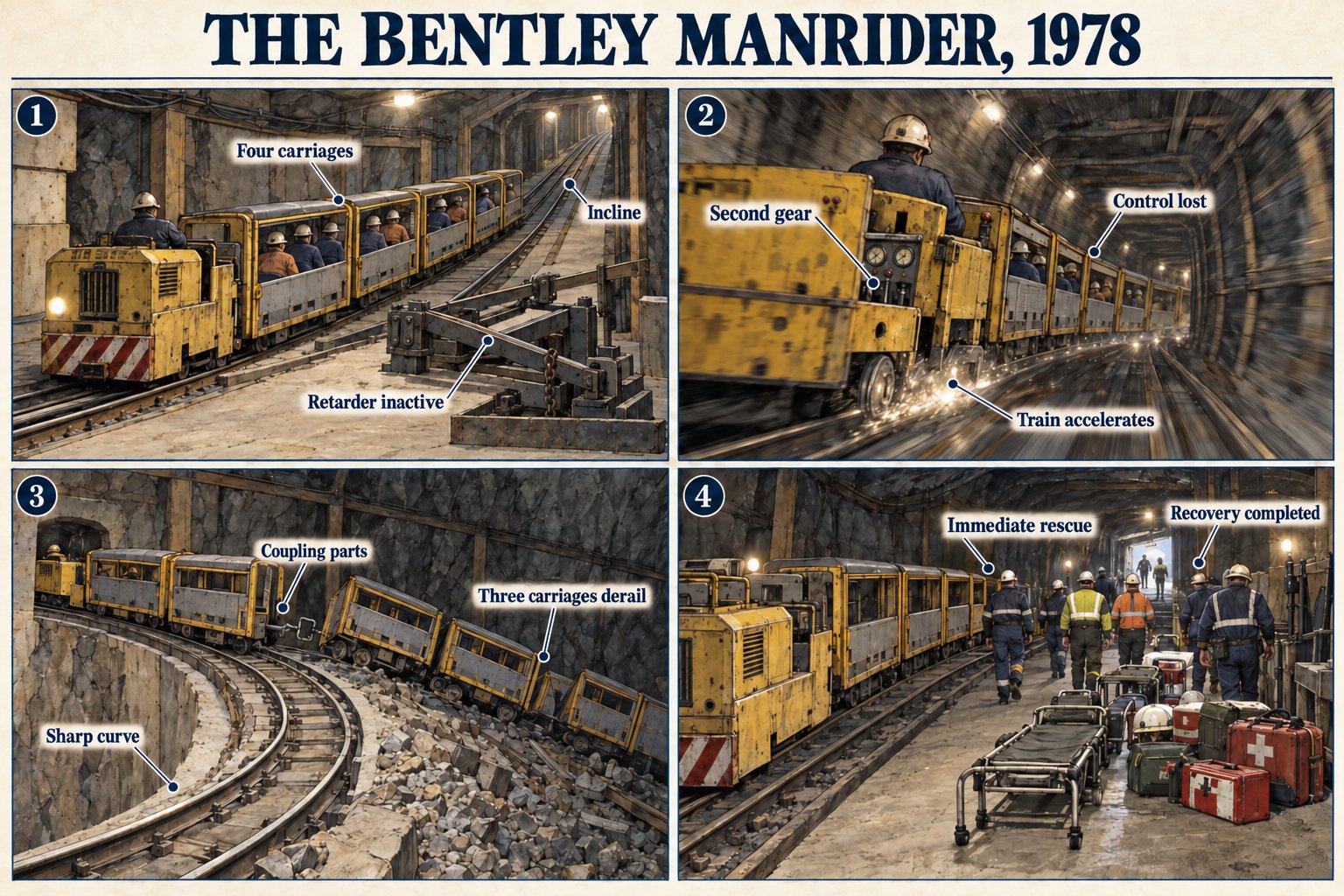
Locomotive driver G. Shone began moving off in second gear rather than first at the top of an incline while repositioning four coupled carriages carrying 65 men at 4:50am; failing to stop after about 30 feet, he lost control on the resulting skid and, realising he could not stop, attempted to take the curve at speed. The impact broke the coupling between the first and second carriages, derailing carriages two, three and four, while the locomotive and first carriage ran a further 67 feet before stopping.
Contributing factors
A safety arrestor, the Godwin Warren Retarder, had been pinned in the lowered (inactive) position by conductor H.A. Wells, who mistakenly believed another locomotive would follow; the coupling pins between the first and second carriages were found not to be fully connected; the retarder's warning-light system had a history of malfunctioning without being properly reported; two earlier runaway-train incidents that August and November had not been properly documented; the substitute conductor on duty had not received full training; and part of the gradient itself exceeded statutory limits.
What happened
The accident happened at 4:50am as four coupled carriages carrying 65 miners were being repositioned at the top of an incline. When the locomotive failed to stop before a curve in the track, the resulting collision broke a coupling and derailed three of the four carriages.
Rescue & recovery
Deputies and overmen already at the scene began recovery immediately, giving first aid while further manriding trains brought reinforcements and medical staff below ground; by 9am, within two hours of the accident, all casualties had been brought to the surface.
Investigation & inquiry
The subsequent inquiry found no single cause but a combination of factors, and made 13 recommendations covering gradient restrictions, automatic speed-sensitive braking, level terminal stations, improved track and coupling design, better driver training, improved signalling, and stricter discipline in following transport rules; tests after the accident showed the train's brakes, correctly used, would have been capable of stopping it within the distance available.
Legal & regulatory aftermath
The accident was raised in the House of Commons the same day, 21 November 1978.
Changes to practice & legislation
The inquiry's 13 recommendations targeted underground manriding safety broadly, including automatic speed-sensitive brakes and stricter gradient limits, rather than being specific to Bentley alone.
Recorded claims
Individual factual claims, each attached to the source(s) that support it below. Where sources disagree, both are kept.
- The locomotive driver started off in the wrong gear and lost control on a downhill curve after a safety retarder had been pinned inactive by a conductor who mistakenly expected another locomotive to follow. 1
- Seven men were killed: Robert Aitchenson, Donald Box, Kenneth Green, David R. Hall, Geoffrey Henderson, Michael E. Hickman and James Mitchell, all face workers or trainees. 1
- The investigation made 13 recommendations covering gradient restrictions, automatic speed-sensitive braking, improved coupling and track design, driver training and signalling. 1
Related terminology
Mining terms this disaster is structurally linked to, with the nature of the relationship.
- Colliery (contextual relationship)
Named in this record’s summary: “…65 miners derailed after running away down an incline at Bentley Colliery on 21 November 1978, killing seven men and injuring many more.” - Deputy (contextual relationship)
Named in this record’s rescue and recovery: “Deputies and overmen already at the scene began recovery immediately, giving…” - Incline (contextual relationship)
Named 3 times in this record, first in the summary: “…train carrying 65 miners derailed after running away down an incline at Bentley Colliery on 21 November 1978, killing seven men and…” - Level (contextual relationship)
Named in this record’s investigation: “…covering gradient restrictions, automatic speed-sensitive braking, level terminal stations, improved track and coupling design, better driver…”
Sources
- (secondary) Bentley Colliery Manrider Accident, Doncaster, 1978 — Northern Mine Research Society
- (primary) Bentley Colliery (Accident) (Hansard, 21 November 1978) — UK Parliament, House of Commons (Historic Hansard)
Record created: 27 August 2026 · Last researched: 27 August 2026