 MineArchive
Ackton Hall Colliery explosion, 1909
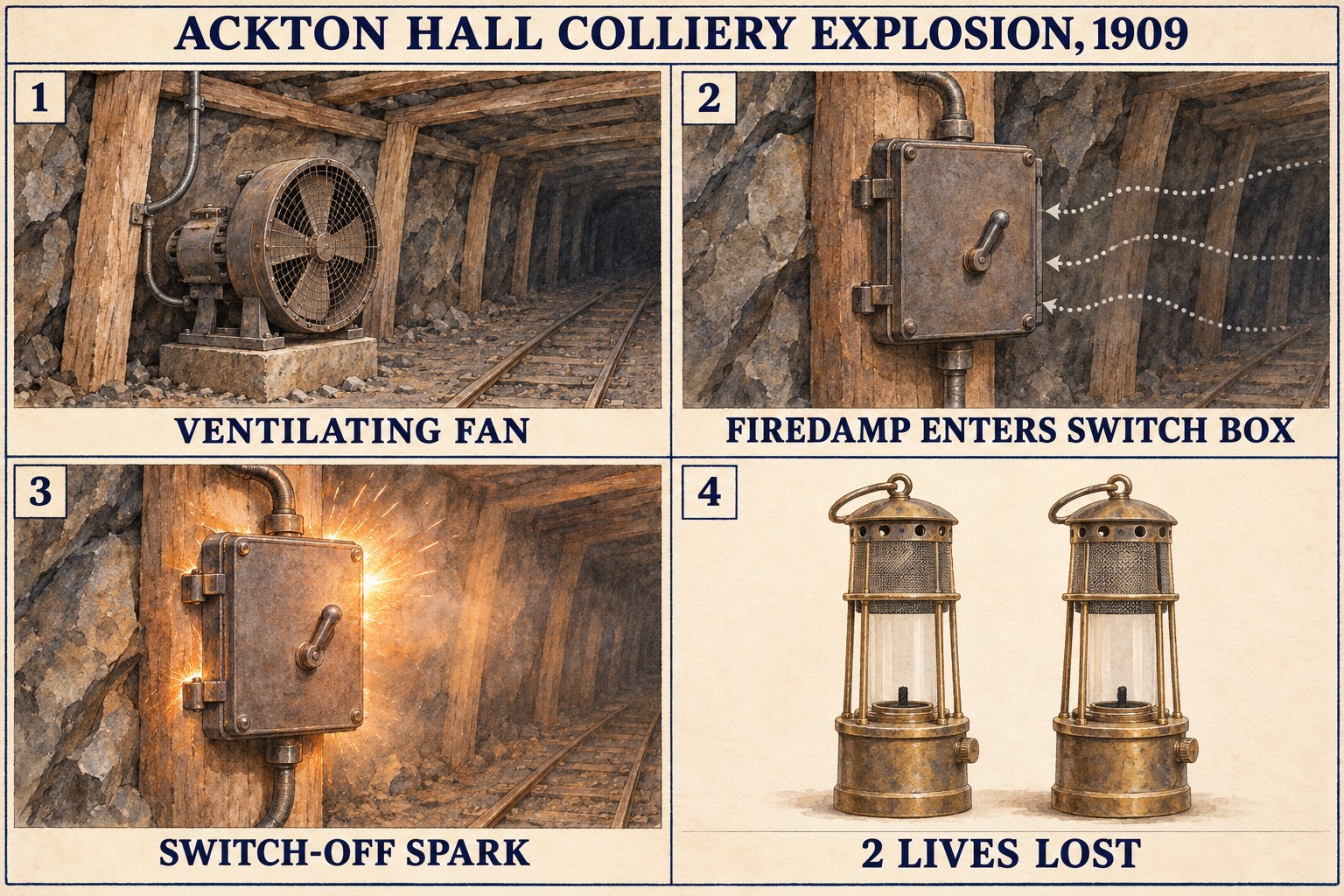
Sparks from the switch box of a small electric fan fired gas in a heading at Ackton Hall Colliery, Featherstone, on 19 January 1909, killing two miners.
| Date | 19 January 1909 |
|---|---|
| Mine | Ackton Hall Colliery |
| Region | West Yorkshire |
| Primary type | Explosion |
| Associated types | Machinery |
| Fatalities | 2 (Herbert Meredith, 23, and James Platt, 34, miners.) |
| Context | During active mining |
Location
Plotted at Ackton Hall Colliery. Approximate location. The large pin is the mine; the small round markers are the nearest mines on record. Click one for its page. View on full map
Cause
Firedamp entered the switch box of a small electric fan motor, which was not gas-tight, and was ignited by the spark when the fan was switched off.
What happened
On 19 January 1909 firedamp exploded in a winning heading at Ackton Hall Colliery, Featherstone, killing two miners, Herbert Meredith, 23, and James Platt, 34. The heading was ventilated by a small electric fan, and the explosion came as one of the men was switching it off: gas from the workings had found its way into the switch box, which was not gas-tight, and the spark fired it. At the inquest at Wakefield the jury found exactly that, and the chief inspector of mines, W. H. Pickering, said the accident drew attention to the potential dangers of electrical appliances in mines where firedamp might appear, adding that few electrical engineers seemed to realise them.
Investigation & inquiry
The inquest at Wakefield heard the chief inspector of mines, W. H. Pickering, on the dangers of electrical apparatus in gassy mines.
Recorded claims
Individual factual claims, each attached to the source(s) that support it below. Where sources disagree, both are kept.
- On 19 January 1909 firedamp exploded in a winning heading at Ackton Hall Colliery, Featherstone, killing two miners, Herbert Meredith and James Platt. 1,2
- The gas was ignited by sparks from the switch box of a small electric fan's motor, which was not gas-tight, as one of the men switched the fan off. 1,2
- At the Wakefield inquest the chief inspector of mines, W. H. Pickering, said the accident showed the dangers of electrical appliances where firedamp might be present. 2
Related terminology
Mining terms this disaster is structurally linked to, with the nature of the relationship.
- Colliery (contextual relationship)
Named twice in this record, first in the summary: “…box of a small electric fan fired gas in a heading at Ackton Hall Colliery, Featherstone, on 19 January 1909, killing two miners.” - Firedamp (contextual relationship)
Named 3 times in this record, first in the cause: “Firedamp entered the switch box of a small electric fan motor, which was not…” - HM Chief Inspector of Mines (contextual relationship)
Named twice in this record, first in the narrative: “…it. At the inquest at Wakefield the jury found exactly that, and the chief inspector of mines, W. H. Pickering, said the accident drew attention to the potential…” - Heading (contextual relationship)
Named 3 times in this record, first in the summary: “Sparks from the switch box of a small electric fan fired gas in a heading at Ackton Hall Colliery, Featherstone, on 19 January 1909, killing…”
Sources
- (primary) Durham Mining Museum: Ackton Hall, 19 January 1909 — Durham Mining Museum
- (secondary) Electrical Dangers in Mines, 29 January 1909 (Welsh Newspapers Online) — Welsh Newspapers Online, National Library of Wales
Record created: 27 November 2026 · Last researched: 27 November 2026