 MineArchive
Dan's Muckhole: Pontypridd RFC and Pwllgwaun Colliery
| Category | Sports |
|---|---|
| Dates | Pwllgwaun Colliery sunk, 1875; Daniel Thomas retired, 1900, and died, 1910; colliery closed, 7 August 1948; Sardis Road ground opened on the site, 1974; artificial pitch laid, 2016. |
Pontypridd RFC's Sardis Road ground, its home since 1974, is laid out on the site of Pwllgwaun Colliery, the small wet pit known locally as Dan's Muckhole after its first owner, Daniel Thomas. The name passed from the pit to the ground, a coal dram stands at the Rhondda end, and the old mine level still opens behind the grandstand.
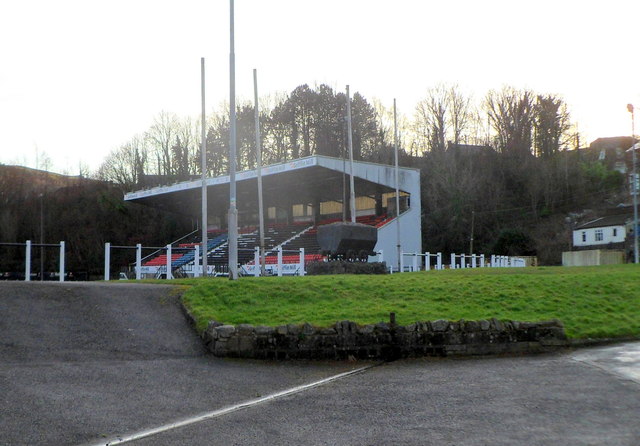
The mining history in this record
Pwllgwaun Colliery was sunk in 1875 to the No. 2 Rhondda seam, only 45 yards down, at Pwllgwaun on the western edge of Pontypridd where the Rhondda meets the Taff. Its first proprietor, Daniel Thomas, was a bare-fist mountain fighter who fought as "Dai Ponty" and later turned religious and philanthropic; he retired in 1900, passing the pit to his son-in-law Henry Mogford and his clerk John Phillips, and died at Porthcawl in 1910. The pit took his name. Dan's Muckhole was a wet, dirty working reached by a walk knee-deep in water, its roadways in places only 2 feet 6 inches high, so that men lay on their sides to cut the coal; the workings ran more than a mile and a half into the seam, and the coal went out on the Rhondda and Barry line behind the pit. It never employed more than a few dozen men. It was worked under licence as a small mine after nationalisation and closed on 7 August 1948.
Rugby came to Pontypridd in the same years. The club's own history has the colliery's sinking in 1875 coinciding with the club's formation, and ties its early strength to the pits: a works team at the Maritime Colliery played the leading clubs, and its amalgamation with the town side in 1892 is credited with the club's later achievements. Pontypridd played at Taff Vale Park and Ynysangharad Park before moving in 1974 to a new ground laid out on the colliery site at Sardis Road, at the confluence of the two rivers.
People
Daniel Thomas, the colliery's first proprietor, a mountain fighter who fought as "Dai Ponty" before turning to religion and good works; the pit's nickname is his. Henry Mogford, his son-in-law, and John Phillips, his clerk, who took the mine on in 1900. Neil Jenkins, the Pontypridd, Wales and British Lions fly-half, who named the ground "The House of Pain".
Legacy today
The name went with the ground. Sardis Road is still Dan's Muckhole in local speech, a name the club says took on a second meaning when the pitch churned to a mudbath in wet weather, and which the fly-half Neil Jenkins later overlaid with "The House of Pain". A coal dram was placed at the Rhondda end of the ground as a tribute to the men who worked underground, and an original mine level survives behind the grandstand as a low archway closed by an iron grid. The pitch was relaid with an artificial 3G surface in 2016. Beneath the village the old workings left subsidence that affected many homes.
Recorded claims
Individual factual claims, each tagged with how solidly it's grounded and attached to the source(s) that support it. Where sources disagree, both are kept.
- Pwllgwaun Colliery was sunk in 1875 to the No. 2 Rhondda seam at a depth of 45 yards. (documented fact) 1,2
- The pit was known locally as Dan's Muckhole, after its first proprietor Daniel Thomas. (documented fact) 3,1,2
- Daniel Thomas fought bare-fisted as 'Dai Ponty', later became religious and a philanthropist, retired in 1900 and died in 1910. (later recollection) 3,2
- The pit was reached by a walk knee-deep in water, with roadways as low as 2 feet 6 inches and workings running more than a mile and a half into the seam. (later recollection) 3
- The colliery closed on 7 August 1948, having been worked under licence as a small mine after nationalisation. (documented fact) 3,2
- A works team from the Maritime Colliery amalgamated with the town club in 1892. (later recollection) 3
- Pontypridd RFC has played at Sardis Road, on the site of the colliery, since 1974. (documented fact) 3,4,5
- The ground is known locally as Dan's Muckhole, a name that gained a second meaning from the mud of the pitch in wet weather. (tradition/folklore) 3,4
- A coal dram stands at the Rhondda end of the ground, and the original mine level survives behind the grandstand as a low archway covered by an iron grid. (documented fact) 3,1,2
- Neil Jenkins named the stadium 'The House of Pain'. (documented fact) 4,1
- The pitch was relaid with a 3G artificial surface in 2016. (documented fact) 4
- The workings beneath Pwllgwaun left subsidence that affected many homes. (unverified claim, uncertain) 1
Mines
- Pwllgwaun Colliery — Rhondda Cynon Taf
Sardis Road, the club's ground since 1974, is laid out on the site of Pwllgwaun Colliery and carries the pit's nickname, Dan's Muckhole; the colliery's level opens behind the grandstand and a coal dram stands at the Rhondda end.
Real-world mining concepts used here
Sources
- (secondary) Pwllgwaun — Wikipedia
- (secondary) Pwllgwaun Colliery — Welsh Coal Mines
- (secondary) Dan's Muckhole — Pontypridd RFC
- (secondary) Sardis Road / Heol Sardis — Pontypridd RFC
- (observational) Stand at Sardis Road Rugby Ground, Pontypridd (Jaggery, 2013) — Geograph Britain and Ireland
Record created: 20 September 2026 · Last researched: 3 October 2026