 MineArchive

Bill Copson and Morton Colliery
| Category | Sports |
|---|---|
| Dates | Born 27 April 1908; started at Morton Colliery 1922; General Strike 1926; Morton Colliery team 1927; Derbyshire 1932 to 1949; County Championship 1936; Test debut 1939; umpire 1958 to 1967; died 14 September 1971. Morton Colliery opened 1865. |
Bill Copson, the red-haired Derbyshire and England fast bowler, went down Morton Colliery at fourteen and only took up cricket during the 1926 strike, when fellow miners got him playing on the recreation ground; a season later he was in the Morton Colliery team.
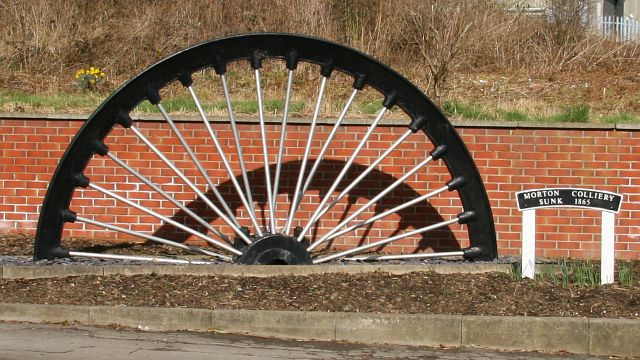
The mining history in this record
William Henry Copson was born at Stonebroom, Derbyshire, on 27 April 1908, in a village made by the coal boom. Morton Colliery, about a mile away, had been opened by the Clay Cross Company in 1865, and by 1896 nearly six hundred men worked underground at its two shafts. His father worked for the Clay Cross Company, and in 1922, at fourteen, Bill started at the colliery, the only real employer in the district. Hewing by hand built the long, powerful arms that later served his bowling.
He took no interest in cricket until the General Strike of 1926. With the pits idle, fellow miners persuaded him to join their games on the local recreation ground, and his pace and straightness showed at once. The next season he had a place in the Morton Colliery team. From there he went to Clay Cross in the Derbyshire League, and Derbyshire engaged him in 1932. He and his county colleague Tommy Mitchell are probably the only first-class cricketers, and certainly the only Test cricketers, who owe the start of their careers entirely to the 1926 strike.
People
Bill Copson; Tommy Mitchell of Creswell Colliery, the other Derbyshire bowler made by the 1926 strike; Kit Bartlett, his biographer.
Legacy today
Copson took a wicket with his first ball in first-class cricket and became the spearhead of the Derbyshire side that won the County Championship in 1936, taking 140 Championship wickets that year at under 13 each. In 1937 he took 8 for 11 against Warwickshire, including five wickets in six balls. He played three Tests for England, in 1939 and 1947, took 1,094 first-class wickets, and was a first-class umpire from 1958 to 1967. He died at Clay Cross in 1971.
Recorded claims
Individual factual claims, each tagged with how solidly it's grounded and attached to the source(s) that support it. Where sources disagree, both are kept.
- Bill Copson started work at Morton Colliery at the age of fourteen, in 1922. (documented fact) 1
- He took no interest in cricket until the 1926 General Strike, when fellow miners persuaded him to play on the local recreation ground. (later recollection) 1,2
- The following season he was given a place in the Morton Colliery team, and went on to Clay Cross and then Derbyshire in 1932. (documented fact) 2
- Copson and Tommy Mitchell are probably the only first-class cricketers, and certainly the only Test cricketers, whose careers began entirely because of the 1926 strike. (later recollection) 1,2
- Morton Colliery was opened by the Clay Cross Company in 1865 and by 1896 employed nearly six hundred men underground at its two shafts. (documented fact) 1
- Copson took 140 Championship wickets in Derbyshire's title season of 1936 and 1,094 first-class wickets in all, and played for England in 1939 and 1947. (documented fact) 2
Mines
- Morton Colliery — Derbyshire
Bill Copson worked at Morton Colliery from the age of fourteen and first played cricket during the 1926 strike, joining the Morton Colliery team the next season.
Real-world mining concepts used here
Related Culture records
- Tommy Mitchell and Creswell Colliery
Tommy Mitchell of Creswell Colliery, the other Derbyshire and England bowler whose career began with the 1926 strike.
Sources
- (secondary) Lives in Cricket No 6: Bill Copson (Kit Bartlett, Association of Cricket Statisticians and Historians) — Association of Cricket Statisticians and Historians
- (secondary) Bill Copson (Wikipedia) — Wikipedia
Record created: 6 November 2026 · Last researched: 6 November 2026