 MineArchive
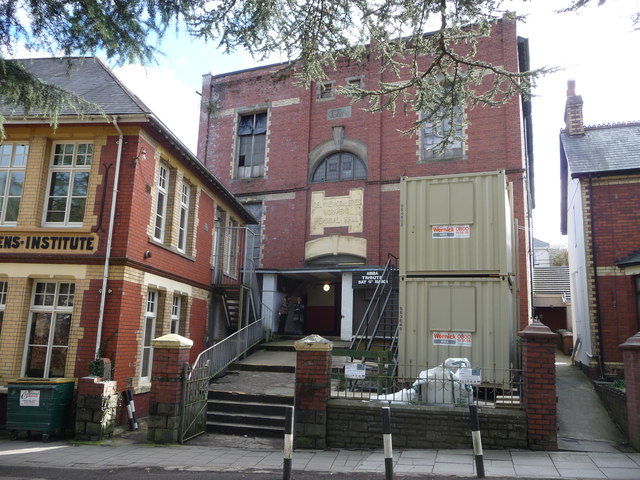
Celynen Collieries' Workmen's Institute and Memorial Hall
| Category | Learning |
|---|---|
| Dates | Miners' committee formed 1898; site bought for £300; Institute opened 21 April 1908; Memorial Hall opened 1924 or 1925; Celynen collieries closed mid-1980s; listed by Cadw 2003; Friends of Newbridge Memo formed 2004; BBC Restoration 2004; Institute reopened 2013 |
An institute and memorial hall at Newbridge in the Ebbw valley, built and paid for by the miners of the Celynen collieries themselves rather than by the owners, and now a restored listed building with an Art Deco cinema whose walls are painted with miners at work.
The mining history in this record
In 1898 a group of miners from the Celynen collieries formed a committee to improve the social conditions of their fellow workers. The colliery owner let them use rooms rent-free in the Coffee Tavern at the top of Main Street, and they met for a time in the Beaufort Arms, but they wanted something of their own. They bought a freehold site in the town centre for £300 and took out a mortgage for building costs approaching £6,000 — a bold thing for men earning about £3 a week and mostly renting their homes.
The Celynen Collieries Workmen's Institute was designed by a local architect, Richard Lewis Roberts of Abercarn, built by Charles F. Morgan of Newbridge, and opened on 21 April 1908 by John Beynon, the owner of the Celynen colliery. Inside were a library, a reading room, a billiards room with four tables, a hall for about 350 people and a separate room for the officials of the Miners' Federation. What makes the building unusual in the South Wales coalfield is who built it: most institutes were put up by colliery owners, or later out of the Miners' Welfare Fund, with the men's contributions stopped from their pay. This one the miners raised themselves.
After the First World War the town resolved on a memorial to the 75 Newbridge men who had not come home. The adjoining Memorial Hall, built under the architect E. D. T. Jenkins by the contractor Ewart Evans at a cost of about £10,000, gave the institute a picture house and stage above and a dance hall and dressing rooms below. Local people called it the Memo. Its cinema seated around 700, and the walls carry paintings of industrial scenes with miners working underground — decoration unlike anything else in the picture palaces.
People
The 1898 committee, among whom W. N. Jones, V. Phillips, H. Badge and H. J. Thomas were central to securing the site; Richard Lewis Roberts of Abercarn, architect of the Institute, and Charles F. Morgan of Newbridge, its builder; E. D. T. Jenkins, architect of the Memorial Hall, and Ewart Evans, its contractor; John Beynon, owner of the Celynen colliery, who opened the Institute in 1908; Don Touhig MP, whose public meeting formed the Friends of Newbridge Memo in 2004.
Legacy today
The Celynen collieries closed in the mid-1980s and the institute declined into a drinking club, bankrupt by 2003. Cadw listed the buildings — the Institute Grade II and the Memorial Hall Grade II*, its citation calling the cinema auditorium unusually high quality and exceptionally well preserved — and in 2004, when the council was considering buying the land for a car park, a public meeting called by the local MP Don Touhig formed the Friends of Newbridge Memo. The building appeared on the BBC series Restoration that summer, narrowly missed winning, and went on to raise money from the Heritage Lottery Fund, the Big Lottery, the European Union and the Welsh Government. The Institute reopened in 2013 after renovation, and the Art Deco auditorium followed.
Between the wars the Memo was a theatre where E. Eynon Evans produced Ibsen's Ghosts with Donald Houston in the cast, and from the 1930s a music hall; from the mid-1970s it was a rock venue that took Dire Straits, Iron Maiden, Motörhead and The Stranglers. Its auditorium has since stood in for other places on screen, in Doctor Who, Sherlock and the Netflix series Sex Education.
Recorded claims
Individual factual claims, each tagged with how solidly it's grounded and attached to the source(s) that support it. Where sources disagree, both are kept.
- The Institute was built and paid for by the miners of the Celynen collieries, who bought the site and took out a mortgage of nearly £6,000, where most institutes in the coalfield were built by the colliery owners. (documented fact) 1,2
- Miners from the Celynen collieries formed an association in 1898 to improve their education and recreation, meeting at first in rooms lent rent-free in the Coffee Tavern. (documented fact) 3,1
- The Institute, designed by Richard Lewis Roberts of Abercarn and built by Charles F. Morgan of Newbridge, opened on 21 April 1908 and was opened by John Beynon, owner of the Celynen colliery. (documented fact) 3,1
- It contained a library, a reading room, a billiards room with four tables, a hall for about 350 people and a room for the officials of the Miners' Federation. (documented fact) 1
- The adjoining Memorial Hall, to the 75 Newbridge men killed in the First World War, opened in 1924. (documented fact, disputed) 3,2
- The adjoining Memorial Hall opened in 1925. (documented fact, disputed) 1
- The cinema auditorium, seating about 700, carries wall paintings of industrial scenes showing miners working underground, and keeps its carbon arc projectors, ticket booth and dressing rooms. (documented fact) 2
- The Friends of Newbridge Memo were formed in 2004 after a public meeting called by the local MP Don Touhig, the building featured on the BBC series Restoration that year, and the Institute reopened in 2013. (documented fact) 3,1
Mines
- Celynen Colliery — Caerphilly
The institute was built by the workmen of the Celynen collieries and carries their name; the colliery's owner John Beynon opened it in 1908.
Real-world mining concepts used here
Sources
- (secondary) Celynen Collieries Workmen's Institute, Newbridge — History Points
- (secondary) Newbridge Memo: heritage — Newbridge Memo (Friends of Newbridge Memo)
- (secondary) Workingman's Institute and Memorial Hall, Newbridge — Wikipedia
Record created: 18 September 2026 · Last researched: 24 September 2026