 MineArchive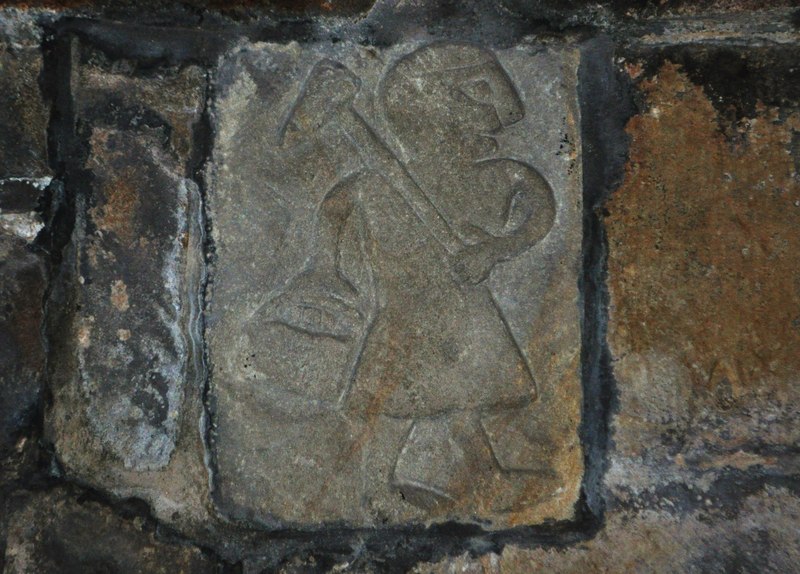
T'Owd Man of Bonsall
| Category | Folklore |
|---|---|
| Dates | Found during restoration of St James' Church, Bonsall, 1862-63; kept as a garden ornament by churchwarden John Broxup Coates; built into St Mary's Church, Wirksworth, between 1870 and 1874 |
A carved relief of a lead miner, possibly Anglo-Saxon or medieval in origin, rescued from one Derbyshire parish church and built into the fabric of another in the 1870s — remembered in local folklore not just as an image of a miner but as a guardian spirit of the mines themselves.
The mining history in this record
During the 1862-63 restoration of St James' Church in Bonsall, Derbyshire, workmen found several carved stones, including the figure now known as T'Owd Man, built into the fabric of the building — almost certainly reused as ordinary building material when the 14th-century church was constructed, taken from a still-earlier building on or near the site. The relief shows a lead miner carrying his pick in one hand and his 'kibble', a workman's basket, in the other. Its true age is disputed: estimates range from the Anglo-Saxon period to as late as the 1200s, and it is often simply described as 'at least 800 years old'; some have gone further and suggested a link to the Roman-era lead mining known to have taken place in Derbyshire, though that claim is speculative rather than established.
The churchwarden at Bonsall, John Broxup Coates, kept the carved stones safe in the garden of his home, Nether Green House, according to an 1875 account by the antiquarian Reverend J.C. Cox. William Marsh, a Bonsall man who had moved to the neighbouring town of Wirksworth, later rescued the figure from its garden setting. Between 1870 and 1874, while Wirksworth's own church, St Mary's, was undergoing restoration under churchwarden George Marsden, T'Owd Man was built into an internal wall of the church's south transept, where it remains today.
People
John Broxup Coates, churchwarden of Bonsall, who preserved the carved stones in his own garden; William Marsh, the Bonsall-born Wirksworth resident who rescued the figure; George Marsden, churchwarden of Wirksworth during the 1870s restoration that gave it its current home; Reverend J.C. Cox, whose 1875 account is the earliest documented record of the figure's rescue.
Legacy today
T'Owd Man is sometimes described as the world's earliest surviving depiction of a miner. Beyond its historical interest, the figure carries a genuine folklore dimension: in local tradition it is regarded not merely as a historical carving but as a guardian spirit of the ancient lead mines of the district, a belief distinct from, though related to, the wider 'knockers'/spirit traditions found in other British mining regions. St Mary's Church, Wirksworth, remains open to visitors most days, alongside several other carved stones recovered from the same restoration.
Recorded claims
Individual factual claims, each tagged with how solidly it's grounded and attached to the source(s) that support it. Where sources disagree, both are kept.
- The carved stones, including the figure now known as T'Owd Man, were found built into the fabric of St James' Church, Bonsall, during its 1862-63 restoration, likely reused as building material from an earlier structure. (documented fact) 1
- The carving's true age is disputed, with estimates ranging from the Anglo-Saxon period to as late as the 1200s; it is commonly described as at least 800 years old. (documented fact, disputed) 1
- Bonsall churchwarden John Broxup Coates kept the carved stones in the garden of his home, Nether Green House, according to an 1875 account by Reverend J.C. Cox. (contemporary account) 1
- William Marsh, a Bonsall-born resident of Wirksworth, rescued the figure, which was built into an internal wall of St Mary's Church, Wirksworth, between 1870 and 1874 during that church's own restoration under churchwarden George Marsden. (documented fact) 1
- Beyond its historical interest as a carving, T'Owd Man is regarded in local tradition as a guardian spirit of the district's ancient lead mines. (tradition/folklore) 1
- The figure is sometimes described as the world's earliest surviving depiction of a miner, though this is a characterisation rather than a formally established record. (unverified claim, uncertain) 2
Real-world mining concepts used here
Sources
- (secondary) The history of T'Owd Man in Wirksworth — Great British Life (Derbyshire)
- (secondary) Meet T'owd Man ~ AKA The Old Man Of Wirksworth — Tish Farrell (local history blog, citing Reverend J.C. Cox)
Record created: 28 August 2026 · Last researched: 28 August 2026