 MineArchive
Knotlow Mine
| Location | Monyash, Derbyshire — 53.2039, -1.7866 (exact) |
|---|---|
| Commodity | Lead |
| Type | Metal |
| Worked | at least 1702–later 19th century |
| Maximum depth | Unknown. |
Overview
A lead mine hand-worked through solid limestone near Monyash, combining the shallow Whalf Pipe vein near its entrance with the deeper Crimbo vein, and now part of a well-known caving system.
History
Knotlow is documented working lead from at least 1702 through to the latter half of the 19th century, worked first along the Whalf Pipe vein near the entrance and later into the deeper Crimbo vein. Both horse-powered whims and steam engines were used at different periods to raise ore and water from the workings, with dedicated engine houses built to house the machinery. Long low 'coffin levels' were driven to extract ore from confined seams, alongside hand-picked climbing shafts and larger engine shafts. Knotlow is one half of a pair: the Whalf Pipe surfaces at Hillocks Mine a few hundred metres away, an early and easily worked mineralised cavern with its own horse gin, engine shaft and climbing shaft and evidence of firesetting in its upper workings, and the two sets of workings are now treated as a single system. Caving clubs still descend it by the Climbing Shaft, rigging the last pitch into Waterfall Chamber to keep clear of the water.
Geology
The mine follows lead-bearing veins and pipe deposits through solid Carboniferous limestone, combining natural cavern passages with worked veins across several interconnected levels.
Workings
Access includes hand-picked climbing shafts, engine shafts, and a series of coffin levels — long, narrow, low passages suited to confined seams — connecting the shallower Whalf Pipe workings to the deeper Crimbo vein.
Closure
Working ended in the latter half of the nineteenth century.
What remains
Now part of the wider Knotlow/Hillocks cave and mine system, still actively visited by caving clubs; conditions can include polluted water and localised bad air, with carbon dioxide build-up reported in the lower workings on occasion.
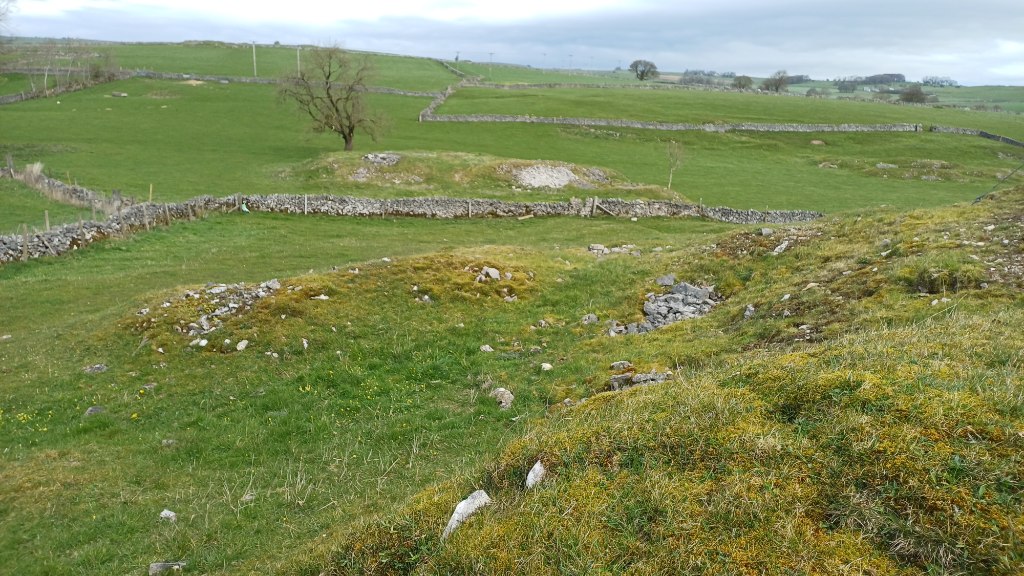
Two surviving gin circles (horse-whim hoisting platforms), a ruined protective wall, possible coe (miners' hut) remains, and the ruins of two steam engine houses with a chimney base survive at one shaft location.
Related mines
- Hillocks Mine — The two are one set of workings underground: the Historic Environment Record treats them as the Crimbo and Whalf Pipe mines, now generally known together as Hillocks and Knotlow, and caving parties go in at one and out at the other.
Nearby mines
- Hillocks Mine — 0.2 miles (0.3 km) SE
- Hubberdale Mines — 1.3 miles (2.1 km) N
- Lathkill Dale Mine — 1.6 miles (2.6 km) SE
- Magpie Mine — 1.9 miles (3.1 km) E
- True Blue Mine — 2.2 miles (3.5 km) E
Straight-line distance, within 9 miles (15 km). Show on the map.
Recorded claims
Individual factual claims, each attached to the source(s) that support it below. Where sources disagree, both are kept.
- The system is known among cavers for occasional polluted water and bad air, with carbon dioxide build-up reported in the lower workings severe enough to curtail trips. 1
- The Derbyshire Historic Environment Record lists two gin circles, a ruined protecting wall, two possible ruined coes, a chimney base on one shaft hillock and the stonework of two demolished steam engine houses, the site centred on SK 143 674 and covering roughly 370 by 360 metres. 2
- The Peak District Mines Historical Society's 1969 plan of Knotlow Cavern in relation to the mine shafts, with a small surface plan (society reference C135), is held by the British Geological Survey as MP26746. 3
- Cavers rig the Climbing Shaft and use passages named Meccano Passage, Pearl Chamber, Chain Passage to the 210 Shaft and Waterfall Chamber; Meccano Passage was once reached by a long signal-box ladder from the foot of Waterfall Chamber. 1
- The Derbyshire HER records Hillocks Mine, centred at SK 145 672, as the lead mine where one of the Whalf pipes surfaces, probably an early mine since it is an easily worked mineralised cavern, with coffin levels, pick marks, a horse gin, an engine shaft and a climbing shaft, and evidence of firesetting in its upper workings; the underground features now known as Hillocks and Knotlow Mines include pipe and vein workings, hand-picked climbing shafts, larger engine shafts and fine examples of coffin levels and later access levels. 4
- A Dudley Caving Club party of five entered Knotlow Cavern by the Climbing Shaft on 28 March 2015 on a single-rope-technique training trip, rigging the bolts into a traverse line at the final pitch into Waterfall Chamber to descend clear of the water, before crossing to Hillocks for an exchange trip. 5
Sources
- (observational) Knotlow/Crimbo Mine — Technical Speleological Group
- (secondary) Knotlow Mine
- (primary) Knotlow Mine Plan (BGS, MP26746) — British Geological Survey / Peak District Mines Historical Society
- (primary) Hillocks Mine, Monyash (Derbyshire HER, MDR1250) — Derbyshire Historic Environment Record
- (observational) Knotlow Cavern and Hillocks Mine, trip report, 28 March 2015 (Dudley Caving Club) — Dudley Caving Club
Record created: 22 August 2026 · Last researched: 24 September 2026