 MineArchive
William Pit Explosion, 1941
A genuinely unusual disaster: water gas, produced when water was poured onto glowing coal in a sealed-off fire area at William Pit, accumulated in a confined space and exploded, killing twelve.
| Date | 3 June 1941 |
|---|---|
| Mine | William Pit |
| Region | Cumbria |
| Type | Explosion |
| Fatalities | 12 (Twelve men died: Sydney Barbour (21, junction hand), Robert Baxter (55, coal filler), John Peter Burney (21, haulage hand), Jonathan Curwen, James George, William Ernest Harker, Charles James Martin, Robert McCreavy, Cornelius Moore, William Perry and James Wells, plus one further victim not separately named; a further four men were fatally injured.) |
| Context | During active mining |
Cause
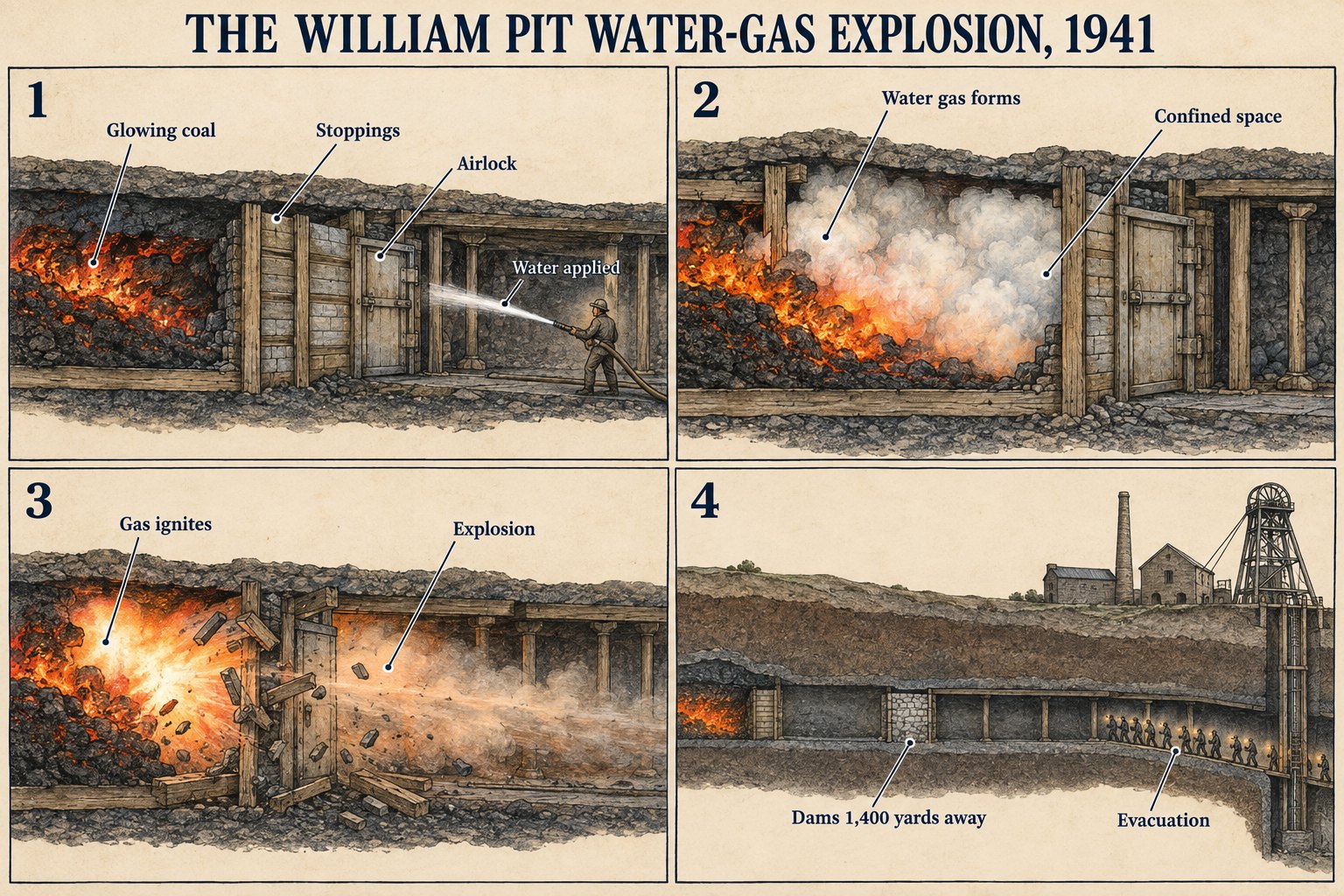
Workers had been pouring water onto exposed, glowing coal as part of fire-suppression efforts in a sealed-off area of the mine. The chemical reaction between water and burning carbon produced inflammable water gas, which accumulated in a confined space between stoppings and an airlock — the Chief Inspector estimated around 700 cubic feet of gas would have been needed to create an explosive atmosphere in the space available — until it ignited.
What happened
On 3 June 1941, an explosion at William Pit killed twelve men outright, with a further four fatally injured. The cause was genuinely unusual: rather than an ordinary firedamp ignition, the explosion resulted from water gas — produced by the chemical reaction between water and burning carbon — after workers poured water onto exposed, glowing coal as part of efforts to suppress a fire in a sealed-off area of the mine. The resulting inflammable gas accumulated in a confined space between stoppings and an airlock until it exploded. Evacuation began immediately after the 2:15pm blast; by 4pm all survivors were either on the surface or being brought up, and recovery of the dead was completed by 9pm the same day. The affected area was sealed off by constructing dams around 1,400 yards from the fire.
Rescue & recovery
Evacuation began immediately after the 2:15pm explosion; by 4pm all survivors were on the surface or in transit there, and recovery of the dead was completed by 9pm the same day. The fire area was subsequently sealed by dams built around 1,400 yards away.
Investigation & inquiry
HM Inspector F. H. Wynne investigated and concluded the explosion was distinctly unusual, 'not associated with normal operations' and 'not one of firedamp but of inflammable gas produced by the application of water' to burning coal — a mechanism he recommended further research into, to prevent similar water gas explosions elsewhere.
Changes to practice & legislation
HM Inspector Wynne's recommendation for further research into water gas explosions followed directly from this disaster's genuinely unusual cause.
Recorded claims
Individual factual claims, each attached to the source(s) that support it below. Where sources disagree, both are kept.
- Twelve men died, including Sydney Barbour, Robert Baxter, John Peter Burney, Jonathan Curwen, James George, William Ernest Harker, Charles James Martin, Robert McCreavy, Cornelius Moore, William Perry and James Wells; a further four men were fatally injured. 1
- The explosion resulted from water gas, produced by the chemical reaction between water and burning carbon after workers poured water onto glowing coal in a sealed-off fire area; the gas accumulated in a confined space until it ignited. 2
- HM Inspector F. H. Wynne concluded the explosion was distinctly unusual, not associated with normal mining operations, and recommended further research into preventing water gas explosions. 2
Related terminology
Mining terms this disaster is structurally linked to, with the nature of the relationship.
- Coal (contextual relationship)
Named 4 times in this record, first in the summary: “…disaster: water gas, produced when water was poured onto glowing coal in a sealed-off fire area at William Pit, accumulated in a confined…” - Firedamp (contextual relationship)
Although caused by water gas rather than ordinary firedamp, the explosion is of the same general hazard class this term describes — an inflammable underground gas accumulation. - Stopping (contextual relationship)
Named twice in this record, first in the cause: “…inflammable water gas, which accumulated in a confined space between stoppings and an airlock — the Chief Inspector estimated around 700 cubic feet…”
Sources
- (primary) William Colliery, Whitehaven — Durham Mining Museum — Durham Mining Museum
- (primary) William Pit Explosion — Whitehaven — 1941 — Northern Mine Research Society
Record created: 25 August 2026 · Last researched: 2 September 2026