 MineArchive
Queen Pit Explosion, 1869
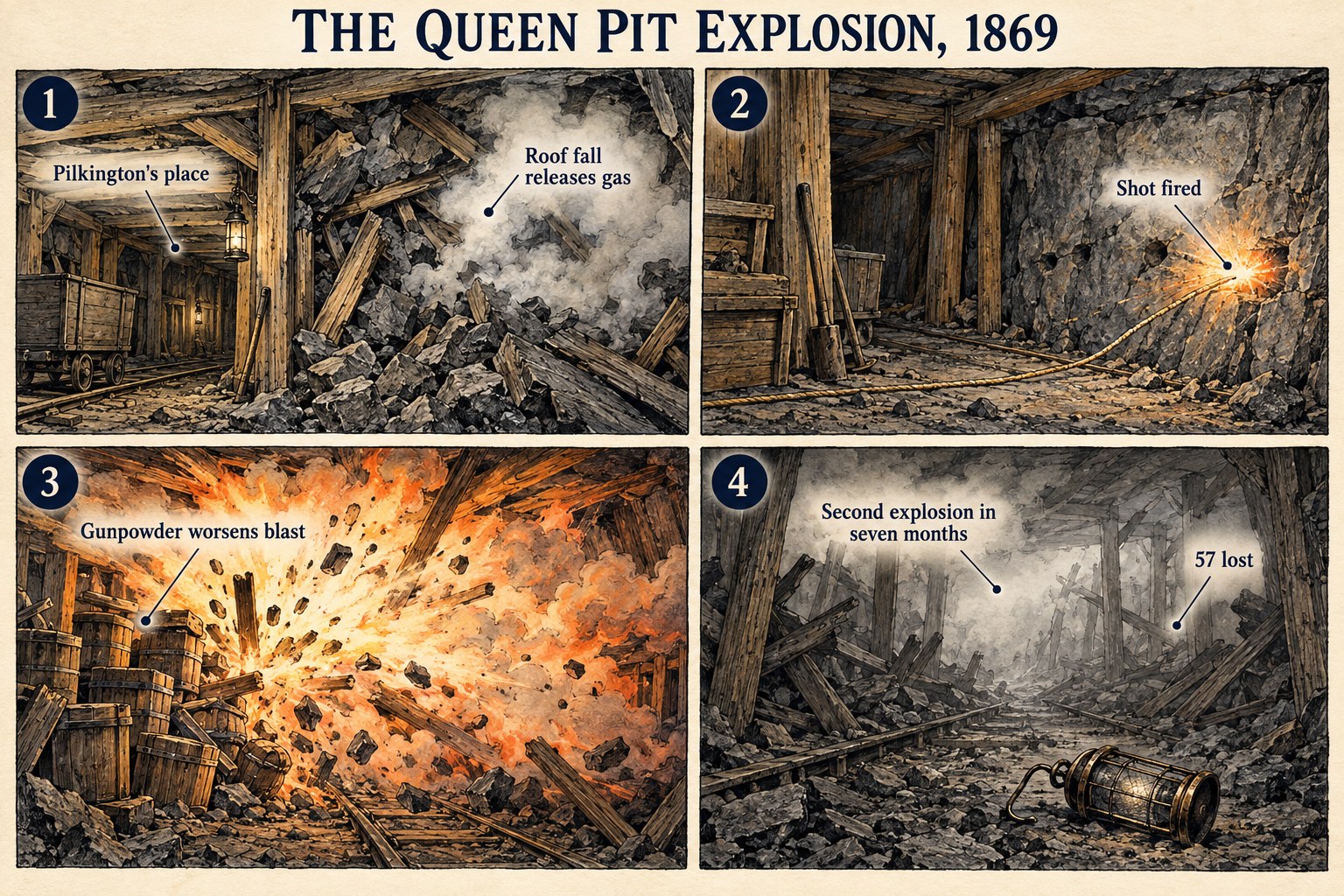
A second, much larger explosion at Haydock's Queen Pit, less than seven months after the December 1868 explosion at the same pit, killed 56-57 men and boys after a shot ignited firedamp released by a roof fall in a working known as Pilkington's place.
| Date | 21 July 1869 |
|---|---|
| Mine | Haydock Colliery |
| Region | Lancashire |
| Type | Explosion |
| Fatalities | 57 (56 men and boys killed outright, plus one survivor who died on the way to hospital, bringing the total to 57.) |
| Context | During active mining |
Cause
A jury found that firedamp, released by a fall of ground in a working known as Pilkington's place, was ignited by a shot; the presence of quantities of gunpowder in the mine was found to have made the resulting explosion worse.
What happened
Work had continued at Haydock's Queen Pit in the months following the pit's earlier explosion in December 1868 (see Queen Pit Explosion, 1868). On 21 July 1869, a second explosion — far larger than the first — tore through the pit, killing 56 men and boys outright; a further survivor died on the way to hospital, bringing the final toll to 57. A fall of ground in a working known as Pilkington's place released a body of firedamp, which was then ignited by a shot; the coroner's jury found that quantities of gunpowder present in the mine had made the resulting explosion significantly worse than it might otherwise have been.
Investigation & inquiry
A coroner's inquest jury found that firedamp released by a roof fall at Pilkington's place had been ignited by a shot, and that gunpowder stored or in use in the mine had aggravated the explosion.
Memorials & commemoration
No dedicated memorial to this specific accident is known; the men are likely among those commemorated at the general Haydock Colliery memorial at St James the Great church.
Recorded claims
Individual factual claims, each attached to the source(s) that support it below. Where sources disagree, both are kept.
- The December 1868 Queen Pit explosion had already killed around two dozen men at the same pit; work continued there afterward until this second, much larger explosion on 21 July 1869. 1
- 56 men and boys were killed outright, with a further survivor dying on the way to hospital, bringing the total to 57. 1
- A fall of ground in a working known as Pilkington's place released firedamp, which was ignited by a shot; a coroner's jury found that gunpowder present in the mine had made the resulting explosion worse. 1
- The Queen Pit was part of the wider Haydock Collieries complex operated by Richard Evans and Company at the time of both the 1868 and 1869 explosions. 2
Related terminology
Mining terms this disaster is structurally linked to, with the nature of the relationship.
- Colliery (contextual relationship)
Named in this record’s memorials: “…the men are likely among those commemorated at the general Haydock Colliery memorial at St James the Great church.” - Firedamp (direct cause)
The explosion was caused by firedamp, released by a roof fall, being ignited by a shot. - Roof Fall (contributing factor)
A fall of ground (roof fall) at Pilkington's place released the firedamp that was then ignited.
Sources
- (primary) Haydock Colliery Queen Pit Explosion — Haydock — 1869 — Northern Mine Research Society
- (secondary) Haydock Collieries — Wikipedia — Wikipedia
Record created: 2 September 2026 · Last researched: 2 September 2026