 MineArchive
Manvers Main Colliery explosion, 1945
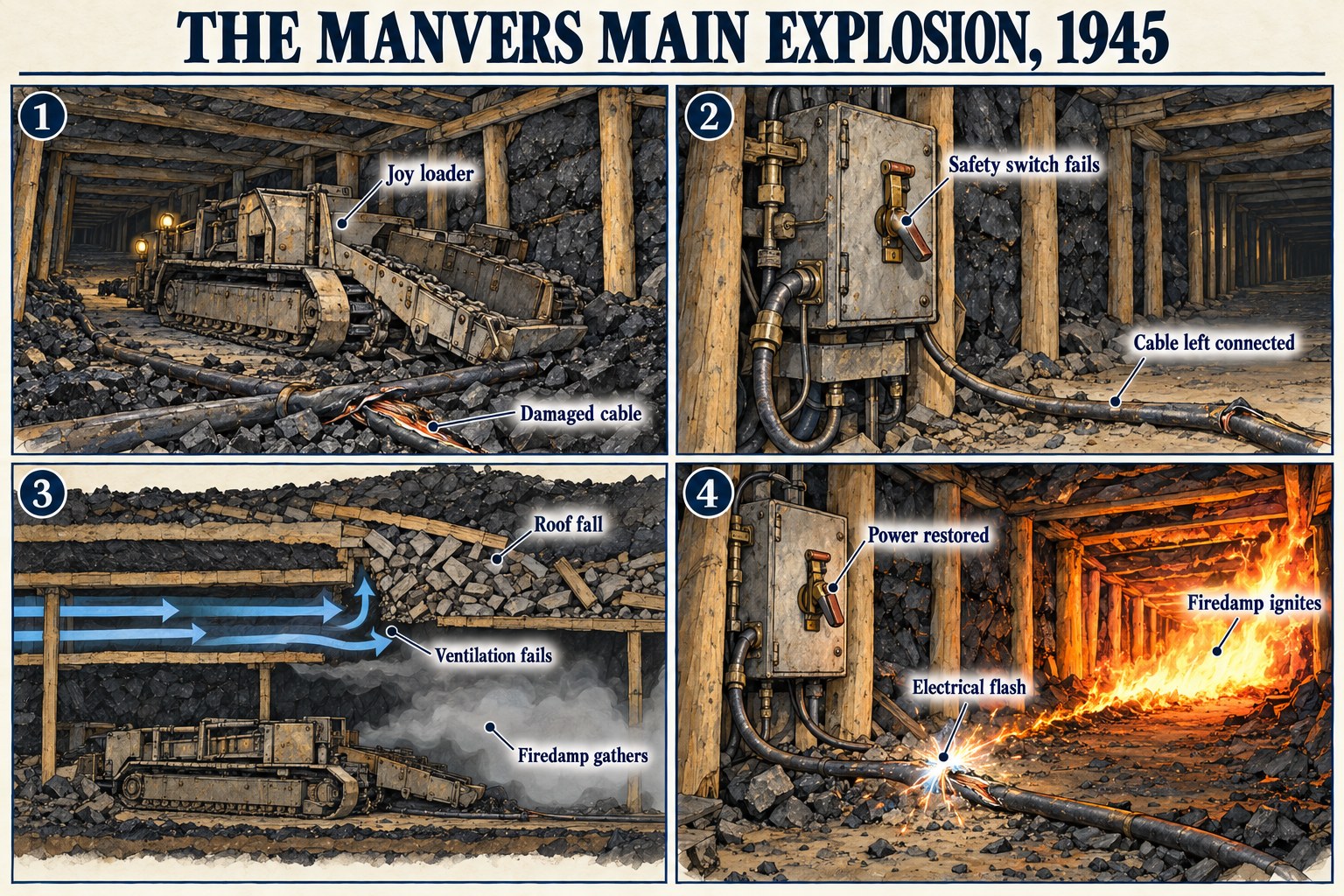
A firedamp explosion in the Meltonfield seam at Manvers Main Colliery on 4 March 1945 killed five men after a damaged power cable, left connected and re-energised, ignited gas that had escaped past a ventilation failure.
| Date | 4 March 1945 |
|---|---|
| Mine | Manvers Main Colliery |
| Region | South Yorkshire |
| Type | Explosion |
| Fatalities | 5 (5 dead is confirmed by NMRS's dedicated disaster page, with all five named.) |
| Injuries | No additional injuries beyond the five fatalities are recorded. |
| Context | During active mining |
Location
Plotted at Manvers Main Colliery. Recorded location. The large pin is the mine; the small round markers are the nearest mines on record. Click one for its page. View on full map
Cause
A trailing cable to a Joy loading machine had been damaged on the previous shift, exposing its core and creating an earth leakage. The cable was still connected to the switch box, and when the power was inadvertently restored, the electrical flash ignited firedamp that had gathered from an unascertained source.
Contributing factors
The inquiry found several failures, each compounding the others: an automatic safety switch that should have tripped on the earlier earth leakage did not; firedamp had accumulated from an unascertained source, possibly worked-out seams below; and ventilation had failed, possibly due to a roof fall obstructing airflow. About 200 men were underground in the Meltonfield seam district at the time.
What happened
The five men killed were Raymond Kelsey, John Ollett, John Kelsey, Bertram John Conroy and Charles Edward Leeman. The explosion struck a district where the Meltonfield seam ran three feet nine inches thick, with a shale roof and fireclay floor.
Investigation & inquiry
The inquiry concluded the explosion was one of firedamp, with the electrical flash from the damaged cable as the igniting medium. It recommended improved ventilation monitoring and called for collieries to establish formal procedures for auxiliary fan operation and periodic air-measurement recording.
Changes to practice & legislation
The inquiry recommended formal procedures for auxiliary fan operation and periodic air-measurement recording.
Recorded claims
Individual factual claims, each attached to the source(s) that support it below. Where sources disagree, both are kept.
- Five men died: Raymond Kelsey, John Ollett, John Kelsey, Bertram John Conroy and Charles Edward Leeman. 1,2
- A damaged trailing cable to a Joy loading machine, left connected to the switch box, produced a flash when power was restored, igniting accumulated firedamp; an automatic safety switch failed to trip on the earlier earth leakage. 2
- The inquiry recommended improved ventilation monitoring and formal procedures for auxiliary fan operation and periodic air-measurement recording. 2
Related terminology
Mining terms this disaster is structurally linked to, with the nature of the relationship.
- Colliery (contextual relationship)
Named in this record’s summary: “A firedamp explosion in the Meltonfield seam at Manvers Main Colliery on 4 March 1945 killed five men after a damaged power cable, left…” - Firedamp (contextual relationship)
Named 4 times in this record, first in the summary: “A firedamp explosion in the Meltonfield seam at Manvers Main Colliery on 4…” - Roof Fall (contextual relationship)
Named in this record’s contributing factors: “…seams below; and ventilation had failed, possibly due to a roof fall obstructing airflow. About 200 men were underground in the…”
Sources
- (secondary) Manvers Main Colliery — Wikipedia
- (secondary) Manvers Main Colliery Explosion - Wath-on-Dearne - 1945 — Northern Mine Research Society
Record created: 27 August 2026 · Last researched: 27 August 2026