 MineArchive
Lofthouse Colliery disaster, 1973
About three million gallons of water burst into the South 9B district of Lofthouse Colliery from abandoned 19th-century workings in the early hours of 21 March 1973, killing seven men. Only one body was ever recovered.
| Date | 21 March 1973 |
|---|---|
| Mine | Lofthouse Colliery |
| Region | West Yorkshire |
| Primary type | Flooding / Inundation |
| Associated types | Entrapment |
| Fatalities | 7 (Charles Cotton (49), whose body was recovered on 26 March, and six men never found: Frederick William Armitage (41), Colin Barnaby (36), Frank Billingham (48), Sydney Brown (36), Edward Finnegan (40) and Alan Haigh (30).) |
| Context | During active mining (A night-shift inrush at a working colliery.) |
Cause
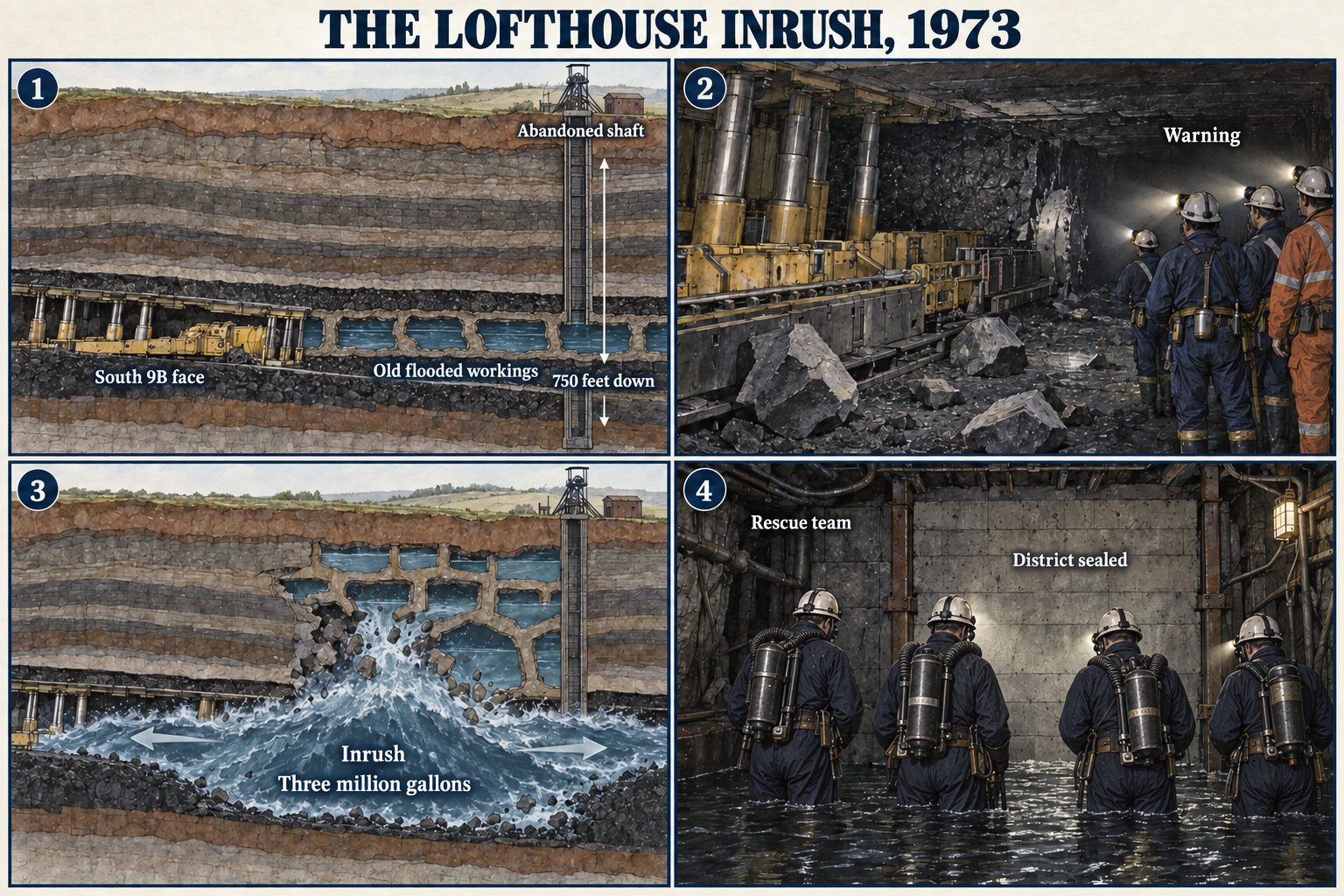
A new coalface was driven too close to flooded, abandoned 19th-century workings in the Flockton Thin seam, connected to the shafts of the long-defunct Old Low Laithes Colliery, and broke into them.
Contributing factors
The National Coal Board's surveyors knew where the old shaft was but believed it shallower than the modern workings. British Geological Survey records showed it reached the same depth; the Board had not consulted them. Warning signs in the days and hours beforehand were not acted on.
What happened
Men working the South 9B face noticed something wrong at about two o'clock in the morning, when large stones began appearing in the main gate, and shut the equipment down. The inrush that followed was sudden and violent, water driving along the face in both directions. Seven men were in its path, roughly 750 feet below the surface, and the inquiry concluded they were probably killed instantly. The water had been sitting in abandoned workings of the Flockton Thin seam, connected to shafts sunk in the previous century for a colliery that had been out of use so long its plans were an antiquarian curiosity rather than an operational document. In a field nearby three holes about nine feet across opened up: the heads of the old Bye Pit, Bull Pit and Engine Pit shafts.
Rescue & recovery
Rescue teams went in and worked for six days against high methane concentrations and debris blocking both access roads. They recovered one man, Charles Cotton. Men worked in shifts to clear by hand a 'piggy-back' tunnel along the roof of the flooded roadway, and the Allerton Bywater rescue crew was among the teams. After six days the rescue was turned into a recovery, partly at the urging of Sid Haigh, a rescuer whose own son was among the trapped, who told a public meeting it was pointless to risk more lives. The remaining six were never found, and the district was eventually sealed.
Investigation & inquiry
A government inquiry sat in May 1973. It found the disaster was caused by the inrush from old workings, that the NCB had failed to make adequate enquiry into the historical records that would have revealed the danger, and that warning signs preceding the inrush had not been properly investigated. Arthur Scargill, then a compensation agent for the Yorkshire NUM, produced 19th-century mining notebooks at the inquiry to demonstrate that the information had been available all along.
Changes to practice & legislation
The disaster led directly to the Mines (Precautions Against Inrushes) Regulations, which require examination of records held by the Natural Environment Research Council relevant to proposed workings, and diligent enquiry into any other available sources of information. Sources date the regulations to 1978 and to 1979.
Memorials & commemoration
The seven men are commemorated at Lofthouse Colliery Nature Park, on the site of the pit. A seven-sided stone obelisk naming all seven stands in the Lofthouse Memorial Garden on Batley Road, Wrenthorpe, above the ground where six of them are believed to lie, and streets in Wakefield are named after them; the anniversaries are marked there and at the pit wheel on the colliery site.
What's uncertain
Points where sources disagree or the record could not be settled; both accounts are kept. All open questions in the archive.
- The Mines (Precautions Against Inrushes) Regulations that followed are dated 1979. (disputed) 2
- The same regulations are dated 1978 elsewhere. (disputed) 1
Recorded claims
Individual factual claims, each attached to the source(s) that support it below. Where sources disagree, both are kept.
- The inrush came from flooded abandoned workings in the Flockton Thin seam, connected to shafts of the long-defunct Old Low Laithes Colliery. 1
- Seven men died. Charles Cotton (49) was recovered on 26 March; Frederick William Armitage, Colin Barnaby, Frank Billingham, Sydney Brown, Edward Finnegan and Alan Haigh were never found. 1
- Large stones began appearing in the main gate at about 2 a.m. and equipment was shut down shortly before the inrush, which drove water along the face in both directions. 1
- NCB surveyors knew the old shaft's position but underestimated its depth, and did not check British Geological Survey records which showed it reached the depth of the modern workings. 2
- The Mines (Precautions Against Inrushes) Regulations that followed are dated 1979. (disputed) 2
- The same regulations are dated 1978 elsewhere. (disputed) 1
- When the South 9B face broke into the old workings, three holes about nine feet across opened in a nearby field: the heads of the old Bye Pit, Bull Pit and Engine Pit shafts. 3
- The rescue was turned into a recovery after six days, partly at the urging of Sid Haigh, a rescuer whose own son was among the trapped men; teams including the Allerton Bywater rescue crew had cleared a tunnel by hand along the roof of the flooded roadway. 3,4
- Six of the men are believed to lie beneath the Lofthouse Memorial Garden on Batley Road, Wrenthorpe, where a seven-sided obelisk names all seven; streets in Wakefield are named after them. 3,4
Related terminology
Mining terms this disaster is structurally linked to, with the nature of the relationship.
- Colliery (contextual relationship)
Named 4 times in this record, first in the summary: “…gallons of water burst into the South 9B district of Lofthouse Colliery from abandoned 19th-century workings in the early hours of 21 March…” - Gate Road (contextual relationship)
Named in this record’s narrative: “…two o'clock in the morning, when large stones began appearing in the main gate, and shut the equipment down. The inrush that followed was sudden…” - Inrush (direct cause)
The disaster is an inrush in the textbook sense: water held in abandoned workings released into a live face, with no warning beyond the stones that began falling minutes before. - National Coal Board (contextual relationship)
Named in this record’s investigation: “…the disaster was caused by the inrush from old workings, that the NCB had failed to make adequate enquiry into the historical records that…” - Shaft (contextual relationship)
An old shaft was the route the water took: the Coal Board's surveyors knew where it was but believed it shallower than their workings, and never checked the BGS records that showed otherwise.
Sources
- (primary) Lofthouse Colliery Disaster, Wakefield 1973 — Northern Mine Research Society
- (secondary) Lofthouse Colliery disaster — Wikipedia
- (secondary) 'For some it will feel like yesterday...Something like that never goes away' (Neil Hudson, on the Lofthouse disaster) — Yorkshire Post
- (secondary) Commemoration will mark 50th anniversary of Lofthouse Colliery disaster that claimed the lives of seven miners — Wakefield Express
- (primary) Mine plans NE106, NE884 and spoil heap plans NEST17: Lofthouse — British Geological Survey / Mining Remediation Authority mine plans catalogue
Record created: 24 August 2026 · Last researched: 24 August 2026