 MineArchive
Hebburn Colliery Explosion, 1814
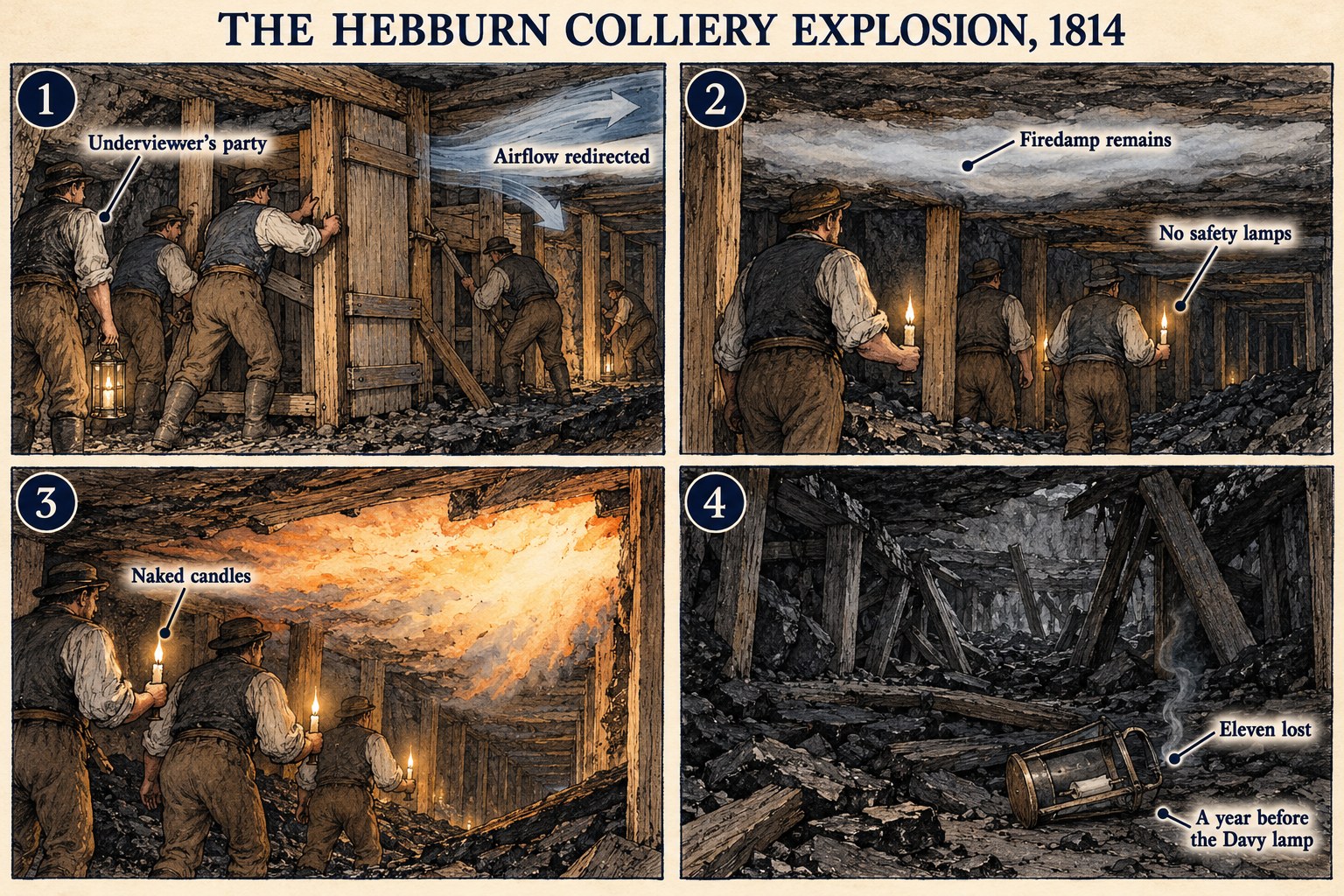
An explosion at Hebburn Colliery on 12 August 1814 killed the underviewer and ten others while they were adjusting the mine's ventilation, after not allowing enough time for firedamp to clear.
| Date | 12 August 1814 |
|---|---|
| Mine | Hebburn Colliery |
| Region | Tyne and Wear |
| Type | Explosion |
| Fatalities | 11 (11 dead: underviewer Elias Mould (37), John Dixon (38), John Rutlidge (51), John Johnson (29), Edward Marshall (25), Richard Defty (35), Robert Hepplewhite (28), George Smith, Peter Pratt (24), Robert Thackwrayferry (38), and Thomas Johnson.) |
| Context | During active mining |
Cause
The underviewer and his assistants were changing the direction of the ventilating air current and were thought not to have allowed enough time for firedamp to clear before continuing with naked candles — the pit had no safety lamps.
What happened
On 12 August 1814, underviewer Elias Mould and ten men working with him were killed when firedamp ignited as they changed the direction of the mine's ventilating air current. It was thought they had not allowed enough time for gas to clear from the affected workings before resuming with naked candles — the pit had no safety lamps at this date, a full year before Humphry Davy's invention. John Buddle, the colliery's head viewer, later testified to a Parliamentary Select Committee that there were no lamps in the pit at the time and it had been thought safe for the men to work by candlelight. Most of the dead were buried at Jarrow St Paul's Church, with one exception at Wallsend.
Investigation & inquiry
John Buddle, head viewer, testified to a Select Committee that the pit had no safety lamps and candles were thought safe to use.
Memorials & commemoration
No dedicated memorial to this specific explosion is known.
Recorded claims
Individual factual claims, each attached to the source(s) that support it below. Where sources disagree, both are kept.
- 11 men died, including underviewer Elias Mould; all individually named by NMRS. 1
- The explosion occurred while the ventilation air current was being redirected, without enough time allowed for firedamp to clear; the pit had no safety lamps and used candles. 1
- Durham Mining Museum's own colliery page independently lists this explosion on 12 August 1814 with 11 lives lost. 2
Related terminology
Mining terms this disaster is structurally linked to, with the nature of the relationship.
- Colliery (contextual relationship)
Named twice in this record, first in the summary: “An explosion at Hebburn Colliery on 12 August 1814 killed the underviewer and ten others while they…” - Firedamp (direct cause)
The explosion was caused by an ignition of firedamp underground. - Viewer (contextual relationship)
Named twice in this record, first in the narrative: “…before Humphry Davy's invention. John Buddle, the colliery's head viewer, later testified to a Parliamentary Select Committee that there were…”
Sources
- (primary) Hebburn Colliery Explosion — Hebburn — 1814 — Northern Mine Research Society
- (primary) Durham Mining Museum — Hebburn Colliery — Durham Mining Museum
Record created: 3 September 2026 · Last researched: 3 September 2026