 MineArchive
Byker Hill (Walker Pits)
| Category | Music |
|---|---|
| Dates | Printed 1812 (Rhymes of Northern Bards, no. 36); in Come All Ye Bold Miners 1952; recorded by The Young Tradition 1966 and Carthy and Swarbrick 1967. |
A Tyneside collier's song, now known as 'Byker Hill', whose earliest printed version is 'Walker Pits', song 36 in John Bell's Rhymes of Northern Bards (1812). Its chorus 'Byker Hill and Walker Shore, collier lads for ever more' and its ironic verse about coming to Walker 'wi' ne coat nor ne pit sark' until 'Walker pit's deun weel for me' tie it to the Walker Colliery east of Newcastle. Revived by A. L. Lloyd, it became a folk-revival standard through Martin Carthy and Dave Swarbrick.
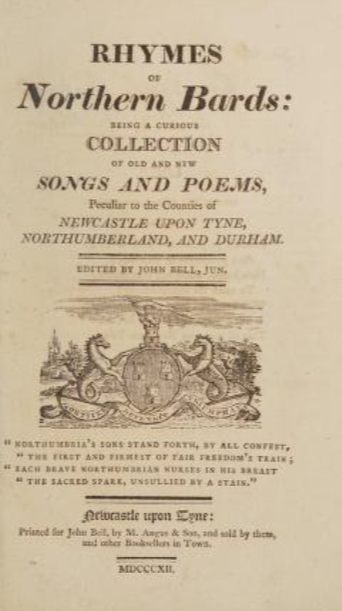
The mining history in this record
Byker and Walker are neighbouring districts in the east end of Newcastle upon Tyne, and both were coal-mining places. John Bell printed the song in 1812, set to the tune 'Off She Goes', in his collection of Northumbrian verse. It is a dance song with a sketchy narrative: the singer wants another penny for another gill and a fiddler to play, and tells of arriving at Walker without a coat or pit shirt; now he has 'twe or three', so 'Walker pit's done well for me' — a line the Ballad Index reads as ironic about the coal-cutters' poor wages. Later versions add verses about the pitman and the keelman and a wife drinking late.
It is Roud 3488 and has been sung to at least three tunes, including 'Off She Goes' and 'The Drunken Piper', some in an uneven dance time.
People
John Bell (Rhymes of Northern Bards, 1812), who first printed it; A. L. Lloyd, who collected it for Come All Ye Bold Miners; Martin Carthy and Dave Swarbrick, who recorded it in 1967.
Legacy today
A. L. Lloyd included the song as 'Walker Pits' in his collection Come All Ye Bold Miners (1952; enlarged 1978). The Young Tradition recorded a version in 1966, and Martin Carthy and Dave Swarbrick made Lloyd's version the title track of their 1967 album Byker Hill, which made it one of the best-known English mining songs of the folk revival; it is still widely performed.
Mining language in this record
Words and phrases in this record that are genuine mining terminology, occupations, methods or economic practice — not scenery or ordinary regional language that merely appears in a mining-adjacent work.
| Expression | Meaning | MineArchive connection |
|---|---|---|
| pit sark | A pit shirt: the singer came to Walker without even a shirt for work. (Tyneside) | (C) Clothing, no UK Term; explained on its own terms. |
| collier lads | Young coal miners; the chorus's 'collery lads for ever more'. (Tyneside) | Hewer — (B) Closest Term; colliers included hewers, putters and others. |
| keelman | Tyne boatman who carried coal from the staithes to the ships; paired with the pitman in later verses. (Tyneside) | (C) No archive Term; explained on its own terms. |
Recorded claims
Individual factual claims, each tagged with how solidly it's grounded and attached to the source(s) that support it. Where sources disagree, both are kept.
- The earliest known version is 'Walker Pits', song 36 in John Bell's Rhymes of Northern Bards (1812), to the tune 'Off She Goes'. (documented fact) 1,2,3
- The 1812 text has the singer arrive at Walker work 'wi' ne coat nor ne pit sark' and conclude 'Walker pit's deun weel for me'. (documented fact) 3
- The Ballad Index reads the line about Walker Pit as ironic, set against poor wages for coal-cutters. (reasonable inference, uncertain) 4
- A. L. Lloyd included it as 'Walker Pits' in Come All Ye Bold Miners; Martin Carthy and Dave Swarbrick recorded it as the title track of their 1967 album. (documented fact) 1,2
Mines
- Walker Colliery — Tyne and Wear
The song's earliest title is 'Walker Pits', and its verse says 'Walker pit's done well by me'.
Regions
Real-world mining concepts used here
Sources
- (secondary) Byker Hill (and Walker Shore) / Walker Pits (Roud 3488) — Mainly Norfolk (Reinhard Zierke)
- (secondary) Byker Hill — Wikipedia
- (primary) Rhymes of Northern Bards (John Bell, 1812) — Project Gutenberg
- (secondary) Byker Hill — The Traditional Ballad Index
Record created: 18 September 2026 · Last researched: 18 September 2026