 MineArchive

The Jack o'Lantern of North Wheal Basset
| Category | Folklore |
|---|---|
| Dates | North Wheal Basset worked from 1844; copper output 1846 to 1869; merged with Wheal Basset about 1878 to 1879; the tradition in print by 1899 (Bluett); repeated in 1987 (Embrey and Symes). |
A Carnkie tradition that the rich copper of North Wheal Basset was found after an old woman told the miners she had seen a Jack o'Lantern light, and that the mine rewarded her with a monthly payment, a new dress every year and a shaft named after her.
The mining history in this record
North Wheal Basset, on the Basset setts at Carnkie near Redruth, was worked for copper, tin and arsenic from 1844 and raised more than 30,000 tons of copper ore between 1846 and 1869. It was merged with Wheal Basset around 1878 or 1879 and took that mine's name.
The story of how it was found was in print by 1899, in Bluett's account, and Embrey and Symes repeated it in Minerals of Cornwall and Devon in 1987. An old woman told the miners she had seen a Jack o'Lantern, the wandering light of West Country folklore, and when they dug where she had seen it they quickly broke into extremely rich secondary copper ores. The mine paid her a monthly sum and gave her a new dress each year, and Grace's Shaft was named after her. For a single sighting of a light, that was a handsome return.
People
The old woman of the tradition, after whom Grace's Shaft was named; Bluett, who recorded the story by 1899; Peter Embrey and Robert Symes, who repeated it in Minerals of Cornwall and Devon (1987).
Legacy today
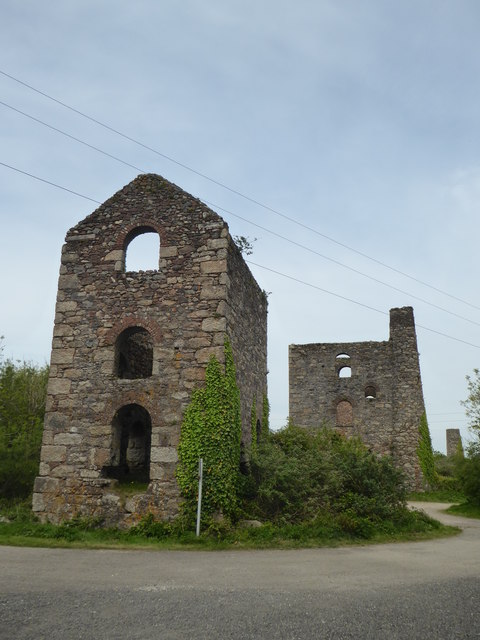
Grace's Shaft is one of the seven shafts recorded on North Wheal Basset, alongside Miner's, Lyle's, New, Flat Rod, Western and North shafts. The two engine houses on Lyle's Shaft still stand beside the road at Carnkie; the pumping engine in the further of them also worked Grace's Shaft through flat rods.
Recorded claims
Individual factual claims, each tagged with how solidly it's grounded and attached to the source(s) that support it. Where sources disagree, both are kept.
- North Wheal Basset is said to have been discovered after an old woman told the miners she had seen a Jack o'Lantern light. (tradition/folklore) 1,2
- Digging where the light had been seen, the miners quickly exposed extremely rich secondary copper ores. (tradition/folklore) 1,2
- The woman was rewarded with a monthly payment and a new dress each year, and a shaft was named after her. (tradition/folklore) 1,2
- The shaft named after her was Grace's Shaft. (tradition/folklore) 2
- The story was recorded by Bluett in 1899 and repeated by Embrey and Symes in Minerals of Cornwall and Devon (1987). (documented fact) 2
- North Wheal Basset was merged with Wheal Basset in 1879 and took its name. (documented fact, disputed) 1
- North Wheal Basset was amalgamated with Wheal Basset around 1878. (documented fact, disputed) 2
- North Wheal Basset produced over 30,000 tons of copper ore between 1846 and 1869. (documented fact) 1,2
Mines
- North Wheal Basset — Cornwall
Local tradition holds that North Wheal Basset's copper was found where an old woman saw a Jack o'Lantern, and that its Grace's Shaft was named after her.
Real-world mining concepts used here
Copper, Flat Rods, Outcrop, Tin, Wheal
Sources
- (secondary) North Wheal Basset (Buddlepit Mine Database) — Buddlepit Mine Database
- (secondary) North Wheal Basset, Wheal Basset, Basset Mines, Carnkie, Carn Brea, Cornwall (Mindat locality 1005) — Mindat
Record created: 18 October 2026 · Last researched: 5 November 2026