 MineArchive

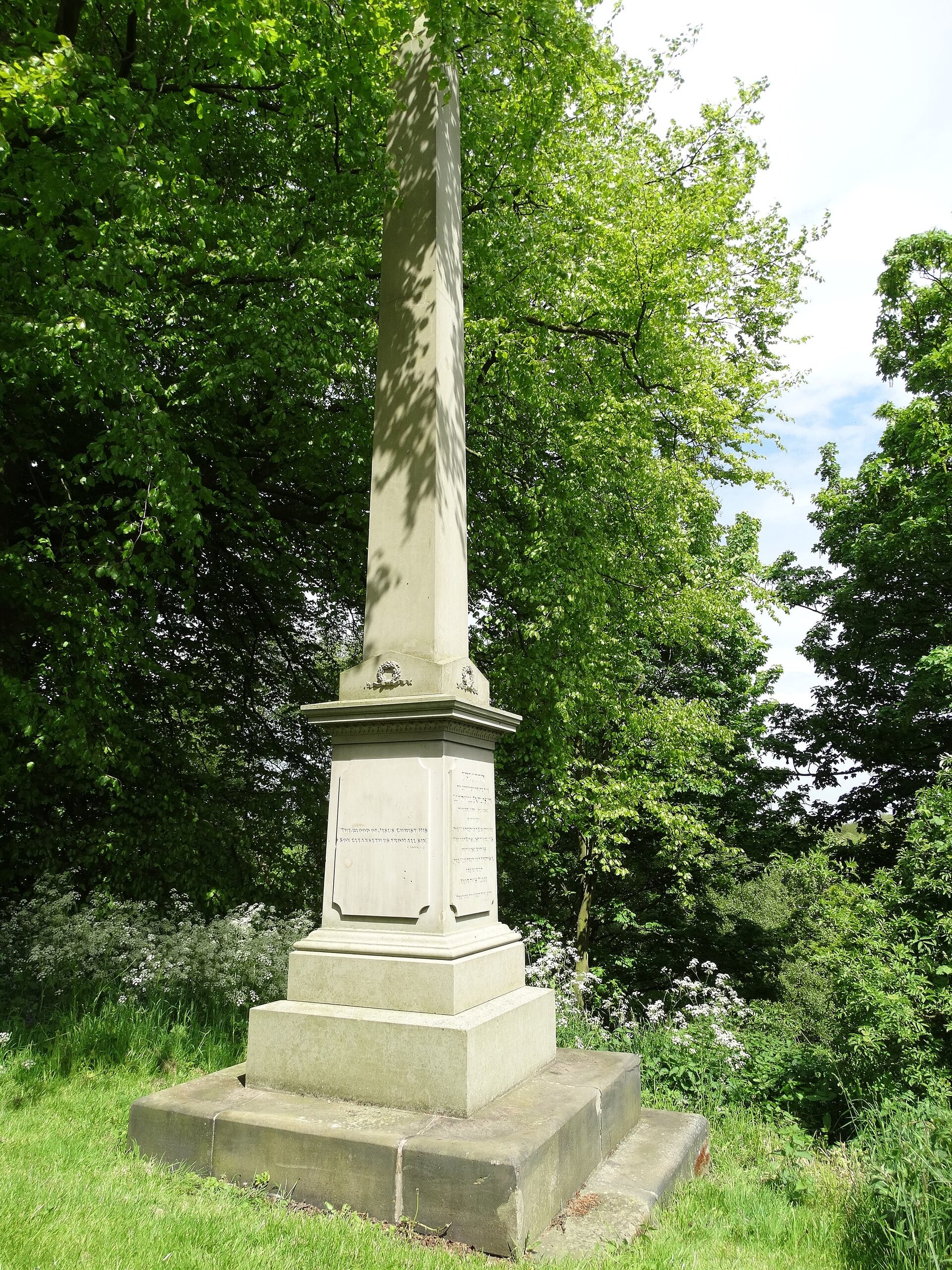
Lundhill Colliery explosion memorial, Darfield
| Category | Art |
|---|---|
| Dates | Explosion 19 February 1857; bodies recovered from April 1857; obelisk c.1857; listed Grade II 18 April 1985; second memorial at Hillies golf course 17 February 2007. |
An obelisk in All Saints' churchyard, Darfield, marks the Lundhill explosion of 19 February 1857, which killed 189 men and boys. 146 of them are buried near it.
The mining history in this record
The explosion at Lundhill Colliery, near Wombwell, on 19 February 1857 killed 189 men and boys. The burning pit was flooded to put the fire out, and the bodies could not be recovered until it was drained in April. The disaster left 90 widows and 220 children without fathers, and the relief fund drew donations from Queen Victoria and Prince Albert. 146 of the dead were buried at All Saints, Darfield.
Their memorial stands at the edge of the churchyard, about 55 metres south-east of the church, above the slope down to the River Dearne. Made by W. Oxley of Barnsley, whose name is cut on one of the steps, it is a tall obelisk on a corniced column, moulded plinth and stepped base, in fine sandstone ashlar. The south face records the explosion, the 189 dead and the 146 buried near this place, with a line from Amos; the other three faces carry verses from John, Thessalonians and Hebrews.
People
W. Oxley of Barnsley, who made the obelisk.
Legacy today
The obelisk, dated to about 1857, was listed Grade II on 18 April 1985. The colliery itself worked until the late 1880s, and its site is now a nine-hole golf course. On 17 February 2007, for the 150th anniversary, a second memorial was placed in front of the clubhouse at Hillies golf course: a sculpture of mining symbols around a large piece of coal caught in twisted metal.
Recorded claims
Individual factual claims, each tagged with how solidly it's grounded and attached to the source(s) that support it. Where sources disagree, both are kept.
- The memorial commemorates the Lundhill explosion of 19 February 1857, in which 189 men and boys died; 146 of their bodies are buried near it. (documented fact) 1,2,3
- It is a sandstone obelisk of about 1857 by W. Oxley of Barnsley. (documented fact) 1,2
- A memorial obelisk was built in the grounds of Darfield church, where 146 of the victims were buried. (documented fact) 4
- The obelisk was listed Grade II on 18 April 1985. (documented fact) 2,3
- The disaster left 90 widows and 220 children orphaned. (documented fact) 4
- A second memorial was placed in front of the clubhouse at Hillies golf course, on the colliery site, on 17 February 2007. (documented fact) 4
Mines
- Lundhill Colliery — South Yorkshire
The Darfield obelisk marks the graves of 146 of the 189 men and boys killed at Lundhill Colliery in 1857; a second memorial of 2007 stands on the colliery site.
Disasters
- Lundhill Colliery explosion — 19 February 1857
The obelisk commemorates this explosion and marks the graves of 146 of its dead.
Real-world mining concepts used here
Sources
- (secondary) Lund Hill mining memorial (PMSA National Recording Project) — Public Art Research Archive, Sheffield Hallam University
- (primary) Monument to Victims of Lundhill Colliery Explosion (list entry 1293398) — Historic England
- (secondary) Monument to Victims of Lundhill Colliery Explosion, Darfield — British Listed Buildings
- (secondary) Lundhill Colliery explosion — Wikipedia
Record created: 29 November 2026 · Last researched: 29 November 2026