 MineArchive
Silver Sand
| Also known as | Silica Sand (The generic industrial name for the same broad mineral, used at larger scale elsewhere), Glass Sand (Named for its principal historic use) |
|---|---|
| Category | Commodities |
| Commodity page | Silver Sand → |
An almost pure, fine-grained silica sand — quartz worn down to rounded grains with almost nothing else mixed in — valued not for any rare mineral content but for its sheer chemical cleanliness.
Historical usage
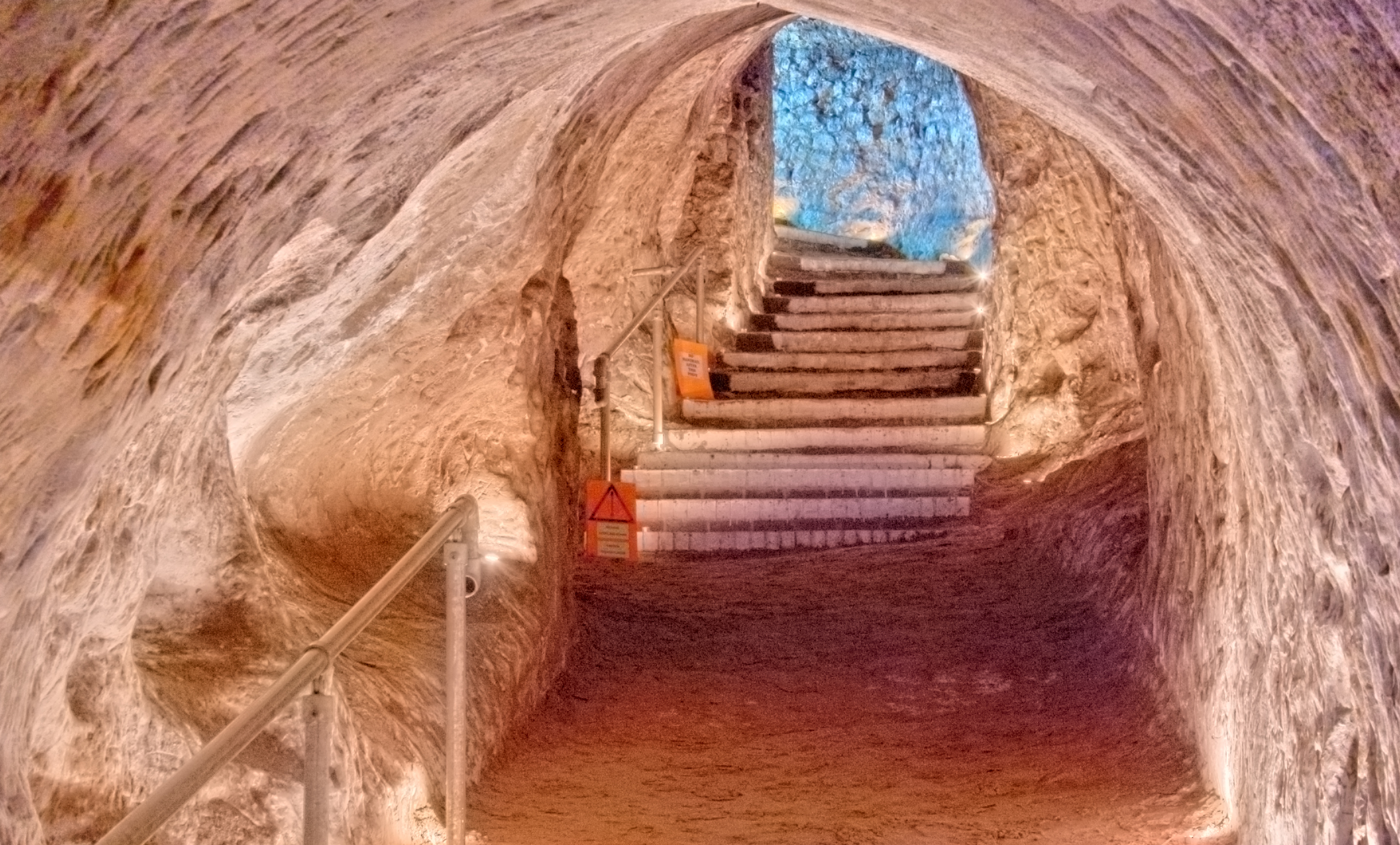
Silver sand was dug from pits and mines across the Weald, most notably in the Dorking-Reigate-Godstone district of Surrey, from at least the 18th century into the early 20th. At Reigate two separate mine complexes were driven into the hillside after the town's road tunnel and cutting opened in 1823, one originally meant only to give the local brewery cellar storage, with the sand removed sold on as a profitable by-product. The Reigate workings ran until around 1900, the eastern mine closing earlier, by the 1860s, after a large fall of roof.
How it worked
The sand occurs within the Folkestone Beds, part of the Cretaceous Lower Greensand, not as a continuous bed but as discrete pockets of unusually fine, well-sorted, almost pure quartz grain within the coarser surrounding sandstone. Because the sand itself was soft and needed no blasting, it could be dug directly from galleries driven into the hillside — the same simple pick-and-gallery method used at Reigate whether the immediate purpose was sand or cellar storage.
Why it was used
Purity was the entire point. Ordinary building or river sand carries clay, iron oxide and other impurities that discolour or weaken whatever it is used in; silver sand's near-total lack of them made it the sand of choice for making clear glass, for horticultural composts and seed-sowing mixes where a clean, inert medium mattered, and as a fine abrasive for scouring and cleaning.
Value over time
Silver sand never commanded a high price by weight, but its purity gave small local pits a genuine, durable market: glassmakers needed exactly the chemical cleanliness it offered, and demand held up through the 18th and 19th centuries even as it remained, in volume, a minor mineral compared with coal or metal ores. It lost that market gradually rather than through any single collapse, as larger-scale industrial silica sand workings elsewhere in Britain, better suited to 20th-century glass and foundry production, took over the trade the old hand-worked pocket mines like Reigate's had once served.
Hazards & challenges
No specific toxic or occupational hazard beyond the generic risks of any soft-rock hand-worked mine — chiefly roof falls in unsupported sandstone galleries and the ordinary dust of quarrying, rather than any hazard particular to the mineral itself.
Risks & limitations
Because it occurs in scattered pockets rather than a predictable seam, a silver sand working could be exhausted or run out of pocket unexpectedly, and soft, weakly-supported galleries driven through sandstone were prone to roof falls — the collapse that closed Reigate's East Mine in the 1860s being a documented example.
Regional variation
Not to be confused with ordinary building or plastering sand, nor with the industrial silica sands later worked at a larger scale elsewhere in Britain for foundry moulding and modern glass manufacture — silver sand is specifically the finer, purer, historically hand-worked variety associated with small pocket deposits like those of the Surrey Weald.
Images
Mines associated with this term
Included only where MineArchive's own research gives a reasonable evidential basis — not every mine where this might plausibly apply.
- Alum Bay Sand and Copperas Workings — Isle of Wight (well documented example)
Alum Bay's cliffs gave up white sand so pure it was worked commercially even though the alum the site was originally searched for was never found there. - Reigate Caves — Surrey (well documented example)
Reigate Caves are explicitly two silver sand mine complexes, worked from around 1820 to about 1900, cut into the Folkestone Beds beneath the town.
Sources
- (primary) Underground Surrey — Wealden Cave & Mine Society
- (secondary) Reigate Caves — Subterranea Britannica
Record created: 24 August 2026 · Last researched: 24 August 2026