 MineArchive
Clashach Quarry
| Also known as | Hopeman Quarries, Clashach Cove quarries |
|---|---|
| Location | Hopeman, Moray Firth coast, Moray — 57.7138, -3.4032 (approximate) |
| Commodity | Freestone |
| Type | Quarry |
| Worked | from Early 1800s |
| Operators | Moray Stone Cutters (1990–?) |
Overview
A coastal sandstone quarry near Hopeman working stone laid down as desert dunes — one of the very few still cutting building stone in Scotland, and the source of the facing on the Museum of Scotland, the 9/11 memorial in New York and part of the Sagrada Familia.
History
Sandstone has been taken from the Hopeman coast since the early 1800s, Clashach being one of a group of quarries along this stretch of the Moray Firth that were working through the later 19th century. The stone went out by sea at first, the quarries sitting close enough to the shore to load directly, and later by rail once the coast was connected. Most of the group have long since closed; Clashach has not, and is now one of the few sandstone quarries still operating in Scotland. Its modern reputation was made from the 1990s, when it supplied cladding for a run of prominent buildings.
Geology
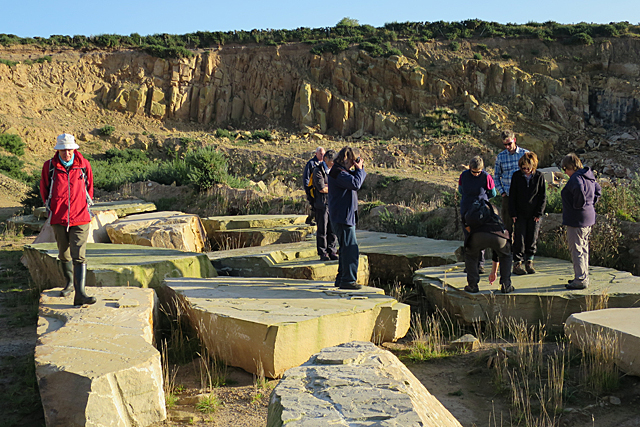
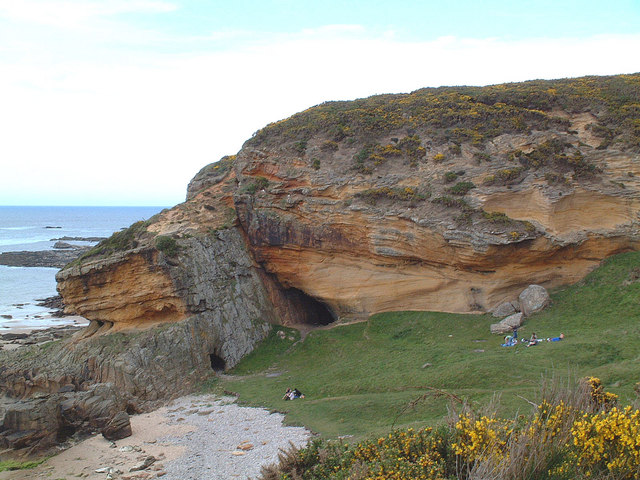
The stone is a Permian to Triassic sandstone of the New Red Sandstone, and it is worth looking at the quarry face for what it records: large-scale cross-bedding, the preserved foresets of desert dunes, laid down when this part of Scotland was an arid continental interior. The grains are well-rounded quartz with some feldspar, highly siliceous and well cemented, which is what makes the stone strong and durable. The colour is yellow to buff and fawn rather than the bright red of other New Red Sandstone quarries, sometimes variegated with brown limonite wisps, and recent workings have produced a dull red variety as well.
Geological setting: Sedimentary Beds and Seams (well documented example)
Workings
Open quarrying of the sandstone beds on the coast, worked as dimension stone — cut in blocks for building rather than crushed — with the waste forming spoil along the cliff top. The same beds are exposed in the sea cliffs at Clashach Cove immediately to the north, where the dune bedding can be seen without going into the quarry at all.
Closure
Clashach has not closed. It is worked by Moray Stone Cutters and remains one of Scotland's few active building-stone quarries, at a time when most such quarries have gone and restoration work on historic buildings struggles to find matching stone.
What remains
A working quarry, and not open to visitors, though the coast path passes above it and the same beds can be examined in the cliffs at Clashach Cove.
The working faces and spoil, and the coastal exposures that show what is being quarried.
Redevelopment
None — still in production.
What's uncertain
Points where sources disagree or the record could not be settled; both accounts are kept. All open questions in the archive.
- Its stone is also reported to have been used in the extension to the National Gallery in Edinburgh, the 9/11 memorial in New York, Barcelona Cathedral and the continuing construction of the Sagrada Familia. (uncertain) 1
Recorded claims
Individual factual claims, each attached to the source(s) that support it below. Where sources disagree, both are kept.
- Sandstone has been quarried on the Hopeman coast since the early 1800s, Clashach being one of a group of quarries working there in the later 19th century; stone went out by sea at first and later by rail. 1
- The stone is a Permian to Triassic New Red Sandstone, highly siliceous and well cemented, yellow to buff and fawn rather than red, with well-rounded quartz grains, some feldspar and brown limonite wisps. 2
- Clashach sandstone shows large-scale cross-bedding indicating an origin as desert dunes. 2
- Clashach is worked by Moray Stone Cutters and is one of the few sandstone quarries still operating in Scotland. 2,1
- The quarry supplied cladding for the Museum of Scotland in Edinburgh in 1998 and the Scottish Widows building in 1997. 2
- Its stone is also reported to have been used in the extension to the National Gallery in Edinburgh, the 9/11 memorial in New York, Barcelona Cathedral and the continuing construction of the Sagrada Familia. (uncertain) 1
Sources
- (secondary) Clashach Quarry, Hopeman, Morayshire — Ogilvie Geoscience
- (primary) Building stones in Edinburgh from the Permian and Triassic New Red Sandstone of Moray — British Geological Survey (Earthwise)
- (secondary) Clashach Quarry — SGT Geosites — Scottish Geology Trust
Record created: 24 August 2026 · Last researched: 24 August 2026