 MineArchive
Braich Goch Quarry
| Location | Corris Uchaf, Gwynedd — 52.6480, -3.8650 (approximate) |
|---|---|
| Commodity | Slate |
| Type | Metal |
| Worked | 1787–1970 |
| Operators | Braich Goch Slate Quarry Company (1864–1906) |
| Status | Researched |
Overview
Braich Goch, the largest and oldest of the Corris slate quarries, worked almost continuously from 1787 to 1970 — nearly two centuries that took it from a simple 18th-century lease through Victorian boom, Edwardian collapse and a slow 20th-century wind-down, before its underground chambers found new life as a tourist attraction.
History
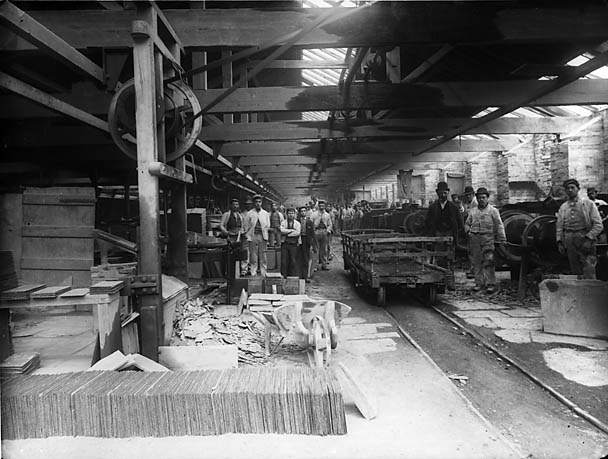
Braich Goch was founded in 1787 by David Williams under a lease from the Vane Estate, making it the oldest quarry in Corris. Early working also took place nearby at Gaewern, under the Merionethshire Slate Company, before quarrying began at Braich Goch itself in earnest in 1836 under the North Wales Slate & Slab Company. The Braich Goch Slate Quarry Company, formed in 1864, employed 250 men by 1878, producing 7,000 tons of slab and roofing slate that year, and the workforce grew to over 350 at the quarry's 1890s peak, forming the economic backbone of the Corris community. The company collapsed in 1906, and six further companies worked the site intermittently over the following decades. Dewi and Gwilym Lloyd of Aberllefenni bought the site in 1962 and continued working it until final closure in 1970.
Geology
The quarry worked slate beds within the Cambrian slate belt of Snowdonia, the same formation worked at the neighbouring Corris-area quarries including Aberllefenni.
Geological setting: Slate and Regional Metamorphism (well documented example)
Workings
The quarry was worked as an extensive underground complex, connected in its early years to the nearby Gaewern workings under common ownership; production peaked at 7,000 tons of slab and roofing slate in 1878 alone.
Closure
The quarry closed in 1970 after nearly two centuries of intermittent working, the last of several companies to attempt to make it pay following the original company's 1906 collapse.
What remains
Part of the underground workings survive and are now open to the public as the King Arthur's Labyrinth show cave and the Corris Mine Explorers attraction.
Abandoned workings can be dangerous — unstable ground, uncapped shafts, flooding and bad air are common even where a site looks safe from the surface. This entry describes history and general location only; it is not an access guide.
Recorded claims
Individual factual claims, each attached to the source(s) that support it below. Where sources disagree, both are kept.
- By 1878 the quarry employed 250 men and produced 7,000 tons of slab and roofing slate; the workforce grew to over 350 at the quarry's 1890s peak. 1,2
- The original company collapsed in 1906; six further companies worked the site intermittently until Dewi and Gwilym Lloyd of Aberllefenni bought it in 1962 and worked it until final closure in 1970. 1,2
Photographs & further reading
This page doesn't try to reproduce everything — these are the best original sources found for this mine.
Images
Sources
- (secondary) Braichgoch slate mine — Wikipedia
- (secondary) History of Braich Goch Mine — Corris Mine Explorers
- (primary) Braich Goch Slate Quarries (BGS Mine Plans Catalogue) — British Geological Survey / Gwynedd Archives Service
Record created: 23 August 2026 · Last researched: 23 August 2026