 MineArchive
Allington Quarry
| Location | Allington, north of Maidstone, Kent — 51.2900, 0.4980 (approximate) |
|---|---|
| Commodity | Limestone |
| Type | Quarry |
| Worked | By the 1790s–2001 |
| Maximum depth | Not applicable: an open quarry, with no recorded working depth. |
| Operators | Hanson (?–2001) |
Overview
A Kentish ragstone quarry on the Medway north of Maidstone, worked on a site where stone has been taken since at least the twelfth century and certainly since the 1790s. Some twenty million tonnes were extracted, the last of it for the Channel Tunnel Rail Link, before Hanson Aggregates closed the quarry in 2001. The worked face is now a geological SSSI, and the rest of the void is a waste management facility.
History
Ragstone was an obvious thing to quarry at Allington: the Hythe Beds outcrop here, and the River Medway runs alongside, so stone could be loaded straight into boats for London. Building stone was being taken in the area by 1174, when Allington Castle was built, and a quarry certainly existed on this site from the 1790s. Over its working life something like twenty million tonnes of stone came out of it, for local buildings, for roads and railways, and most recently for the Channel Tunnel Rail Link.
In 2001 the owners, Hanson Aggregates, decided to close Allington and move to Blaise Farm near Offham, a site reckoned to hold some thirty-five million tonnes of reserves. Among the last stone raised was a quantity given to Langley Park School for Boys at Beckenham to build stone seating circles. Only two ragstone quarries now work in Kent — Hermitage at Barming, which supplies building stone, and Blaise Farm, which is mostly aggregate.
Part of the quarry was notified as a Site of Special Scientific Interest in 1993, not for the ragstone but for what quarrying exposed in it: an extensive section through gulls — fissures opened in the rock — filled with wind-blown loess, probably formed by seasonal freezing and thawing during the last glaciation. The remainder of the void became the Allington Quarry Waste Management Facility.
Geology
Kentish ragstone is a hard grey limestone from the Hythe Beds of the Lower Greensand, laid down in the Cretaceous and outcropping along the Greensand Ridge above the Weald and at the cliffs of Hythe. It is the only significant source of hard limestone in south-east England, which is why it was worked so early and so hard. Fresh from the quarry it is grey-green or blue-grey, weathering to an autumnal colour; it breaks along ragged edges, which is how it got its name.
The SSSI interest is Pleistocene rather than Cretaceous. Quarrying exposed an extensive section through gulls — fissures opened in the rock mass — infilled with loess, and these are interpreted as the product of seasonal freezing and thawing under periglacial conditions during the last ice age.
Workings
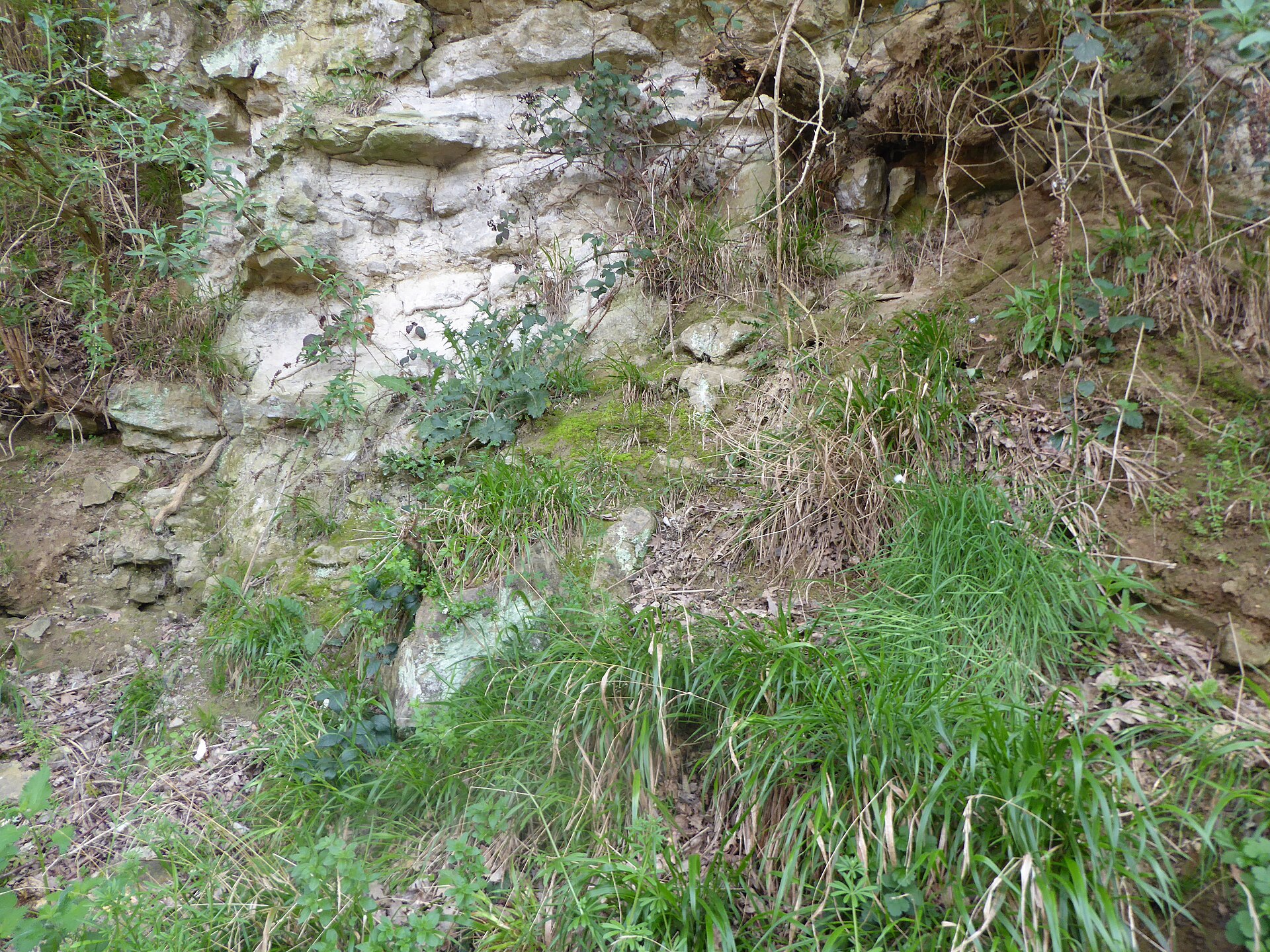
Open quarrying of ragstone and sand from the Hythe Beds. The ragstone occurs in bands between about 15 and 60 cm thick alternating with a loose material called hassock, of similar thickness, which gives the quarry faces their characteristic striped appearance and is the origin of the quarrymen's phrase 'rag and hassock'. Stone was moved by boat down the Medway, the reason the site was worth working in the first place.
Closure
Hanson Aggregates closed the quarry in 2001 and relocated extraction to Blaise Farm near Offham, which had far larger reserves.
What remains
Part of the site is the 0.8-hectare Allington Quarry SSSI, notified in 1993 and a Geological Conservation Review site; the land within it is owned by the local authority and there is no public access. The rest of the former void operates as the Allington Quarry Waste Management Facility.
Quarry faces within the SSSI; the remainder of the void is in use for waste management.
Redevelopment
The worked-out quarry was redeveloped as the Allington Quarry Waste Management Facility, an integrated waste disposal and energy-from-waste site.
What's uncertain
Points where sources disagree or the record could not be settled; both accounts are kept. All open questions in the archive.
- In the region of twenty million tonnes of stone were extracted from the quarry, for local buildings, roads and railways, most recently for the Channel Tunnel Rail Link. (uncertain) 1
- There is evidence of quarrying in the area from 1174, when Allington Castle was built, and the quarry itself had certainly existed since the 1790s. (uncertain) 1
- In 2001 Hanson Aggregates decided to close the site and relocate to Blaise Farm near Offham, estimated to hold thirty-five million tonnes of reserves. (uncertain) 1
- Only two ragstone quarries now operate in Kent: Hermitage Quarry at Barming, the sole supplier of Kentish ragstone building stone, and Blaise Farm, worked mainly for aggregate. (uncertain) 1
Recorded claims
Individual factual claims, each attached to the source(s) that support it below. Where sources disagree, both are kept.
- In the region of twenty million tonnes of stone were extracted from the quarry, for local buildings, roads and railways, most recently for the Channel Tunnel Rail Link. (uncertain) 1
- There is evidence of quarrying in the area from 1174, when Allington Castle was built, and the quarry itself had certainly existed since the 1790s. (uncertain) 1
- In 2001 Hanson Aggregates decided to close the site and relocate to Blaise Farm near Offham, estimated to hold thirty-five million tonnes of reserves. (uncertain) 1
- Allington Quarry is a 0.8-hectare geological Site of Special Scientific Interest, notified in 1993 and a Geological Conservation Review site, for an extensive section through gulls infilled with loess. 2,3
- Only two ragstone quarries now operate in Kent: Hermitage Quarry at Barming, the sole supplier of Kentish ragstone building stone, and Blaise Farm, worked mainly for aggregate. (uncertain) 1
Photographs & further reading
The stone Allington was worked for: its geology in the Hythe Beds, its use from Roman London to Victorian churches, and the other Kent quarries that produced it.
View sourceSources
- (secondary) Kentish ragstone — Wikipedia
- (secondary) Allington Quarry — Wikipedia
- (primary) Designated Sites View: Allington Quarry SSSI — Natural England
Record created: 3 September 2026 · Last researched: 3 September 2026