 MineArchive
Whitwick Colliery Fire, 1898
A gob fire in Whitwick Colliery's No. 5 Pit killed 35 men and boys overnight, the worst mining disaster in Leicestershire's history, leaving 27 widows and 84 children under 13 orphaned.
| Date | 19 April 1898 |
|---|---|
| Mine | Whitwick Colliery |
| Region | Leicestershire |
| Primary type | Fire |
| Associated types | Gas / Asphyxiation |
| Fatalities | 35 (Thirty-five men and boys died, the youngest 13 years old; only seven of the 42 men underground at the time escaped. Twelve bodies were never recovered.) |
| Context | During active mining |
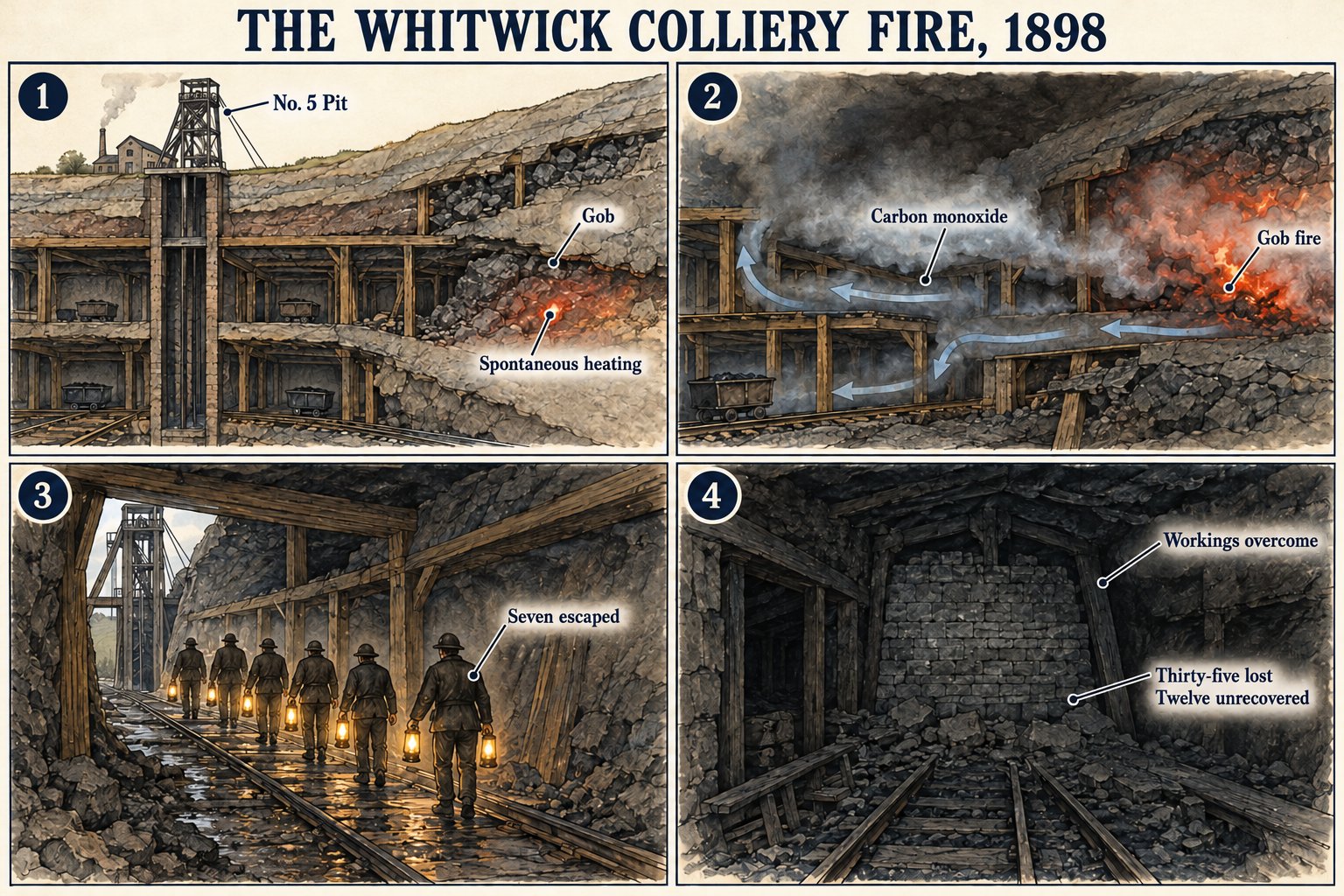
Cause
A 'gob fire' -- a spontaneous outbreak of combustion in the colliery's waste workings -- broke out overnight in No. 5 Pit.
What happened
On the night of 18-19 April 1898, a gob fire broke out in the waste workings of Whitwick Colliery's No. 5 Pit. Of the 42 men and boys underground at the time, including a 13-year-old, only seven managed to escape; the other 35 died of carbon monoxide poisoning as the fire consumed the workings' oxygen and produced toxic gas. Twelve of the bodies were never recovered. The disaster was the worst in Leicestershire's mining history, leaving 27 widows and 84 children under the age of 13 orphaned. A memorial service was held on 24 April 1898 at Christ Church, Coalville, the town that had grown up around the colliery.
Investigation & inquiry
Nothing is recorded of a formal inquiry or inquest into the cause of the gob fire.
Recorded claims
Individual factual claims, each attached to the source(s) that support it below. Where sources disagree, both are kept.
- Of the 42 men and boys underground at the time, including a 13-year-old, only seven escaped; the disaster left 27 widows and 84 children under 13 orphaned, and 12 of the 35 bodies were never recovered. 1
- The disaster occurred at a colliery that, by the 1870s, comprised five shafts and had grown to employ over 200 men and boys as early as the 1840s -- context for the scale of loss relative to the workforce on shift. 2
Related terminology
Mining terms this disaster is structurally linked to, with the nature of the relationship.
- Colliery (contextual relationship)
Named 4 times in this record, first in the summary: “A gob fire in Whitwick Colliery's No. 5 Pit killed 35 men and boys overnight, the worst mining…” - Old Workings (contextual relationship)
Named twice in this record, first in the cause: “…'gob fire' -- a spontaneous outbreak of combustion in the colliery's waste workings -- broke out overnight in No. 5 Pit.” - Spontaneous Combustion (contextual relationship)
Named 4 times in this record, first in the summary: “A gob fire in Whitwick Colliery's No. 5 Pit killed 35 men and boys overnight,…”
Sources
- (secondary) Whitwick Colliery — Whitwick Historical Group
- (secondary) Whitwick Colliery — Northern Mine Research Society
Record created: 2 September 2026 · Last researched: 2 September 2026