 MineArchive
Portland Colliery, Kirkstyle Pit explosion
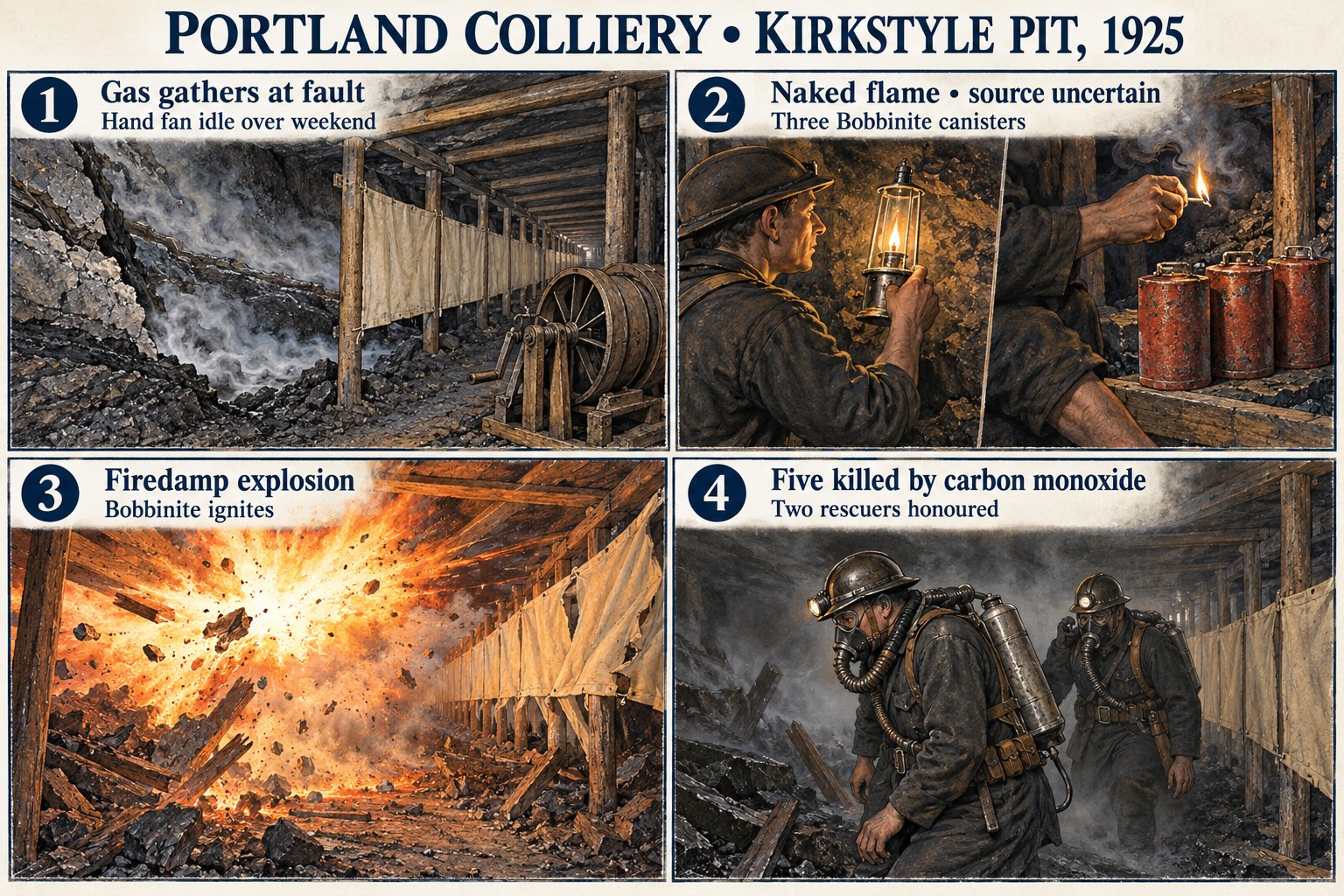
Three men went into a working place in Kirkstyle Pit at the start of the Sunday night shift and firedamp exploded, setting off canisters of Bobbinite left in the mine over the weekend. The fireman and a shaftman went into the smoke after them and did not come out. All five died of carbon monoxide poisoning. The manager and under-manager were prosecuted over the ventilation of the place, and the Carnegie Hero Fund made posthumous awards to the two would-be rescuers.
| Date | 18–19 January 1925 |
|---|---|
| Mine | Portland Colliery |
| Region | East Ayrshire |
| Primary type | Explosion |
| Associated types | Gas / Asphyxiation, Rescue |
| Fatalities | 5 (Alexander Rodman, fireman, 67, of Old Street, Riccarton; William Campbell, miner, 39, and his son Alexander Campbell, drawer, 15, both of Portland Row, Hurlford; Alexander Cree, miner, 22, of Portland Row, Hurlford; and William Stevenson senior, of New Street, Riccarton.) |
| Context | During active mining |
Cause
Firedamp accumulated at a fault in McKnight’s working place and was ignited by a naked flame — either a lighted flame lamp opened to relight an extinguished one, or a match struck to relight both. The explosion in turn fired three canisters of Bobbinite, two of which had been wrongfully left in the mine over the weekend.
Contributing factors
The place lay near the return end of the section and was ventilated by air coursed some 220 yards behind a brattice partition, with a hand-cranked fan set 20 yards from the face and worked only occasionally. Gas had gathered at the fault and been cleared on each of the five days before the accident. From Saturday morning until Sunday night nobody was in the place to work the fan. Matches and cigarettes were found in a jacket at the end of the road and the fireman’s lamp was found unlocked — evidence the inspector took as pointing to a lack of discipline.
What happened
The night shift went down Kirkstyle Pit at eleven o’clock on Sunday 18 January 1925, three of the eight men into the McNaught Major section, four into the Tourha’ seam, and the fireman ahead of them to make his inspection. Soon after, two men on the main road felt a heavy blast of air. They fetched two shaftsmen and started towards McKnight’s place, meeting the fireman, Alexander Rodman, who had apparently been trying to get in. Through the smoke Rodman and one of the shaftmen, William Stevenson, went in after the three miners, and were never seen alive again. The bodies were eventually recovered by the superintendent of the Kilmarnock Rescue Station, Joseph Bryce, and by Rodman’s own son Philip, both wearing Proto apparatus. All five had died of carbon monoxide poisoning; the three miners caught in the blast were also burned, though not badly enough to have killed them. William Campbell had played full back for the Hurlford football team for many seasons, and the son who died with him was the eldest of five children. William Stevenson had been champion bowler on the Riccarton green two seasons running.
Rescue & recovery
Philip Rodman tied a shot-firing cable round his waist and went into the after-damp, bringing out a body with the help of two other men and finding it to be his father’s; he then put on rescue apparatus and helped the rescue station superintendent recover four more. The Carnegie Hero Fund trustees made posthumous awards to Alexander Rodman and William Stevenson — a memorial certificate, a headstone and £1 a week for their dependants each, with their names on the Roll of Heroes — and gave Philip Rodman an honorary certificate and £20.
Investigation & inquiry
HM Inspector of Mines set out two possible ignition sources and could not choose between them, and found that the lamps lay on the intake side of the brattice about two yards from the fan, so that gas driven back from the fault would have been drawn through a parted screen onto a naked light. Legal proceedings were taken against the manager and under-manager, each fined £5. The Sheriff Principal, hearing the case himself, ruled that ventilating a mine generally while leaving individual places inadequately ventilated is not compliance with section 29(1) — so that where cross-measure drifts, single coal places or whole districts need auxiliary fans, hand or power driven, those fans must be worked through the weekends as well.
Changes to practice & legislation
The Sheriff Principal’s ruling on section 29(1) is the lasting consequence: a duty to ventilate each working place adequately, not merely the mine as a whole, and to keep auxiliary fans running at weekends where a place depends on them.
Recorded claims
Individual factual claims, each attached to the source(s) that support it below. Where sources disagree, both are kept.
- An explosion of gas occurred at Portland Colliery, Kirkstyle Pit, on Sunday night 18 January 1925 and resulted in the deaths of five persons. 1
- The explosion was due either to the opening of a lighted flame lamp to light an extinguished one, or to a match struck to relight both; the firedamp explosion then lighted three canisters of Bobbinite, two of which had been wrongfully left in the mine over the weekend. 1
- The fireman Alexander Rodman and the shaftman William Stevenson went into the smoke in an attempt to reach the three miners and were never seen alive again; all five men died of carbon monoxide poisoning. 1
- The manager and under-manager were each fined £5, and the Sheriff Principal ruled that ventilating a mine generally while leaving individual places inadequately ventilated does not comply with section 29(1), so that auxiliary fans on which a place depends must be worked through weekends. 1
- The Carnegie Hero Fund trustees made posthumous awards to Rodman and Stevenson — a memorial certificate, a headstone and £1 a week for dependants each — and gave Philip Rodman, who recovered his father’s body and then helped recover four more, a certificate and £20. 1
Related terminology
Mining terms this disaster is structurally linked to, with the nature of the relationship.
- Brattice (contextual relationship)
Named twice in this record, first in the contributing factors: “…section and was ventilated by air coursed some 220 yards behind a brattice partition, with a hand-cranked fan set 20 yards from the face and…” - Fireman (contextual relationship)
Named 4 times in this record, first in the summary: “…off canisters of Bobbinite left in the mine over the weekend. The fireman and a shaftman went into the smoke after them and did not come out.…” - Proto Apparatus (contextual relationship)
Named in this record’s narrative: “…Station, Joseph Bryce, and by Rodman’s own son Philip, both wearing Proto apparatus. All five had died of carbon monoxide poisoning; the three miners…” - Stone Drift (contextual relationship)
Named in this record’s investigation: “…ventilated is not compliance with section 29(1) — so that where cross-measure drifts, single coal places or whole districts need auxiliary fans, hand or…” - Undermanager (contextual relationship)
Named twice in this record, first in the summary: “…out. All five died of carbon monoxide poisoning. The manager and under-manager were prosecuted over the ventilation of the place, and the Carnegie…”
Photographs & further reading
This page doesn't try to reproduce everything — these are the best original sources found for this disaster.
The Inspector of Mines report on the Kirkstyle Pit explosion in full, with the Scotsman’s account of 20 January 1925 and the Carnegie Hero Fund awards.
View sourceSources
- (primary) Portland Colliery, 19 January 1925: Inspector of Mines report and newspaper accounts — Scottish Mining Website
- (primary) Portland Colliery Co., Ltd. — Durham Mining Museum
Record created: 6 September 2026 · Last researched: 6 September 2026