 MineArchive
Grinshill Quarry
| Location | Grinshill and Corbet Wood, near Wem, Shropshire — 52.8087, -2.7061 (approximate) |
|---|---|
| Commodity | Sandstone |
| Type | Quarry |
| Worked | By the 12th century–Still active |
| Maximum depth | Not applicable: open quarries cut into the face of the Grinshill sandstone ridge, which rises to 192 metres. |
| Operators | Grinshill Stone Quarry |
Overview
The sandstone quarries cut into the ridge above Grinshill in north Shropshire, worked since at least the twelfth century and still working today. Grinshill stone is the pre-eminent building stone of Shropshire and the county's only building stone used nationally: it faces Haughmond Abbey, Shrewsbury railway station and the Welsh Bridge, and was chosen for the lintels and door surround of Number 10 Downing Street. The abandoned workings on the hill are now a nature reserve and a climbing ground.
History
Stone has been quarried at Grinshill since at least the twelfth century, and the hill has been worked more or less continuously since; the quarrying company at work there today counts over nine centuries of extraction. An archaeological survey of Corbet Wood and Grinshill recorded 135 features on the hill, most of them associated with post-medieval quarrying, together with ruined cottages and settlement sites that may have been the quarrymen's homes. The stone is a Triassic sandstone of the Sherwood Sandstone Group, and Shropshire's own building stone atlas singles out these white sandstones as the only Shropshire building stone type used across the county and beyond, and Grinshill stone in particular as the almost universal choice for restoration work in the county once the railways had made it easy to move. Pevsner's guide to Shropshire calls it the pre-eminent building stone of the county.
Its reach is out of proportion to the size of the hill. Grinshill stone was used at Haughmond Abbey, at Shrewsbury railway station and on the town's Welsh Bridge, and, most conspicuously, for the lintels and door surround of Number 10 Downing Street and in the building of Chequers. White, red and pink varieties have all been quarried, the white a creamy-buff colour with brown speckles. One working quarry still supplies the stone in white and red for new building and for restoration; the rest of the hill has passed out of the industry and into the care of the county, its faces and spoil now woodland, heath and rock outcrop.
Geology
Grinshill stone is a Triassic sandstone of the Sherwood Sandstone Group, forming one of the hills that protrude through the glacial till of north Shropshire. White, red and pink varieties occur: the white is a creamy-buff colour with brown speckles, the others brownish red or purplish pink. The exposed faces are of enough geological interest for the site to be a Site of Special Scientific Interest, showing rain prints and the successive layers of the rock's formation, and the fossilised remains of a Triassic reptile have been found here. The county's building stone atlas describes these white sandstones as the only Shropshire building stone used county-wide and beyond.
Workings
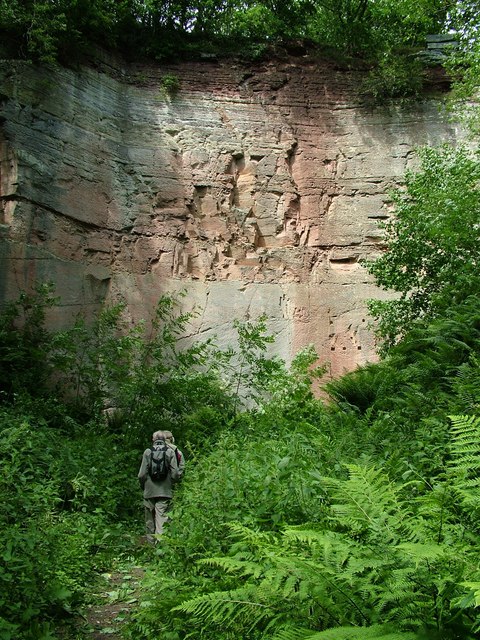
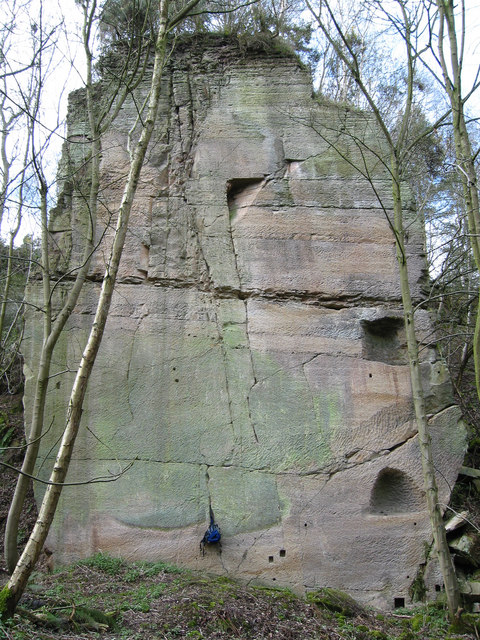
A series of open quarries cut into the sandstone ridge, worked from the top of the hill down its faces over many centuries; the surviving faces reach forty to fifty feet. The archaeological survey of the hill recorded 135 features, mostly post-medieval quarrying, along with ruined cottages and settlement sites likely to be quarrymen's dwellings. One quarry remains in commercial production.
Closure
Not closed. One quarry on the hill is still worked commercially for white and red Grinshill sandstone for new build and restoration; the older workings around it have been given up and now form part of the Corbet Wood countryside heritage site and local nature reserve.
What remains
Part working, part nature reserve. The abandoned faces and spoil form the Corbet Wood countryside heritage site west of the A49 between Shrewsbury and Wem, designated a Site of Special Scientific Interest for its geology, a county wildlife site, and a local nature reserve on 30 January 2006. Mixed woodland covers the quarried edges and relic heathland survives on the summit; more than 120 species of butterflies and moths have been recorded, along with woodland birds. Walking routes cross the site, the Humphrey Kynaston Way runs through it, and the old faces are used for climbing on routes up to about fifty feet, under an access agreement that asks for small groups only. One quarry is still worked.
Extensive quarry faces, spoil and 135 recorded features including ruined cottages and settlement sites, probably the quarrymen's.
Redevelopment
Countryside heritage site, local nature reserve and climbing ground, alongside one working quarry.
Nearby mines
- Clive Mine — 3.7 miles (5.9 km) NW
Straight-line distance, within 9 miles (15 km). Show on the map.
Recorded claims
Individual factual claims, each attached to the source(s) that support it below. Where sources disagree, both are kept.
- Stone has been quarried at Grinshill since at least the twelfth century; the working quarry counts over nine centuries of extraction from the area. 1,2,3
- Grinshill stone is a Triassic sandstone described by the Pevsner Architectural Guides as the pre-eminent building stone of Shropshire. 1
- The white sandstones of the Sherwood Sandstone Group hills, Grinshill among them, are the only Shropshire building stone type used county-wide and beyond, and Grinshill stone was the almost universal choice for post-railway restoration work in the county. 4
- Grinshill stone has been used at Haughmond Abbey, Shrewsbury railway station and the town's Welsh Bridge, and for the lintels and door surround of Number 10 Downing Street and in the building of Chequers. 1,3
- An archaeological survey of Corbet Wood and Grinshill recorded 135 features, most linked to post-medieval quarrying, along with ruined cottages and settlement sites possibly the quarry workers'. 5
- The site is a Site of Special Scientific Interest for its geology, a county wildlife site and, from 30 January 2006, a local nature reserve; the sandstone outcrop reaches 192 metres and relic heathland survives on the ridge. 5
- Fossilised remains of a Triassic reptile have been found at the site, and rain prints and the layering of the rock are visible in the exposed faces. 5
- One quarry is still worked commercially, supplying white and red Grinshill sandstone for new build and restoration. 3
Photographs & further reading
The working quarry's own site, describing the white and red sandstone still produced and the buildings the stone has gone into.
View sourceShropshire Council's visitor page for the quarried hill, with access, parking and what can be seen of the workings on the paths.
View sourceSources
- (secondary) Grinshill (Wikipedia) — Wikipedia
- (secondary) Corbet Wood countryside heritage site (Shropshire's Great Outdoors) — Shropshire Council
- (secondary) Grinshill stone quarry (the working quarry's own site) — Grinshill Stone Quarry
- (primary) Strategic Stone Study: a building stone atlas of Shropshire — English Heritage / Shropshire Council
- (secondary) Corbet Wood and Grinshill (Wikipedia) — Wikipedia
Record created: 9 September 2026 · Last researched: 9 September 2026