 MineArchive
Dinorwic Quarry
| Location | Llanberis, Gwynedd — 53.1210, -4.1120 (approximate) |
|---|---|
| Commodity | Slate |
| Type | Slate |
| Worked | commercial extraction from 1787–1969 |
| Operators | Assheton Smith family (1809–1969) |
| Status | Researched |
Overview
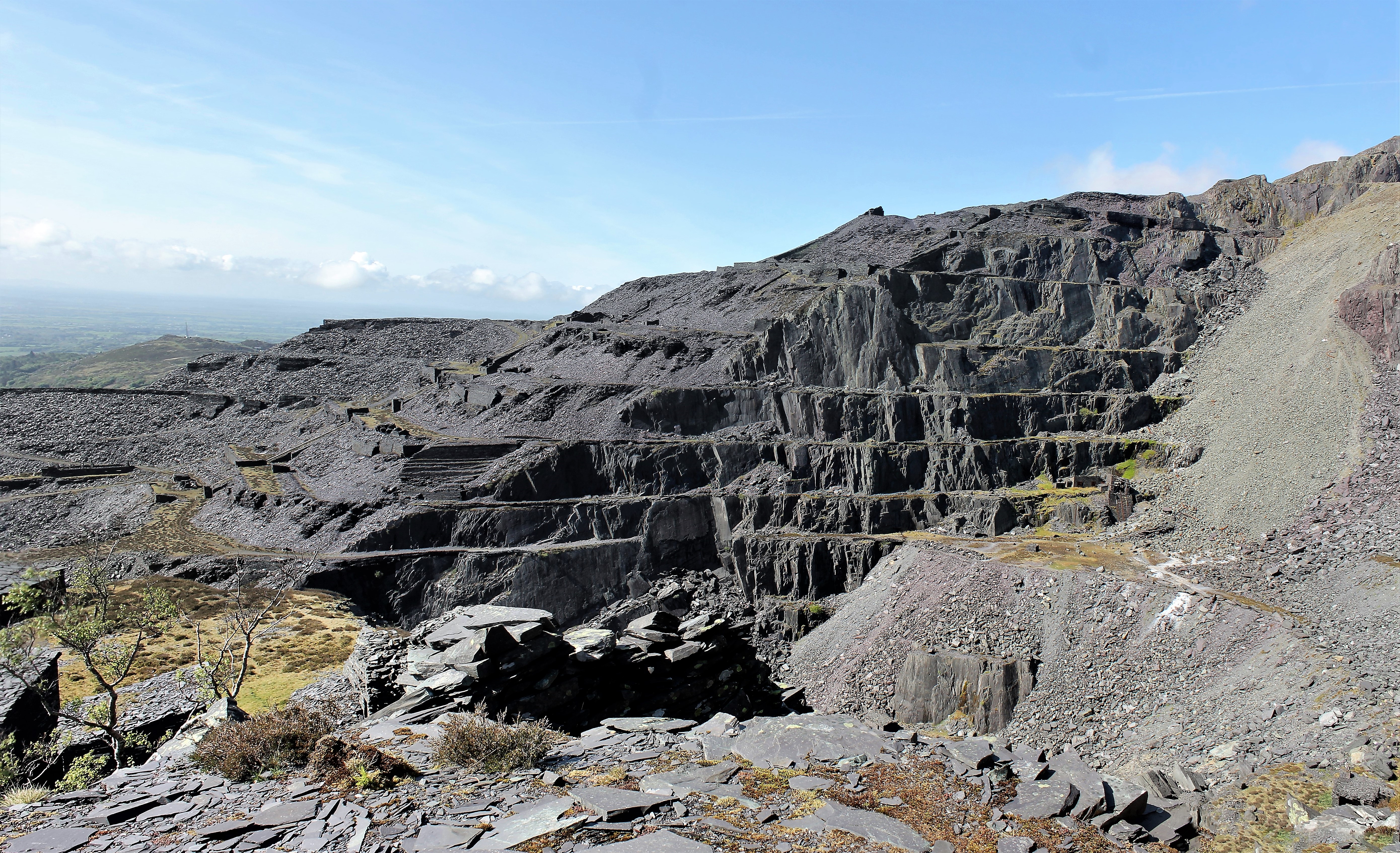
Dinorwic, above Llanberis in Snowdonia, was for over a century the world's second-largest slate quarry after its neighbour Penrhyn — a vast terraced landscape of some 20 galleries a side that employed 3,000 men at its peak, and where, by its own official return, one worker in three was injured in a single year.
History
Commercial slate extraction at Dinorwic began in 1787 under a lease from landowner Thomas Assheton Smith, though early progress was slow, hampered by the French Revolutionary and Napoleonic Wars, heavy taxation and poor transport. The Assheton Smith family formed a new partnership in 1809, and the quarry expanded rapidly once a horse-drawn tramway to Port Dinorwic opened in 1824. By the turn of the 20th century Dinorwic was the second-largest slate quarry in Wales and the world, after the neighbouring Penrhyn quarry, employing over 3,000 men across some 700 acres divided into two main sections, each with around 20 galleries connected by a network of internal tramways and cable-worked inclines. Conditions were dangerous: a parliamentary return for 1909 recorded four men killed and 332 seriously injured among 1,017 men working inside the quarry that year alone, and in June 1910 the Liberal MP Ellis Davies told the Commons that one in three of the men working inside Dinorwic had been injured in each of the previous two years. Home Secretary Winston Churchill confirmed to the House that a Royal Commission then sitting would take evidence on safety conditions in the North Wales slate industry as a result. The quarry's fortunes declined through the mid-20th century as unstable waste tips increasingly threatened the workings; a major slide in the Garret section in 1966 brought production almost to a halt, and quarrying ended for good on 4 July 1969, putting more than 300 men out of work.
Geology
The quarry worked the thick Cambrian slate beds of the Nantlle-Llanberis belt, the same formation exploited at the neighbouring Penrhyn quarry, extracted from a series of stepped open terraces rather than underground chambers.
Geological setting: Slate and Regional Metamorphism (well documented example)
Workings
The quarry was divided into two main sections, each with around 20 galleries stepped down the mountainside, connected by a network of internal tramways and cable-worked inclines; an accident book covering 1908 to 1968 documents the scale of the quarry's casualty record over six decades of operation.
Closure
Increasingly unstable waste tips culminated in a major slide in the Garret section in 1966, and quarrying ended for good on 4 July 1969.
What remains
Part of the former quarry site was redeveloped from the 1970s as the Dinorwig Power Station, a pumped-storage hydroelectric scheme known as 'Electric Mountain'; the quarry's former workshops at Gilfach Ddu now house the National Slate Museum, part of National Museum Wales.
The quarry's stepped galleries, inclines and quarrymen's structures survive extensively across the mountainside; the 1870s workshops, foundries and machine shops at Gilfach Ddu remain largely as they were left when the quarry closed in 1969.
Abandoned workings can be dangerous — unstable ground, uncapped shafts, flooding and bad air are common even where a site looks safe from the surface. This entry describes history and general location only; it is not an access guide.
Recorded claims
Individual factual claims, each attached to the source(s) that support it below. Where sources disagree, both are kept.
- By the turn of the 20th century the quarry employed over 3,000 men across some 700 acres, divided into two main sections each with around 20 galleries. 1
- A parliamentary return for 1909 recorded four men killed and 332 seriously injured among 1,017 men working inside the quarry that year; in 1910 it was stated that one in three men working inside Dinorwic had been injured in each of the previous two years. 2,3
- Home Secretary Winston Churchill confirmed in June 1910 that a Royal Commission then sitting would take evidence on safety conditions in the North Wales slate industry. 3
Images
Sources
- (secondary) Dinorwic quarry — Wikipedia
- (primary) Dinorwic Slate Quarries (Accidents) — Hansard, House of Commons, 9 March 1910
- (primary) Dinorwic Slate Quarry Accident — Hansard, House of Commons, 22 June 1910
Record created: 23 August 2026 · Last researched: 23 August 2026