 MineArchive
Shocking Pit Accident at Frizington (1864)
A temporary scaffold erected at the mouth of the Crossgill iron-ore pit collapsed, dropping three men to their deaths while three others narrowly escaped.
| Date | 10 December 1864 |
|---|---|
| Mine | Crossgill Mine |
| Region | Cumbria |
| Primary type | Surface / Tip Failure |
| Associated types | Winding / Shaft Accident |
| Fatalities | 3 (John Skinner (40), Henry Gowdy (23) and Robert Atkinson (32) died; three other men on the same scaffold survived.) |
| Context | During active mining |
Cause
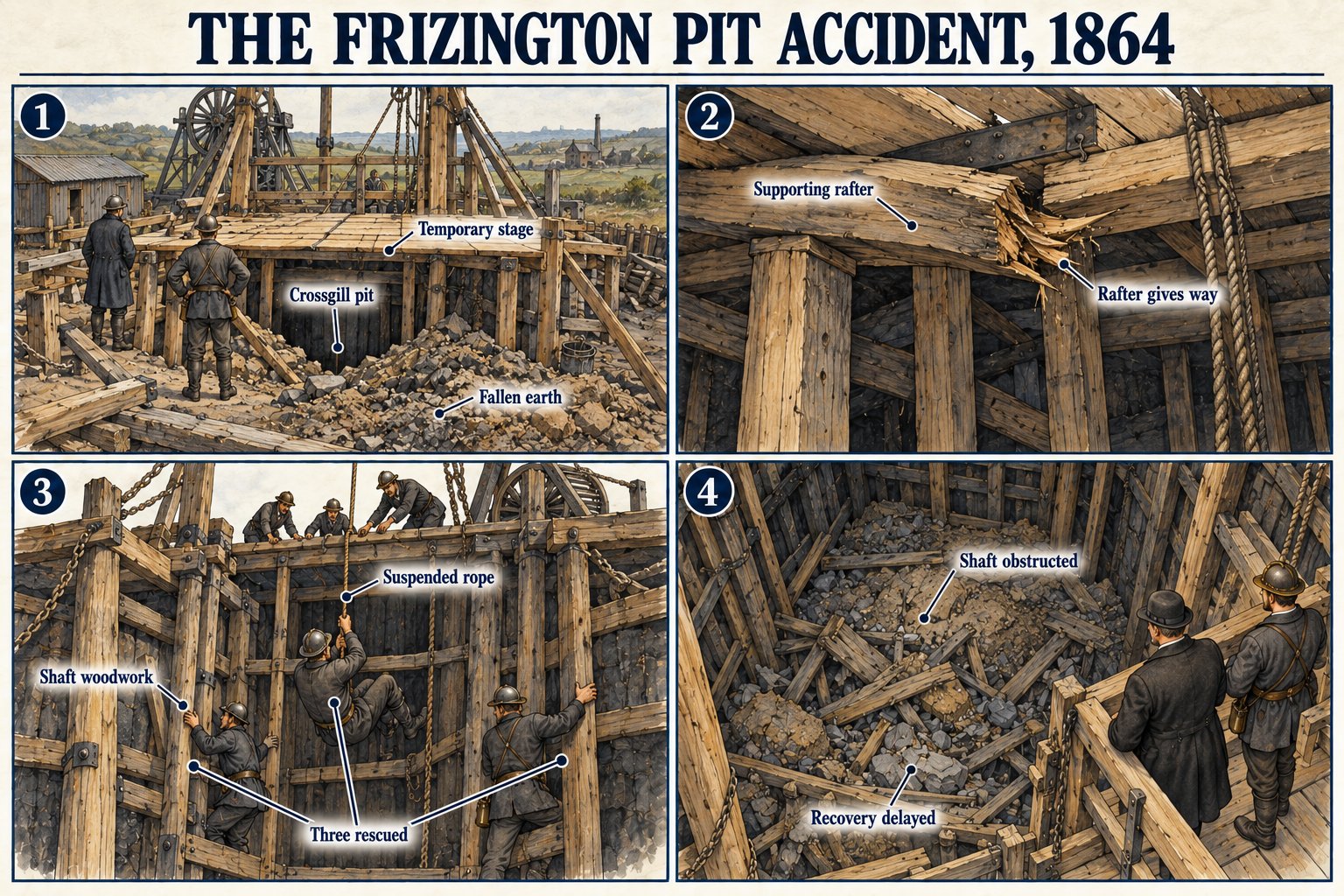
A rafter supporting a temporary stage erected at the pit mouth, put up after earth had fallen from the shaft top a few days earlier, gave way and pitched six men down the shaft.
What happened
Early on Saturday morning, 10 December 1864, an accident occurred at the Crossgill iron-ore pit at Frizington, then belonging to Mr Smith of Whitehaven. A quantity of earth had fallen from the top of the shaft on the preceding Wednesday evening, and on examination the shaft was found to be in a dangerous condition; the manager had a temporary stage or platform erected at the pit mouth so work could continue safely while repairs were made. Between one and two o'clock in the morning, six men were engaged on this scaffold when one end of a supporting rafter suddenly gave way, pitching three of them headlong down the pit. John Skinner, 40, of Cleator Moor, Henry Gowdy, 23, and Robert Atkinson, 32, both of Frizington, were killed. Skinner left a wife and seven children; the other two left no family. The other three men on the scaffold survived: Thomas Jacques caught hold of a rope suspended in the shaft and clung to it until help came, while John Stainton and James Gowdy managed to grab hold of woodwork on the side of the shaft and were eventually brought to safety from their perilous position.
Rescue & recovery
The bodies of the three dead men had not been recovered by the following day, owing to the quantity of earth and debris that had fallen in, despite every effort being made under the supervision of the mine's owner and its manager, Mr Hodgets, both of whom were at the pit on the day of the accident and the day after.
Recorded claims
Individual factual claims, each attached to the source(s) that support it below. Where sources disagree, both are kept.
- A rafter supporting a temporary scaffold at the Crossgill pit mouth gave way on 10 December 1864, dropping three of six men on it down the shaft; John Skinner (40), Henry Gowdy (23) and Robert Atkinson (32) died, while Thomas Jacques, John Stainton and James Gowdy survived. 1,2
- The scaffold had been erected days earlier after a fall of earth left the shaft top in a dangerous condition; the three victims' bodies had not been recovered the day after the accident owing to the quantity of fallen debris, despite efforts supervised by the mine's owner and manager. 2
Related terminology
Mining terms this disaster is structurally linked to, with the nature of the relationship.
- Shaft (contextual relationship)
Named 6 times in this record, first in the cause: “…erected at the pit mouth, put up after earth had fallen from the shaft top a few days earlier, gave way and pitched six men down the shaft.”
Sources
- (primary) Crossgill (Iron Ore) (Durham Mining Museum) — Durham Mining Museum
- (primary) Shocking Pit Accident at Frizington (Durham Mining Museum, newspaper transcript, 13 December 1864) — Durham Mining Museum / West Cumbria Mines Research
Record created: 31 August 2026 · Last researched: 31 August 2026