 MineArchive

Bill Beynon and Bryn Navigation Colliery
| Category | Sports |
|---|---|
| Also known as | Billy Beynon (as in the fatality lists and the press), William Beynon (full name) |
| Dates | Born 8 April 1891; first professional fights 1909; British and Empire bantamweight champion 2 June 1913; lost the title to Digger Stanley late 1913; last fight 1931; killed at Bryn Navigation Colliery 20 July 1932 |
Bill Beynon (1891-1932) of Taibach, the collier who outpointed Digger Stanley for the British and Empire bantamweight title in 1913, boxed for twenty-two years to supplement a miner's wage and was killed by a fall of stone at Bryn Navigation Colliery on 20 July 1932, a year after his last fight.
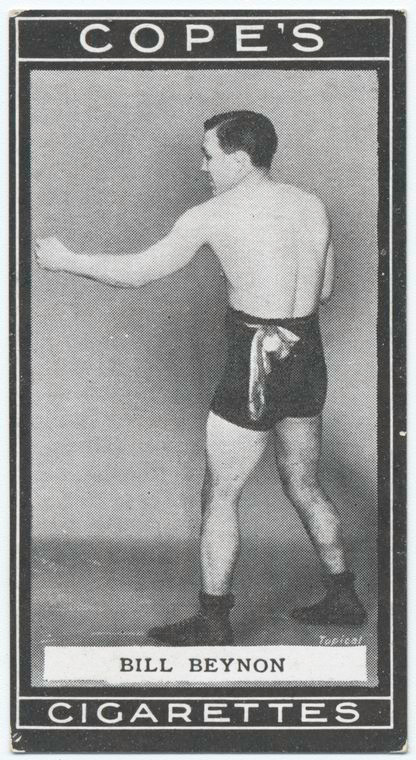
The mining history in this record
William Beynon was born at Taibach, Port Talbot, on 8 April 1891 and went underground like most boys of the town. He took up boxing as a teenager to add to a collier's wage and turned professional in 1909; one of his first bouts was a loss to George Dando of Merthyr. On 2 June 1913 at The Ring, Blackfriars, he outpointed the reigning champion Digger Stanley over twenty rounds to take the British and Empire bantamweight title and the Lonsdale belt, only the second officially recognised holder of the title. He beat the Frenchman Robert Dastillon, then lost the belt back to Stanley on points later the same year.
He fought on until 1931, meeting the best bantamweights of Europe and America: a win over the former British flyweight champion Joe Symonds in 1921, two stoppages by Charles Ledoux, the European champion, the first with a split eyebrow in a title fight. The compiled record runs to 192 contests, 70 won, 30 lost and 91 drawn. He never left the pit. He lived in later years at Llangynwyd above Maesteg and worked at Bryn Navigation Colliery, and the press called him the hero of a thousand fights; in his forties he was still beating Welsh bantamweights.
On 20 July 1932, a year after he had retired from the ring at thirty-nine, Beynon was leaving work at Bryn Navigation when a huge stone fell and partly buried him. He died of his injuries, the father of a large family: the fatality lists say thirteen children, Theatr na nÓg's account fifteen, and the same account says he died saving one of them. The Times and the Western Mail carried his obituary the next day.
People
Bill Beynon (1891-1932), Taibach collier, British and Empire bantamweight champion 1913. Digger Stanley, the champion he beat and lost to in 1913. Charles Ledoux, the European champion who twice stopped him.
Legacy today
Beynon has an entry in the Dictionary of Welsh Biography, written in 1959, and a page on the Port Talbot Historical Society's site. Theatr na nÓg's teaching pack on the collier-boxers of South Wales lists him with his pit beside Jimmy Wilde, Tommy Farr, Frank Moody and Dai Dower. His name stands in the Welsh Coal Mines fatality list for 1932 as a Bryn Navigation miner, the only British champion on it.
Recorded claims
Individual factual claims, each tagged with how solidly it's grounded and attached to the source(s) that support it. Where sources disagree, both are kept.
- William Beynon was born at Taibach, Port Talbot, on 8 April 1891. (documented fact) 1,2,3
- Beynon was a collier who took up boxing as a teenager to supplement his wages, and fought professionally from 1909 to 1931. (documented fact) 3,4
- On 2 June 1913 at The Ring, Blackfriars, he outpointed Digger Stanley over twenty rounds for the British and Empire bantamweight title and the Lonsdale belt, and lost the title back to Stanley on points later that year. (documented fact) 2,3,4
- He twice fought Charles Ledoux, the European bantamweight champion, and was stopped in the eighth round both times, the first time with a split eyebrow in a European title fight. (documented fact) 3,4
- Boxing records give Beynon 192 contests: 70 won, 30 lost and 91 drawn. (documented fact) 3
- Beynon worked at Bryn Navigation Colliery, and on 20 July 1932 he was killed there by a fall of stone that partly buried him as he was leaving work. (documented fact) 5,1,2
- Theatr na nÓg's Welsh-language text says he died saving one of his children. (unverified claim, disputed) 1
- Welsh Coal Mines gives his age at death as 48 and his children as thirteen; Theatr na nÓg says fifteen children, and his birth date makes him 41. (documented fact, disputed) 5,1,3
- The press called him the hero of a thousand fights, and in his forties he was still beating Welsh bantamweights two years before his death. (contemporary account) 5
Mines
- Bryn Navigation Colliery — Neath Port Talbot
Beynon boxed to supplement a collier's wage and was killed at Bryn Navigation by a fall of stone on 20 July 1932, a year after his last fight.
Regions
Real-world mining concepts used here
Related Culture records
- Jimmy Wilde and Tylorstown Colliery
Wilde, a Rhondda collier, took the world flyweight title three years after Beynon's bantamweight win. - Tommy Farr and the Cambrian Colliery
Another South Wales collier-boxer and British champion; Theatr na nÓg's miner-boxers resource lists them together.
Sources
- (secondary) Miner Boxers: Top Trumps (teaching resource) — Theatr na nÓg
- (secondary) Beynon, William ('Bill') (1891-1932), former British bantam-weight champion — Dictionary of Welsh Biography
- (secondary) Bill Beynon — Wikipedia
- (secondary) Billy Beynon — Port Talbot Historical Society
- (secondary) Welsh Coal Mines: fatalities 1932 — Welsh Coal Mines
Record created: 20 October 2026 · Last researched: 21 October 2026