 MineArchive
George Eliot and Griff Colliery
| Category | Literature |
|---|---|
| Dates | Robert Evans became agent at Arbury in 1806; Mary Ann Evans born 22 November 1819; at Griff House 1820-1841; Robert Evans retired 1840, died 1849; Felix Holt, the Radical published 1866 |
Mary Ann Evans grew up at Griff House on the Arbury estate, where her father Robert Evans was land agent and where part of his work was negotiating with the coal-mining businesses of the North Warwickshire coalfield. She took the colliers of a mining village into Felix Holt, bought with beer at the election of 1832.
The mining history in this record
Robert Evans (1773-1849) was a Derbyshire man who ran his own carpentry business and worked for the landowner Francis Parker. When Parker inherited the Arbury estate at Nuneaton in 1806 and took the name Newdigate, he brought Evans with him to manage seven thousand acres. Evans surveyed land and buildings, managed the tenant farmers, collected rents, and was involved in negotiations with the road-builders and the coal-mining businesses of the area. He took his young daughter with him on his rounds of the estate.
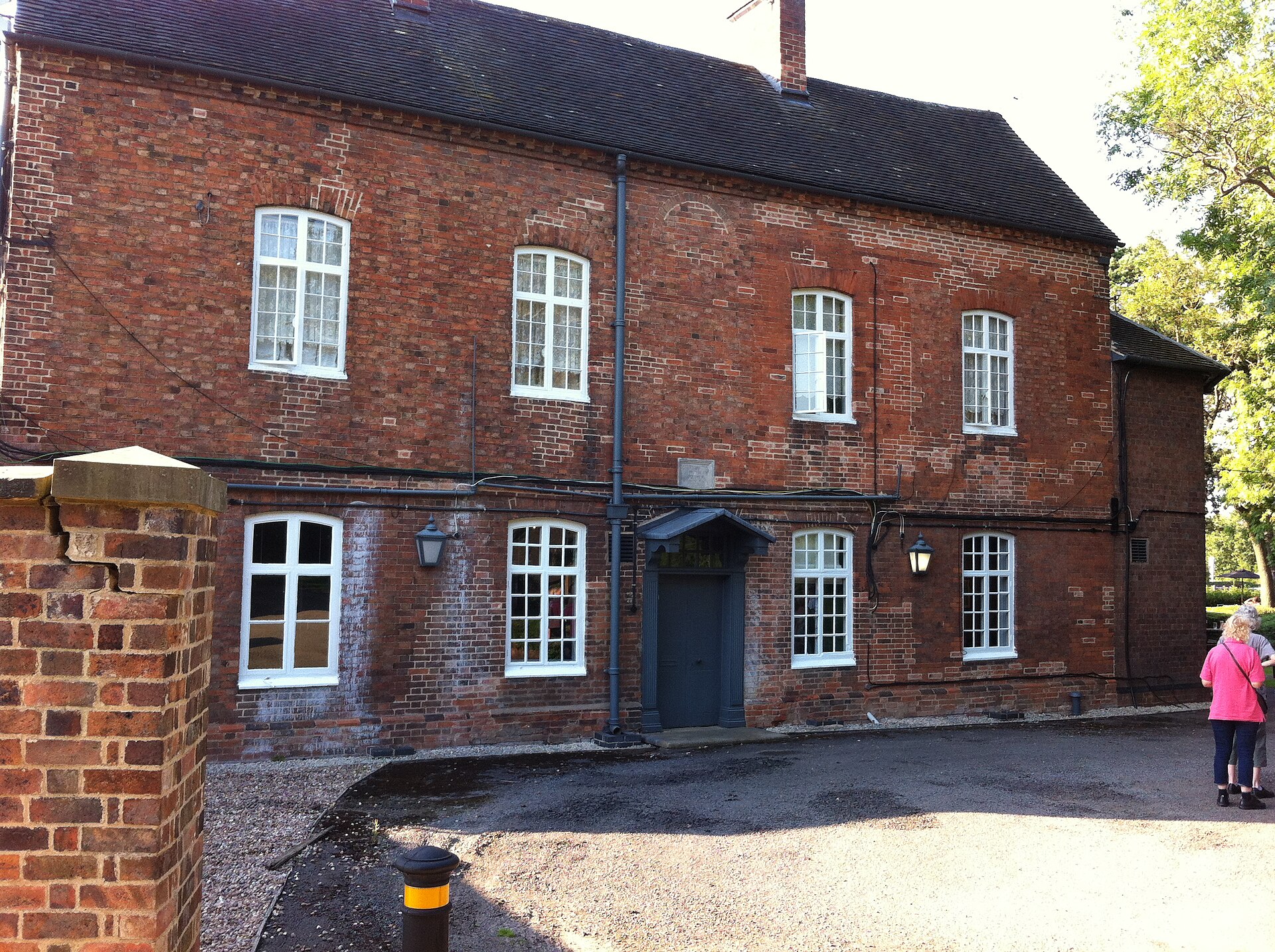
Mary Ann Evans was born at South Farm on the estate on 22 November 1819. The family moved to Griff House, between Nuneaton and Bedworth, before she was a year old, and it was her home until 1841. Griff was old coal ground: there is evidence of coal being got there as early as the twelfth century, long before the Newdigates or their agent.
She left with her father for Coventry after his retirement in 1840, nursed him through his last illness despite the quarrel over religion she called her holy war, and he died in 1849. Several of her characters draw on him, among them Adam Bede and Caleb Garth in Middlemarch. Nuneaton Museum & Art Gallery holds two of his diaries.
People
Robert Evans (1773-1849), land agent to the Newdigate family at Arbury from 1806, whose work included negotiating with the coalfield's businesses, and the model for Adam Bede and for Caleb Garth in Middlemarch. Francis Parker, afterwards Newdigate, who inherited Arbury in 1806 and brought Evans with him.
Legacy today
Felix Holt, the Radical, written in 1865-66 and set around the first Reform Act election of 1832, turns in part on a mining village called Sproxton and the colliers who work there. Garstin, one of the candidates' backers, is a capitalist with a share in the Sproxton mines, and is honoured by the men for it — a capitalist, the narrator observes, being held worthy of pious honour as the cause why working men exist. Spratt, the mines' manager, is hated, and the narrator notes that hatred of the too-immediate Spratt is a stronger motive with the men than any love of the far-off Garstin, though a visible cause of beer acts on them more strongly still. The election agent Johnson and Chubb the publican work out between them how to buy the Sproxton men with drink, and the treating ends in a riot on nomination day.
Eliot researched the electoral practices of 1832 for the novel, and had watched the agitation of that election as a schoolgirl in a Midland town. Her father did election work for his employers in his capacity as land agent.
Recorded claims
Individual factual claims, each tagged with how solidly it's grounded and attached to the source(s) that support it. Where sources disagree, both are kept.
- Robert Evans managed the seven-thousand-acre Arbury estate for the Newdigate family from 1806. He surveyed land and buildings, managed tenant farmers, collected rents and took part in negotiations with road-builders and with the coal-mining businesses of the area, and he took his daughter with him on his rounds. (documented fact)
- Mary Ann Evans was born at South Farm on the Arbury estate on 22 November 1819 and moved to Griff House, between Nuneaton and Bedworth, before she was a year old. It was her home until 1841. (documented fact)
- Griff was a coal-mining place long before the estate's nineteenth-century workings: there is evidence that coal was being got at Griff as early as the twelfth century. (documented fact)
- Felix Holt, the Radical (1866) is set around the 1832 election and turns in part on the mining village of Sproxton, whose colliers are treated with beer in exchange for noisy support. The novel names Garstin as a capitalist with a share in the Sproxton mines and Spratt as the manager the men hate, and the treating ends in a riot at the nomination. (documented fact)
- Sproxton is an invented village and is not identified with Griff Colliery or with any other particular pit. What connects the novelist to this coalfield is her upbringing beside it, in a household whose living came partly from an estate's dealings with the coal-mining businesses of the district, and a father who did election work as part of that same job. (reasonable inference, uncertain)
- Several of Eliot's characters are drawn in some way from Robert Evans, among them Adam Bede and Caleb Garth in Middlemarch. Nuneaton Museum & Art Gallery holds two of his diaries. (documented fact)
Mines
- Griff Colliery — Warwickshire
Griff Colliery worked the coal of the Arbury estate whose land agent, Robert Evans, was Eliot's father and handled the estate's dealings with the coalfield; Griff House, her home from 1820 to 1841, stands beside it.
Sources
- (primary) Felix Holt, the Radical, chapter 30 — George Eliot (1866), via Wikisource
- (secondary) Felix Holt, the Radical — Wikipedia
- (secondary) Griff, Warwickshire — Wikipedia
- (secondary) Robert Evans — Exploring Eliot (Nuneaton Museum & Art Gallery)
Record created: 23 September 2026 · Last researched: 23 September 2026