 MineArchive
Tidying up MineArchive as it grows
20 November 2026
A couple of weeks ago I wrote about a fairly big cleanup of MineArchive.
That started after an advertising review described the site as having “low-value content”. I still think that description was wrong, but it did make me look much harder at the way the site had grown.
MineArchive expanded very quickly. That was useful because it meant a lot of material became searchable in a short space of time, but it also meant some early decisions were starting to show their age. Things existed because the database had somewhere to put them. Some pages exposed fields which weren't especially useful to a reader. A few bits of interface had survived mainly because I'd enjoyed building them.
So I've spent a fair bit of time going back through it.
The archive is still growing, but there's been much more emphasis lately on how the existing material is presented, how sourcing is shown, and whether each part of a page is actually helping somebody use it.
What changed
The terminal has gone
MineArchive used to have a little terminal hidden away in the settings.
There was no particularly serious justification for it. I put it there because I'm a nerd and thought it was fun.
It has now been removed.
The normal settings remain behind the cog, but I've also tightened up when some of them appear. Seasonal decorations are staying, because I like them and they're part of the site's character. The switch for them now only appears when there's actually a seasonal mode running.
There isn't much point offering somebody a Halloween control in June.
I've been doing the same sort of housekeeping elsewhere in the site template, looking for controls, hidden text and old interface elements which are being sent with every page despite having no current purpose.
I'm not trying to make MineArchive aggressively minimal. I just don't want thousands of pages carrying old furniture around forever because I once thought it looked nice.
Recorded Claims have had a rethink
Recorded Claims is one of the parts of MineArchive I care about most.
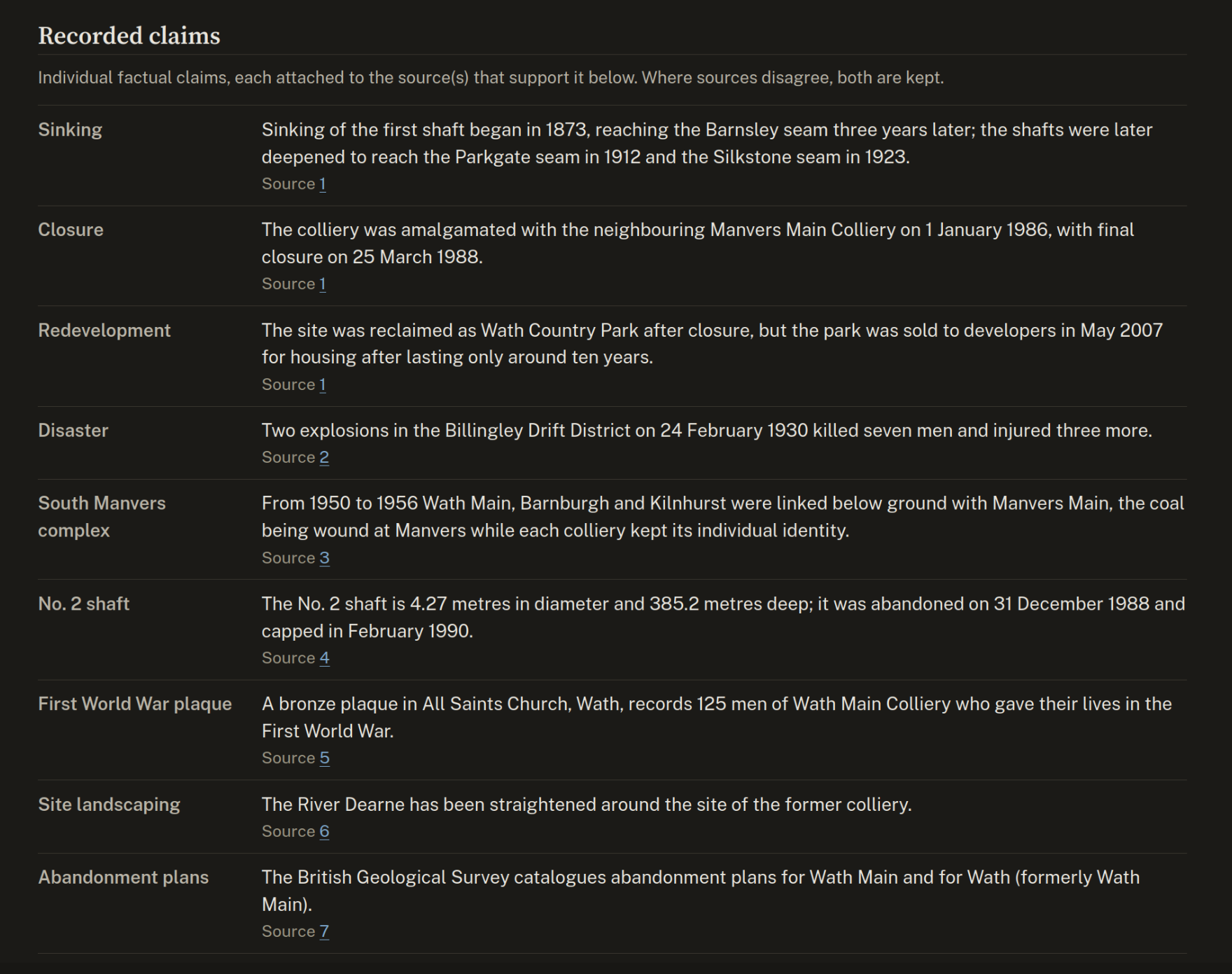
The History section gives you the readable version of a mine's story. Recorded Claims shows the individual facts behind it and the sources which support them.
The problem was that the two could sometimes look repetitive.
If the history told you that a mine opened in 1869, and the claims section then repeated almost the same sentence with a citation after it, the sourcing was doing something useful but the page didn't always make that obvious.
I've changed the presentation so the claims behave more like an evidence register.
Dates, operators, workforce figures, depths, workings and similar facts can now be shown in a much more compact form alongside their sources. The provenance is still there. In fact, it should now be easier to see what that part of the page is for.
I've also brought uncertainty into the same area.
If sources disagree, the disagreement stays visible. Claims can be marked Disputed or Uncertain, and the evidence sits beside them rather than being tidied into a single answer.
Pendarves is a useful example of that.
This is still an experiment. I want to see how it feels in real use before deciding whether it's the final form. One advantage of doing this through the template is that it's cheap to change again if I decide I've made it worse.
Privacy has its own page now
MineArchive now has a standalone Privacy Policy.
Nothing new is being collected. This was mostly a case of giving the existing information a proper home rather than burying it in the About page.
It explains the site's own analytics, cookies, advertising-related services and the controls available to visitors.
It also lets the About page concentrate on what MineArchive actually is and how the archive is maintained.
The About page has been trimmed again
The About page has changed several times since MineArchive launched.
Some of the earlier wording talked too much about the mechanics behind the site. I've simplified that.
MineArchive uses research and editorial tooling extensively. There are thousands of records, and maintaining them at this scale would be very difficult without it.
What matters more to me is how the material is handled.
Sources need to support the claims being made. Conflicting accounts should remain visible where they can't be resolved. Uncertainty should stay uncertainty. Records get revisited when better material appears, and reader corrections are checked before they're incorporated.
I've also tightened up the way sources are labelled.
Newspaper material in particular had become inconsistent over time, so roughly nine hundred existing source records have been relabelled to bring them into line with the current rules.
That was one of those jobs which sounds tiny until you actually do it.
Editor's Notes
Some records now carry an Editor's Note.
These only appear where there's something useful to say about how the record came together.
Sometimes two sources disagree. Sometimes a location is awkward to identify. Sometimes an apparently obvious connection stops making sense once the dates are compared. Occasionally the surviving evidence simply isn't good enough to reach a confident conclusion.
Helder Mine is a good example.
The note gives me somewhere to explain that in ordinary language without turning the main history into a discussion about the research process.
They aren't intended to appear everywhere. If there was nothing particularly interesting or difficult about researching a record, it doesn't need one.
I've also been running a wider readability pass across the archive.
Some older records had developed a fairly uniform reference-book tone. The facts, citations and uncertainty stay intact, but the prose is being made shorter, clearer and a bit more natural where it needs it.
A mine record can be careful and well sourced without sounding as though it was approved by committee in 1897.
The mine pages are settling down
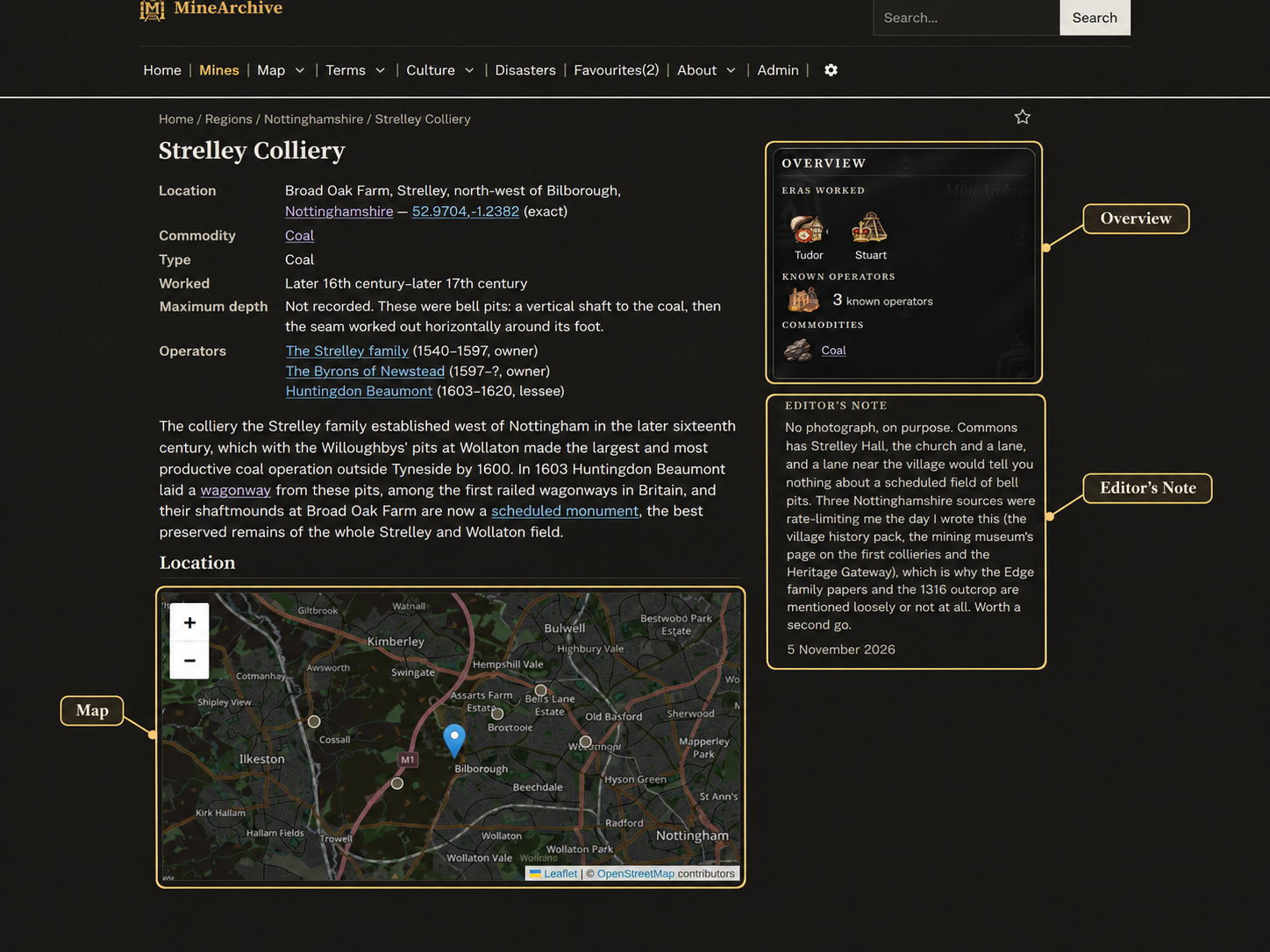
The maps and visual Overview introduced in the previous update are now part of the normal mine-page layout, and the newer work has mainly been about making everything around them sit together properly.
Editor's Notes now have a natural place alongside the rest of the record where there's something worth adding.
I've also fixed some awkward layout problems, including the empty band which could appear beside the Overview, improved summary text, cleaned up redirects and old addresses, and strengthened duplicate-name checks.
Disaster pages are also being brought closer to the same overall presentation where the underlying material supports it.
There have been a lot of small changes like that recently.
None of them is especially dramatic on its own, but taken together the archive feels much more settled than it did a month ago.
Under the bonnet
A bit more discipline behind the scenes
Some of the recent work isn't visible unless something goes wrong.
Source labels are now being applied more consistently.
Record summaries are expected to read as proper sentences.
Redirects are being checked more carefully.
Duplicate names are being treated as something to investigate rather than something to leave for later.
I've also added a private journal to the administration side of MineArchive.
It keeps track of changes, decisions, outstanding problems, statistics and the reasons behind some of the larger bits of work.
That probably sounds slightly excessive for a website about old mines.
It probably is.
But the site has grown quickly enough that relying on me to remember why I changed something three months earlier was becoming a fairly optimistic system.
Where I'm trying to take it
The way I think about MineArchive has changed a bit since it started.
Early on, the database structure had a strong influence on what appeared publicly. If something had a record, there was a tendency to give it a page and show the fields attached to it.
I'm much more selective now.
Some things are useful as relationships or filters and don't need their own article.
Missing information often doesn't need a label announcing that it's missing.
Different mines can share the same underlying template without every page needing to look or read exactly the same.
The history of the place should decide what gets emphasis.
The database is there to keep the research organised. The public site needs to make that research useful to somebody who has just arrived from a search result and wants to know about a particular mine.
That's becoming the main test I use when deciding whether something stays.
Tell us what you think
Is any of this helping?
Search traffic has continued to rise while these changes have been happening.
Some individual mine records are now appearing at the top of Google for their names, and traffic is still spread across a very large number of records rather than depending on one unusually successful page.
That's encouraging.
More importantly, people are using the archive for the things I hoped they would: local history, family research, study, general curiosity, and occasionally telling me that something is wrong.
I'm particularly interested in feedback on the new Recorded Claims layout.
The sourcing underneath MineArchive matters a lot to me, so I don't want to make that section prettier at the expense of making it less useful.
If the new evidence register makes it easier to understand where the information came from, it'll stay.
If it doesn't, I'll change it again.
MineArchive is still young. This is the best time to keep poking at the bits which don't quite work yet.
Every change here is made for readers, and the best way to find out whether it works is to hear from them. If this one helps, gets in the way, or gave you an idea for something better, write to . Short notes are as welcome as long ones.