 MineArchive
Grove Rake Mine
| Also known as | Groverake Mine |
|---|---|
| Location | Rookhope, Weardale, County Durham — 54.7561, -2.1319 (approximate) |
| Commodity | Fluorspar |
| Type | Metal |
| Worked | 17th century (lead); 1930s (fluorspar)–1999 |
| Operators | Sherburn Minerals (1991–1999) |
| Status | Researched |
Overview
A 17th-century Weardale lead vein reworked in the 20th century for fluorspar, ending its life as the last commercial fluorspar mine to close anywhere in the North Pennines, and the orefield's last surviving headgear.
History
Lead has been worked at Grove Rake, in upper Weardale, since the 17th century, continuing into the late 19th century as the lead trade declined generally. In the 20th century the same veins were reworked for fluorspar (fluorite), which had become newly valuable as a flux for steelmaking and as a feedstock for the chemical industry. Deposits along the Groverake, Greencleugh and Red veins proved rich, and the mine grew into one of the North Pennines' leading fluorspar producers through the mid-20th century, developed via Rake Level, a horizontal drift, and the steeply inclined Firestone Decline. The 1980s collapse of British Steel, fluorspar's main domestic market, hit the mine hard; it was acquired by Weardale Minerals and Mining, whose parent company Minworth Ltd went into receivership in 1991. Sherburn Minerals then took over and worked the mine until it finally closed in the summer of 1999 — by which point it was the last commercially operating fluorspar mine anywhere in the North Pennine Orefield.
Geology
Grove Rake sits at the junction of the Groverake, Greencleugh and Red mineral veins in the North Pennine Orefield, where fluorite occurs in bands with purple and green banding alongside white quartz and bluish chalcedony, hosted in the limestones and sandstones typical of the orefield.
Workings
Ore was worked from twin shafts and the near-horizontal Rake Level drift, later supplemented by the steep Firestone Decline (graded at 1 in 4) driven into the hillside to reach deeper ground.
Closure
The mine closed in summer 1999 under its final operator, Sherburn Minerals, ending commercial fluorspar mining across the entire North Pennine Orefield.
What remains
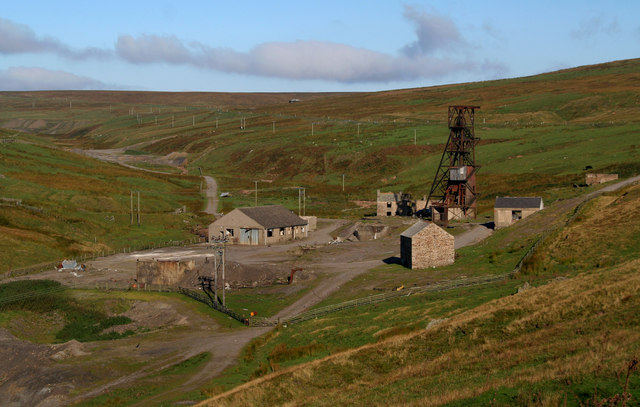
Much of the surface plant was demolished in 2005, but the site retains the last surviving mine headgear anywhere in the North Pennine Orefield.
Twin headframes (the orefield's only survivors), spoil heaps and scattered surface structures around the mouth of Rake Level.
Abandoned workings can be dangerous — unstable ground, uncapped shafts, flooding and bad air are common even where a site looks safe from the surface. This entry describes history and general location only; it is not an access guide.
Recorded claims
Individual factual claims, each attached to the source(s) that support it below. Where sources disagree, both are kept.
- Lead has been worked at Grove Rake since the 17th century, with the same veins reworked for fluorspar in the 20th century once it became valuable as a steelmaking flux and chemical feedstock. 1,2
- The mine was acquired by Weardale Minerals and Mining after the 1980s collapse of British Steel hit the fluorspar market; its parent company Minworth Ltd went into receivership in 1991, after which Sherburn Minerals took over and worked the mine until 1999. 1
- Grove Rake closed in summer 1999, the last commercially operating fluorspar mine in the North Pennine Orefield. 1,3
- The mine retains the only surviving headgear anywhere in the North Pennine Orefield, though most other surface buildings were demolished in 2005. 3
Photographs & further reading
This page doesn't try to reproduce everything — these are the best original sources found for this mine.
28DaysLater exploration report and photographs covering the mine's history and current surface remains.
View sourceImages
Sources
- (secondary) Grove Rake Fluorspar Mine, County Durham — The View From the North
- (primary) Groverake Mine, Rookhope, Stanhope, County Durham, England, UK — Mindat
- (secondary) Groverake Mine geosite — North Pennines National Landscape
Record created: 21 August 2026 · Last researched: 21 August 2026