 MineArchive
Wheal Agar Shaft Accident
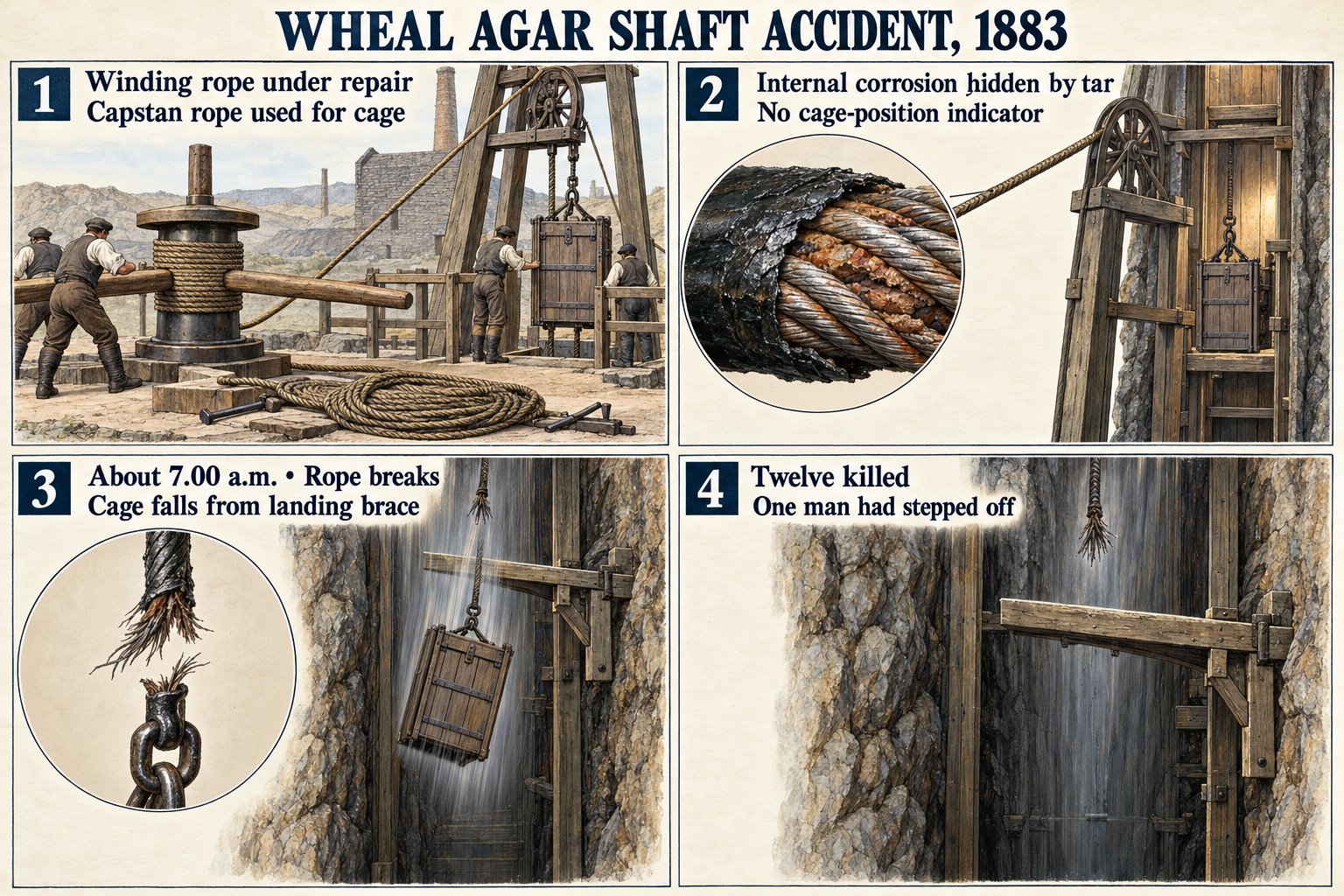
At about seven on the morning of 15 August 1883, a cage carrying thirteen men reached the landing brace at Wheal Agar in Illogan. One man jumped off. At that moment the capstan rope broke ten feet above the shackle, and the cage fell the length of the shaft with the other twelve men in and on it. All twelve were killed. The rope had been in use at least two years, was internally corroded where it parted, and the corrosion had been hidden by layers of tar and grease. The men were on the capstan rope at all only because the winding rope was under repair, and the agent had chosen not to send them up the ladders while the work was finished.
| Date | 15 August 1883 |
|---|---|
| Mine | Wheal Agar |
| Region | Cornwall |
| Primary type | Winding / Shaft Accident |
| Associated types | Machinery |
| Fatalities | 12 (Twelve miners were killed: Charles Trevena, 27; William Carrill, 27; Edward Dawe, 19; Thomas Cock, 18; George Clemens, 25; Joseph Roberts, 43; James Caddy, 21; Paul Pope junior, 22; Charles Osborne, 23; Henry Thomas, 17; Thomas Richards, 19; and Francis H. Woolcock, 19. Seven of the twelve were under twenty-five and two were teenagers of seventeen and eighteen. Henry Cardines, who jumped from the cage as it reached the brace, survived.) |
| Context | During active mining (The mine was at work and the shift was changing: the night core was coming up and the day core going down when the accident happened, at about seven in the morning.) |
Cause
The capstan rope broke ten feet above the shackle while raising a cage of thirteen men. The Inspector of Mines found the rope internally corroded at the point of fracture, the defect masked by many layers of tar and grease.
Contributing factors
The Inspector set out a chain of contributing causes. There was no indicator on the capstan to show where the cage was, so the engine driver knew when to stop only from a mark on the rope and a signal rung from underground through the lander — an arrangement exact enough that a gate had to be fixed across the shaft at the 195-fathom level to arrest the cage. Any delay in stopping let slack rope down, which could take up a kink when the engine started again, separating the strands and throwing the weight unequally on the wires. Starting a cage on a slack rope put at least double the working load on it, more than the rope should have carried where life depended on it even in good condition. Three of the thirteen were riding on the outside of the cage, against regulations, and their weight added to the strain. The rope had also been worked hard: a pitman told the inquest it had been lowered with twenty tons on it and, days before the accident, had raised a lift of pumps weighing at least ten.
What happened
During the night of 14-15 August the engine had been drawing minerals from 225 fathoms. Between one and two in the morning the winding rope was found to have stripped for some fathoms from the shackle, one of its strands having broken. Captain Ralph Danniell, the agent in charge, climbed the shaft by ladders and inspected the rope, could see nothing wrong, and on reaching the surface ordered the damaged length cut off and the shackle reset. The work was not finished by six, when the night core was due up and the day core down. Rather than make the men use the ladders, Danniell had the cage attached to the capstan rope and sent down to the 195-fathom level, without first making a careful examination of that rope. One cage load came up safely and another went down. On the next trip there were ten men inside the cage and three on the outside. As it reached the top of the landing brace Henry Cardines jumped off; the rope broke and the cage fell.
Rescue & recovery
The cage fell 253 fathoms and the twelve men in and on it were killed outright. No rescue was possible.
Investigation & inquiry
The inquest opened at Pool on 22 August 1883. R. J. Frecheville, H.M. Inspector of Mines, examined the broken ends and found many of the wires very much corroded, the state of the rope hidden under layers of tar and grease. The rope was four and a half inches in circumference, six strands of steel wire round a hemp core with eighteen wires to the strand. No invoice for it was produced and there was no satisfactory evidence of its age, though it had plainly been in use at least two years, during which the mine had been renovated and the rope subjected to severe strains. The shackle was sent to Thomas W. Trail, Engineer in Chief at the Board of Trade and Inspector of the Chain Cable and Anchor Proving Establishments, for examination.
Legal & regulatory aftermath
The Inspector took the view that a serious breach of the Metalliferous Mines Act had been committed, resting on the absence of any exact means of knowing the cage's position, the practice of starting the cage on a slack rope, and the men riding outside it against regulations.
Recorded claims
Individual factual claims, each attached to the source(s) that support it below. Where sources disagree, both are kept.
- The capstan rope broke ten feet above the shackle as the cage reached the top of the landing brace; the Inspector found the rope internally corroded at the point where it parted, the defect masked by many layers of tar and grease. 1
- Twelve men were killed. A thirteenth, Henry Cardines, jumped from the cage as it reached the brace and survived. 2,1
- The winding rope had stripped from the shackle during the night and was being repaired. The repair was unfinished at six in the morning, and rather than send the men up the ladders the agent ordered the cage onto the capstan rope without first making a careful examination of it. 1
- Three of the thirteen were riding on the outside of the cage, against regulations; the Inspector held that their extra weight contributed to the disaster. 1
- The capstan rope was four and a half inches in circumference, six strands of steel wire round a hemp core with eighteen wires to each strand. No invoice was produced and there was no satisfactory evidence of its age, though it had been in use at least two years and had been lowered with twenty tons on it and used days earlier to raise a lift of pumps weighing at least ten. 1
Related terminology
Mining terms this disaster is structurally linked to, with the nature of the relationship.
- Cage (contextual relationship)
Named 14 times in this record, first in the summary: “At about seven on the morning of 15 August 1883, a cage carrying thirteen men reached the landing brace at Wheal Agar in…” - Capstan (contextual relationship)
Named 4 times in this record, first in the summary: “…at Wheal Agar in Illogan. One man jumped off. At that moment the capstan rope broke ten feet above the shackle, and the cage fell the length…” - Captain (contextual relationship)
Named in this record’s narrative: “…for some fathoms from the shackle, one of its strands having broken. Captain Ralph Danniell, the agent in charge, climbed the shaft by ladders…” - Ladders (contextual relationship)
Named 3 times in this record, first in the summary: “…was under repair, and the agent had chosen not to send them up the ladders while the work was finished.” - Winding Rope (contextual relationship)
Named twice in this record, first in the summary: “…and grease. The men were on the capstan rope at all only because the winding rope was under repair, and the agent had chosen not to send them up the…”
Photographs & further reading
This page doesn't try to reproduce everything — these are the best original sources found for this disaster.
An account from the Institute of Cornish Studies covering the morning of the accident, the men who died and the effect on the communities of Brea, Illogan and Redruth.
View sourceSources
- (primary) Wheal Agar Shaft Accident, Redruth, 1883 — Northern Mine Research Society, after the Inspector of Mines report and the inquest (read via a 2024 Wayback Machine capture)
- (primary) Durham Mining Museum: Wheal Agar — Durham Mining Museum, from the Mines Inspectors Reports and the Lists of Mines
- (primary) Newspaper report of the Wheal Agar accident, 23 August 1883 — Durham Mining Museum, transcribing a contemporary newspaper report
- (secondary) The Wheal Agar Disaster of 1883 — Cornish Story, Institute of Cornish Studies
Record created: 11 September 2026 · Last researched: 11 September 2026